
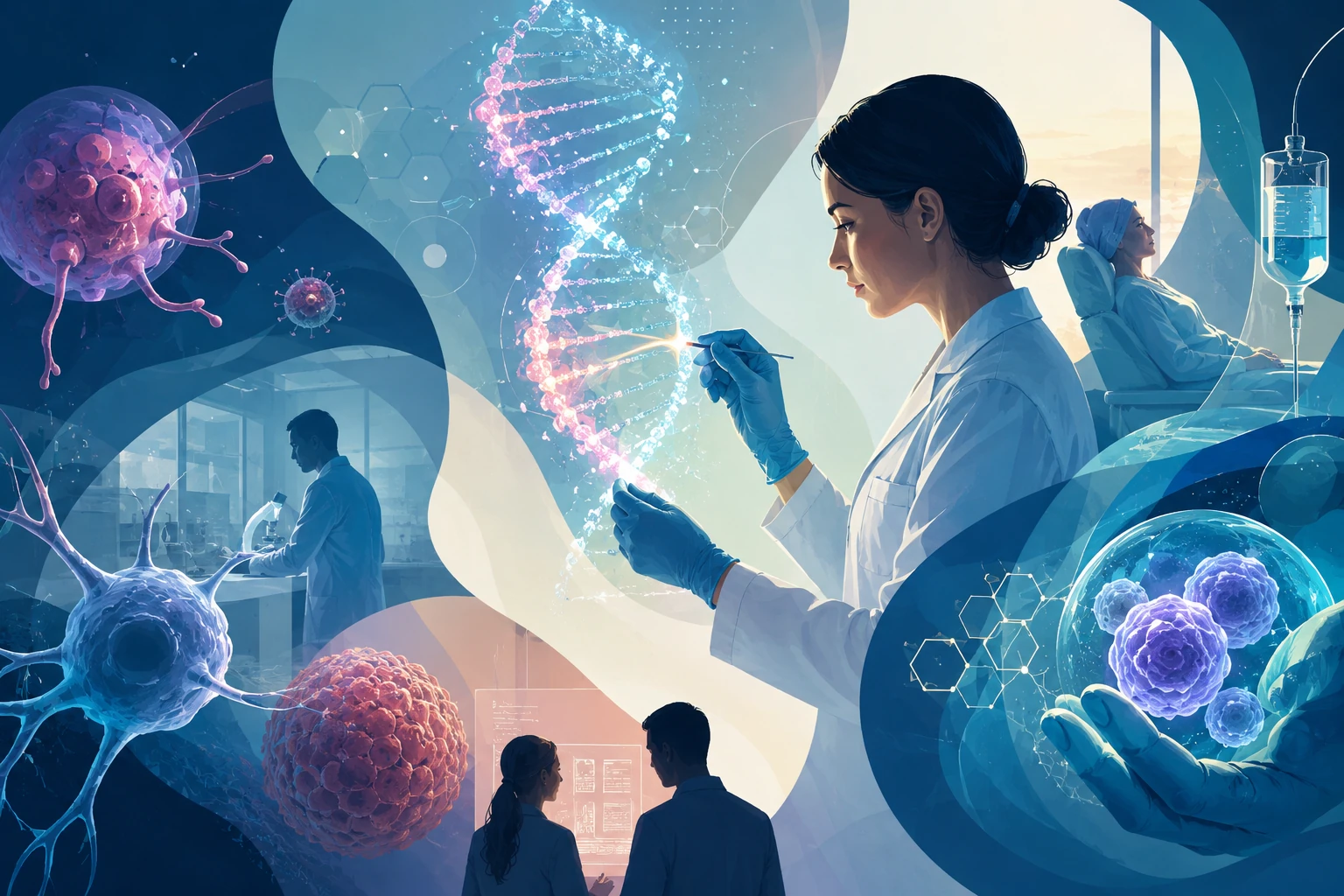
For most of human history, medicine has worked in roughly the same way: something goes wrong with the body, and doctors try to manage the consequences.
You develop high blood pressure, so you take a pill. Your immune system attacks your body, so doctors suppress it. Cancer grows, so physicians cut it out, irradiate it, poison it with chemotherapy, or help the immune system fight it.
Those approaches have saved countless lives.
But medicine is beginning to make a much more ambitious shift.
Instead of asking, “How do we control this disease?” researchers are increasingly asking:
“Can we fix the biological machinery causing it?”
And some of the technologies now emerging sound more like science fiction than traditional medicine.
We Can Edit Human DNA
CRISPR allows scientists to target and modify specific sections of DNA.
That means a disease caused by a genetic error may eventually be treated by correcting the error itself.
This is no longer theoretical. CRISPR-based therapies are already being used for diseases such as sickle cell disease, where a patient’s blood-forming stem cells can be removed, genetically edited and returned to the body.
It’s still an intensive procedure, but conceptually it represents something extraordinary:
Medicine is beginning to treat genetic disease by editing a patient’s cells.
The next frontier is doing that editing directly inside the body, which could eventually make gene therapies simpler and useful for many more diseases.
Cancer Treatment Could Become Personalized
Researchers are also developing cancer treatments tailored to the genetic fingerprints of an individual person’s tumor.
A tumor can be sequenced, its mutations identified, and a personalized therapy created to help the immune system recognize those specific cancer cells.
Instead of simply saying, “Treat melanoma,” future medicine may increasingly say:
“Attack these exact abnormalities found in this patient’s cancer.”
Personalized mRNA cancer vaccines are already being tested in large clinical trials.
If they work, cancer treatment could become far more individualized than it is today.
Doctors Can Reprogram Immune Cells
CAR-T therapy may be one of the strangest medical breakthroughs already in use.
Doctors remove a patient’s immune cells, genetically engineer them to recognize a target, multiply them, and return them to the body.
Essentially, they turn immune cells into biological guided missiles.
CAR-T has produced remarkable results in some blood cancers, and researchers are now testing whether similar approaches could treat autoimmune diseases such as lupus.
The idea is not simply to suppress the immune system forever, but potentially to reset the malfunctioning part of it.
Researchers are even developing ways to create CAR-T cells directly inside the body, which could someday eliminate the complicated process of removing and manufacturing a patient’s cells.
The body itself could become the factory.
Viruses Are Becoming Medicines
Viruses normally make us sick.
Scientists are learning how to turn them into weapons against disease.
Some viruses can be genetically modified to preferentially infect cancer cells, destroy them and alert the immune system to attack the tumor.
Think about how bizarre that would have sounded a few decades ago:
Doctors deliberately using an engineered virus as a cancer treatment.
Medicine Is Becoming More Personal
Underlying all of this is another enormous change.
Medicine has traditionally treated large groups of patients as though they were biologically similar.
You have Disease X, so you receive Drug Y.
But two people with the same diagnosis may have completely different mutations, immune systems and responses to treatment.
Genomic sequencing is making those differences increasingly visible.
The question is slowly changing from:
“What treatment works for people with this disease?”
to:
“What treatment is most likely to work for this specific person?”
The Biggest Change Is the Philosophy of Medicine
None of this means cancer is about to disappear or that Alzheimer’s is about to be cured.
Many experimental treatments will fail. Gene therapies remain expensive. CAR-T can cause serious complications. Human biology is extraordinarily complicated.
But something fundamental really has changed.
For centuries, doctors mostly had relatively blunt tools:
Remove something. Block something. Kill something. Replace something. Reduce a symptom.
Now researchers can sequence tumors, edit DNA, program immune cells, deliver genetic instructions with RNA and engineer viruses.
And increasingly, these technologies are beginning to work together.
Artificial intelligence can help analyze proteins and genomes. Sequencing can identify mutations. Gene editing can correct them. Engineered immune cells can hunt specific targets.
The really exciting part isn’t any one breakthrough.
It’s what happens when all of these technologies begin converging.
The Medicine of 2050 Could Look Very Different
Imagine a child born with a mutation known to cause a devastating disease and doctors correcting it before serious damage occurs.
Imagine developing cancer and receiving a treatment designed around the genetic sequence of your own tumor.
Imagine developing a severe autoimmune disease and receiving a therapy that resets the malfunctioning immune cells instead of suppressing your immune system for decades.
Not all of that will happen quickly, and some of today’s most exciting ideas will inevitably fail.
But pieces of this future are already appearing in hospitals.
For much of medical history, doctors were fighting biology with whatever tools they had.
The next generation of medicine is beginning to learn how to program biology itself.
And that may turn out to be one of the biggest changes in the history of medicine.