
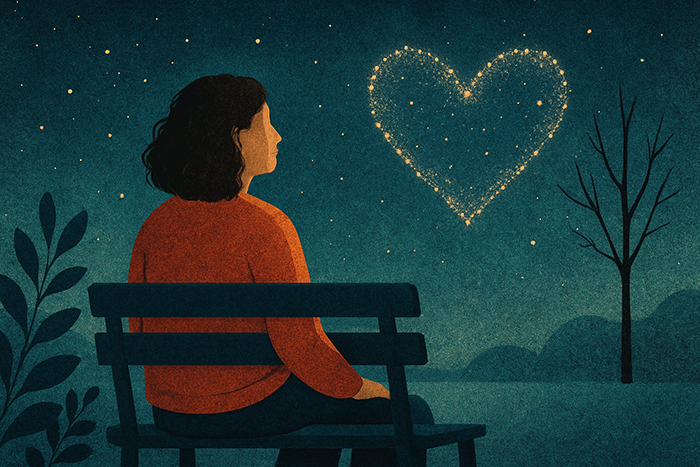
Loneliness isn’t just the absence of people. It’s the absence of connection. You can be surrounded by a room full of coworkers, family members, or social media followers and still feel profoundly alone. And on the flip side, one deep, meaningful conversation can make you feel held, seen, and human again.
We often try to cure loneliness by adding more people to our lives. We swipe, we scroll, we text. We go to parties or join groups. And while there’s nothing wrong with seeking out others, we sometimes forget that quantity doesn’t equal quality. What our hearts are aching for isn’t just presence—it’s presence with resonance.
True connection is when we are vulnerable and met with empathy. It’s when someone doesn’t try to fix us or rush us or cheerlead us out of our pain, but simply says, “I get it. I’m here.” That kind of connection doesn’t require dozens of friends. It doesn’t even require words. It requires courage—to be seen in our struggle—and compassion, both from others and ourselves.
There’s a difference between being alone and being lonely. Being alone is a state of solitude; being lonely is a state of disconnection. Some of the loneliest people I’ve met are in marriages, offices, and churches. Some of the most grounded people I’ve met spend a lot of time alone but are deeply connected to themselves, their purpose, and a few trusted souls.
We are wired for connection. It’s as essential as food and water. Our brains are social organs. We co-regulate with others; our nervous systems respond to kindness, tone, touch, and shared emotion. But here’s the kicker: for that regulation to happen, the connection has to be real. Mask-wearing—emotionally, not literally—blocks connection. Performing who we think we should be keeps people from truly knowing us.
Loneliness thrives in the gap between how we feel and what we show. When we edit our grief, mute our need, or pretend we’re fine, we send people a message: “Don’t come closer.” And then we wonder why no one does.
Curing loneliness means learning to tell the truth. First to ourselves, then to others. It means asking for what we need instead of hoping someone reads our mind. It means finding the courage to say, “I’m lonely. Can you talk?” Or “I miss you. Let’s reconnect.”
But it also means connecting to ourselves. Because until we feel at home inside our own skin, other people can only do so much. One of the most radical forms of self-care is not just journaling or bubble baths—it’s radical self-honesty. Asking: What do I need? What am I avoiding? What part of me is crying out to be heard?
We often think loneliness is a signal we need more people. But more accurately, it’s a signal we need more depth. Deeper conversations. Deeper self-reflection. Deeper intimacy, even if it’s with just one person.
If you’re feeling lonely, don’t be ashamed. Loneliness is not a personal failure; it’s a human signal. It says, “You matter. You are built for more than surface. You are ready to be known.”
Reach out to someone who’s earned the right to hear your story. Write a letter. Go for a walk and talk to yourself with kindness. Pray. Meditate. Create. Listen to music that mirrors your heart. Let yourself be moved.
And then, when you’re ready, risk connection again. Not perfect, Instagram-worthy connection, but the messy, beautiful, eye-contact, tell-the-truth kind. The kind that says, “I see you.” The kind that says, “Me too.”
Because loneliness doesn’t disappear when the room fills up. It disappears when the walls come down.
Connection heals. And it starts not with more people, but with more honesty. With one brave moment of truth.
You are not alone. Not really. You just need one real connection to remind you.