
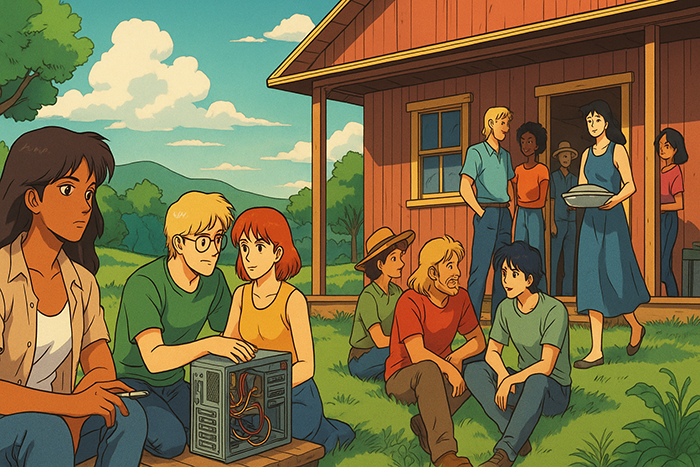
If you’d told me a few years ago that I’d be living on a farm with thirty other people—sharing everything from income to lasagna recipes—I would’ve laughed. It sounded like something out of a movie, or maybe a cult. But now, sitting on the porch of our farmhouse, I know it’s neither of those things.
Sure, people outside sometimes ask if we’re a cult. They imagine we’re some sort of brainwashed collective, repeating the same slogans and never letting anyone leave. That’s not how it works here.
If anything, what makes this place unique is how different we all are, and how easy it is to leave if you want to. Some people stick around for a few months, others for years, and a handful might be here forever, but no one is ever pressured to stay.
We do share some core values: things like egalitarianism, feminism, and non-violence. But underneath that, everyone brings their own flavor. Some people identify as anarchists; others refuse any labels at all. I’m in that latter camp. Labels are only useful until they start feeling like handcuffs, and here, there’s a real effort not to box anyone in. The only things that really matter are that you pull your weight, respect others, and don’t try to control what anyone else does.
We don’t have leaders in the traditional sense. There are different levels of membership, mostly based on how long you’ve been here. Full members—those who’ve lived here a year or more—carry more weight in consensus decisions. But nobody is “in charge.” What I love most is that nobody’s my boss, and nobody makes more money off my labor than I do. The freedom is both exhilarating and, at times, a little chaotic. Consensus decision-making can be painfully slow. But the payoff is that, when we finally agree on something, it’s because everyone is genuinely on board. If you really don’t want something to happen, you can block it, or keep working to change it until it works for everyone.
We run a business selling heirloom seeds. All the money goes into a communal pot. Each of us gets a modest stipend every month, which you can save up for personal stuff if you want—say, your own laptop or a special pair of headphones. If you want the community to buy something big for everyone, you pitch it at a meeting. Routine things—like chicken feed or shipping supplies—just get handled by whoever’s in charge of that area. Some costs don’t need a vote; other things spark debates that can last weeks. And if you ever feel strongly about how money is spent, you can always bring it up.
My day-to-day life here is wonderfully unscheduled. Unless I’ve signed up to cook lunch or take a phone shift for our business, I wake up whenever I want. Yesterday was typical: I helped my partner build a new computer for the office—he’s trying to teach me about hardware, and I’m starting to get into programming, so it’s actually pretty interesting. Later, I cooked three different lasagnas for dinner because of everyone’s dietary preferences: one with local beef, one vegetarian, and one vegan. After dinner, I smoked a cigarette in the designated area with some visitors from another commune, packed seed orders in my room while listening to music, wrote a few pages of a play, and eventually crashed.
Of course, living with thirty people isn’t always easy. Conflict is inevitable. We have this thing called the “clearness process,” where if you’re applying for membership or if there’s any tension, you sit down with everyone for a one-on-one about what it’s like to live together. Sometimes it’s as simple as a quick chat; other times, it’s a chance to dig into stuff you’d rather avoid. If someone’s slacking off, it comes up in clearness. If they cross a real line—like violence or violating consent—they’re usually asked to leave after a serious meeting. Drama, breakups, arguments—they all happen here, just like anywhere else. The only difference is that we don’t pretend it’s not happening. We deal with it.
There are kids around, too. It’s easier to have a kid if you’re already part of the community than to show up with one, but it happens both ways. Most of the children are homeschooled, or they go to local schools that the community pays for. The kids are bright, articulate, and unusually good at talking to adults. I play theater games with them sometimes. Living outside the mainstream isn’t always easy for them, but they have a ton of support here.
People always ask about relationships—whether everyone is polyamorous, or if lovers are shared. Some people here are poly, others aren’t. I’m monogamous. It really just comes down to respecting each other’s choices and keeping everything consensual.
Sometimes I miss Brooklyn, where I grew up. I miss the city streets, the wild energy, and the endless parade of strangers. I miss theater auditions and old friends. But people come through here all the time—guests, visitors, new members. Friends visit, sometimes they stay for a while, sometimes they move on. It’s a different kind of community, but the feeling of possibility is still here, just at a different pace. And at night, the sky is so clear you can see a ridiculous number of stars.
Why do I stay? For the freedom, honestly. For the chance to live without a boss, or a landlord, or someone profiting off my back. I don’t always love how slow or messy our decision-making is. Sometimes I don’t like the outcome of a decision. But I always have a say, and if I really care, I can block something or help reshape it. There’s a sense of agency here that I never felt anywhere else.
People come and go, and maybe I will too, someday. I might chase my old dream of acting again. But for now, this is where I feel most like myself. My parents are relieved to know where I am, and my friends are happy I found a place that fits. And honestly, so am I.