
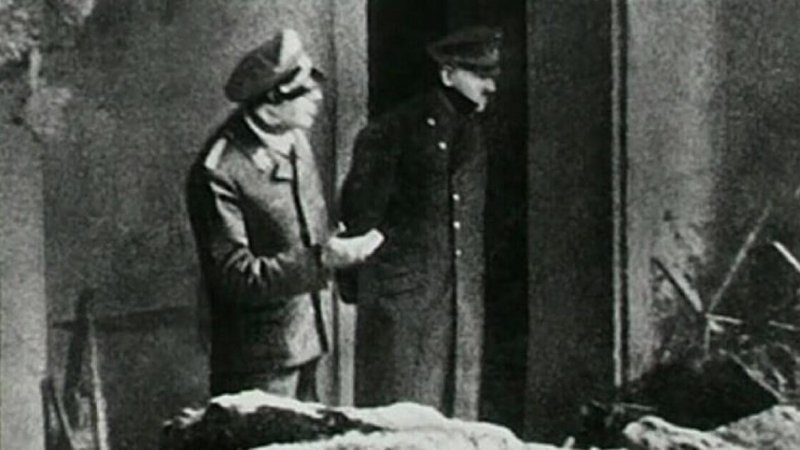
It’s a Monday. Berlin is unrecognizable. The once-proud capital of the Third Reich is now a pulverized hellscape, hammered into submission by relentless Soviet artillery. The Red Army is pushing through the rubble with a fury born not only of war but of vengeance. And at the center of this ruin—thirty feet below the surface in a reinforced concrete maze—the architect of this nightmare is living out the last hours of his life like a cornered animal.
1:00 a.m.
A message from Field Marshal Wilhelm Keitel comes in. The Ninth Army, which Hitler had pinned his last hopes on, is encircled. There’s no relief coming. Berlin is finished. Everyone knows it. Even Hitler knows it. But no one says it aloud.
The man who once commanded the armies of Europe is now pacing around a concrete tomb, a shaking wreck with a disjointed shuffle. His body is failing—his left hand trembles violently, his face is gaunt, his voice barely a whisper. The charisma is gone. What’s left is a figure of defeat clinging to delusions.
4:00 a.m.
Otto Günsche, Hitler’s personal adjutant, walks toward the bathroom and finds a chilling scene. Dr. Werner Haase and dog handler Fritz Tornow are crouched over Hitler’s German Shepherd, Blondi. They’re feeding her a cyanide capsule. A test—of the capsule, not of the dog. Blondi convulses and dies. The poison works.
That’s the level of distrust now. The cyanide came through channels linked to Heinrich Himmler, who’s been branded a traitor for trying to negotiate with the Western Allies. Hitler won’t trust the poison unless he sees it kill.
10:30 a.m.
General Helmuth Weidling is summoned. He lays out the inevitable: the Soviets are within blocks, ammunition is nearly gone, the defensive lines are disintegrating. He asks for permission to attempt a breakout rather than wait to be crushed.
Hitler refuses to surrender the city. He agrees only that men attempting to break out must intend to keep resisting elsewhere. It’s not strategy so much as dogma—resistance as liturgy, divorced from reality.
2:00 p.m.
Lunch in the bunker’s stale air. At the table: Eva Braun—now Eva Hitler—along with a handful of secretaries. The conversation drifts to cyanide capsules, to what it feels like to die from them, to whether poison should be paired with a bullet “to be sure.”
He tells the women he’s sorry he can’t part with a better gift than cyanide. There’s no ceremony to it. It’s the theater of control performed by someone who has none left.
3:15 p.m.
Hitler and Eva enter his study and close the door. He carries a 7.65 mm Walther pistol and a capsule of cyanide. Minutes pass. A single crack echoes through the hallway.
Heinz Linge opens the door. Hitler is slumped, blood draining from his temple. Eva’s lips are blue. The faint smell of bitter almonds hangs in the room. The epoch they created is ending in a room the size of a modest office, with one gunshot and one swallow.
4:00 p.m.
The bodies are wrapped in blankets, carried up the narrow stair to the shell-torn garden of the Reich Chancellery, and placed in a crater. Gasoline is poured. Artillery thuds nearby. The first attempts to set the fire falter—wind, nerves, the sheer unreality of it. Then the flames take hold.
There are no speeches. Only smoke and shrapnel and the sound of a city being ground into dust. By the next day there will be fragments, ash, and rumor.