
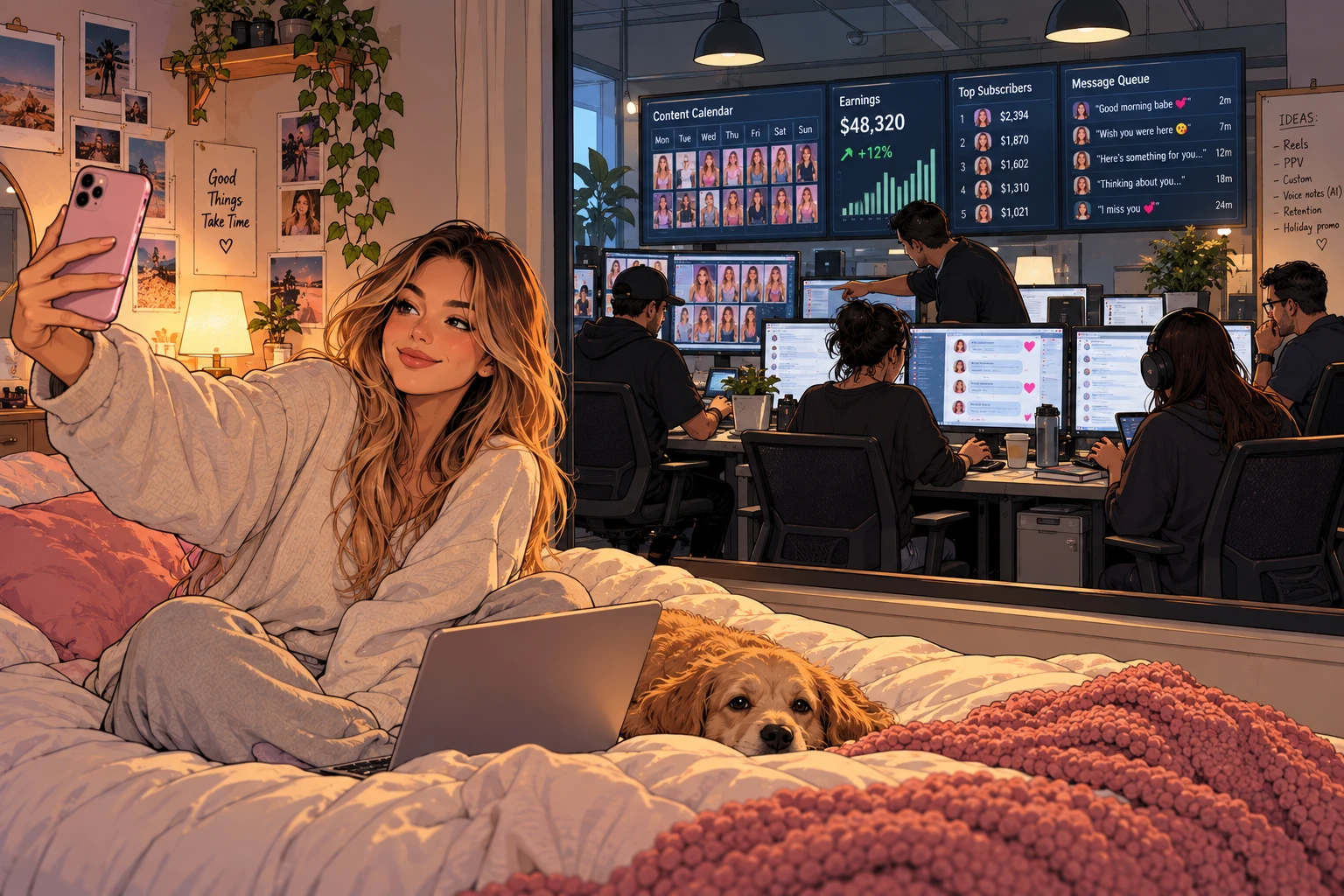
People imagine OnlyFans as a woman and her phone—a bedroom, a ring light, a few messages, and a stream of adoring fans. They think it’s raw, unfiltered, spontaneous. But that’s a fantasy. OnlyFans is a factory. Every pixel, every emoji, every “good morning” is engineered to extract money from loneliness.
My job is to make the illusion feel real. To turn desire into data, affection into analytics. It starts at the top of the funnel—what we call acquisition. I don’t post; I deploy. Instagram, TikTok, YouTube Shorts—each clip is designed like bait. We test thumbnails, facial expressions, tone of voice, even the speed of a wink. A half-second too long, and watch time drops. A half-second too short, and the viewer doesn’t feel the spark. We A/B test human connection until it converts.
Once we’ve caught attention, we start grooming behavior. “Just a peek,” “behind the scenes,” “something I can’t post here.” Each post narrows the audience, filtering for the men most likely to pay. The ones who are always online. The ones who check their phones at 2 a.m. The ones who say they don’t believe in love but still need someone to tell them goodnight.
That’s when the content furnace kicks in. We don’t wake up and “feel cute.” We shoot like a studio. Everything is planned around efficiency: an hour of filming becomes thirty days of “new” material. Every outfit, every expression, every angle gets sliced, re-colored, recaptioned, and re-uploaded until it feels fresh again. Once a creator has built a big enough library, there’s almost no need to shoot new explicit content. We just recycle, reframe, and rename. The illusion of “today” sells yesterday indefinitely.
Behind that creator’s account is an entire ecosystem. A team in Croatia and Germany works rotating shifts, pretending to be her in chat. They follow a playbook that includes her favorite coffee, her dog’s name, and the way she types “lol.” If three different chatters respond to the same man in a single day, their messages still sound like one seamless personality. Every subscriber is labeled and scored: how often he responds, how much he’s spent, when he gets paid, how lonely he sounds. When payday hits, the messages start to drip: “I miss you,” “Thought about you in the shower,” “Wish you were here.”
If he hesitates, we apply pressure. A subtle guilt trip here, a scarcity trigger there. “I don’t send this to everyone.” “I’m deleting this in an hour.” “Guess you’re not interested anymore.” Each word is tested like code. The goal is not to turn him on—it’s to turn him into a habit.
The average subscriber lasts ninety days. That’s the window we have to extract maximum lifetime value. We keep him longer by making him part of a ritual. Monday check-ins. Friday “movie nights.” A voice note on payday. And yes, even the voice notes are fake. We record hours of our models talking, feed the audio into AI, and generate custom “Good morning, babe” messages for whoever pays enough. One man caught us—ran the voice clip through an AI detector, realized it wasn’t real—and kept paying anyway. He said he didn’t care. He just wanted to believe.
Everything is tracked. There’s a dashboard for revenue per user, average spend per message, conversion rate per photo set. If the line dips, I know which chatter slipped off-script. If engagement drops on Tuesdays, we move content drops to Monday night when loneliness peaks. It’s not sex work—it’s emotional stock trading.
The content, the conversations, even the heartbreak—it’s all inventory. The men think they’re buying connection; the women think they’re selling empowerment. What they’re really part of is a perfectly optimized feedback loop where the currency is dopamine and the product is delusion.
And the most efficient part? The recycling. We use old photos, old clips, old words, dressed up like something new. The same moment sold a hundred different ways. Once a model’s library is big enough, her past becomes a gold mine—every smile, every moan, every glance frozen in high resolution and ready to be resold. Labor becomes rearrangement.
At the top, the “girl next door” isn’t a person anymore; she’s a brand run by a small army. Producers, editors, growth strategists, compliance officers, contractors, chatters, data analysts. An entire company hidden behind one face and a soft voice. The intimacy is mass-produced, but the illusion is bespoke.
AI is already closing the loop. Voice cloning is routine. Video synthesis is next. Soon you won’t even need the girl. Just her likeness, her mannerisms, her digital ghost whispering into the void. The men won’t care—they’re not looking for reality, just reassurance. The bottom ninety percent of creators will vanish when that happens. The rest will survive only if they can sell status—the fantasy of proximity to fame.
And through it all, the lie stays intact: he thinks she’s real, she thinks they care, the chatters think they’re helping, and I tell myself it’s just business. The dashboards go up, the profits come in, and the machine hums quietly through the night, converting loneliness into cash at scale.