
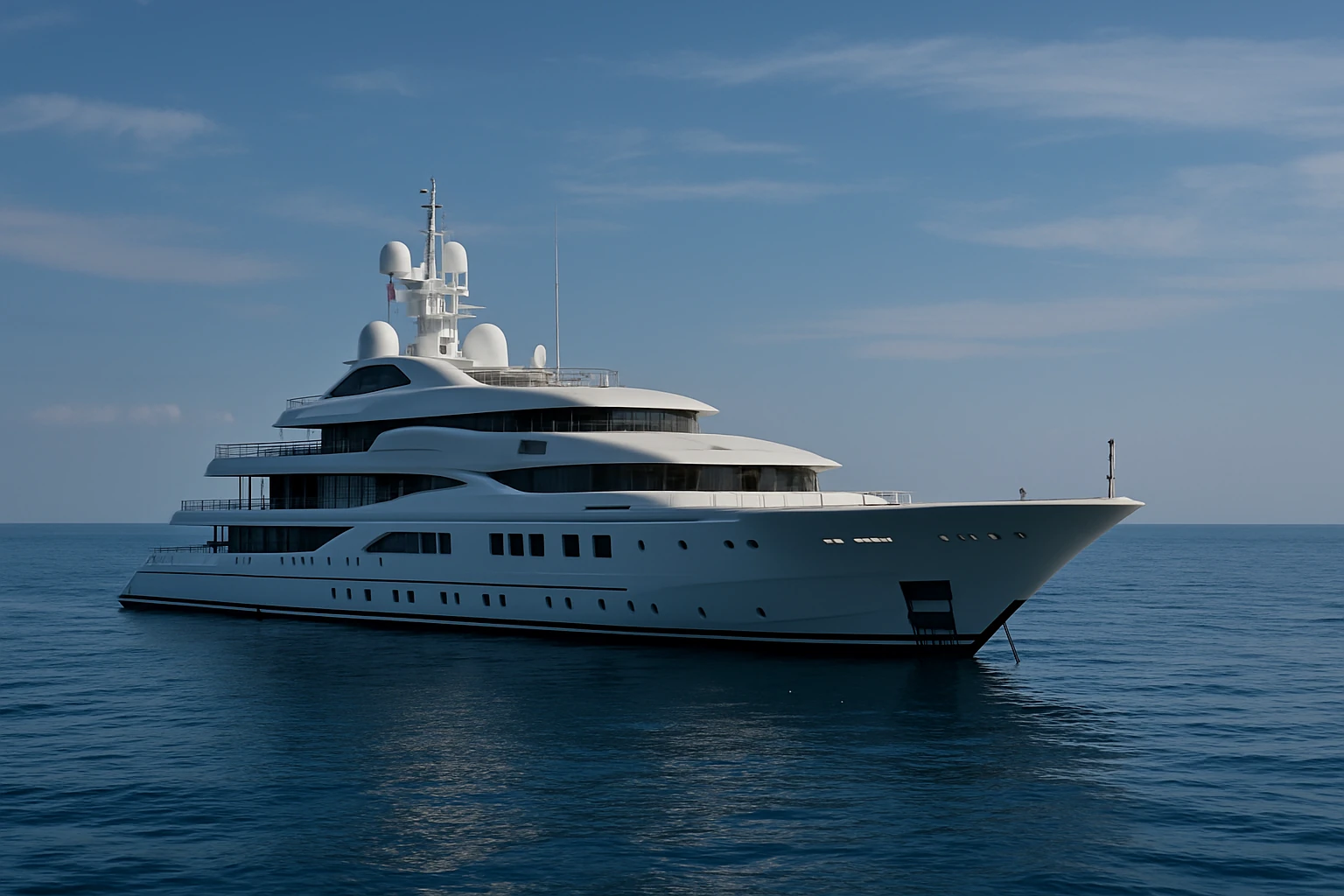
I spent eleven years driving other people’s toys around the most expensive stretch of ocean you can imagine, and the thing I miss most now is… having my own bed every night.
I didn’t stumble into superyachts by accident. I grew up on boats. My idea of a normal weekend as a kid was scraping barnacles, getting sunburned, and figuring out currents. Eventually I went to a maritime academy, got my licenses, and started out in the “real” merchant world—cargo ships, industrial work, steel hulls, rusty decks, long watches. It was honest, ugly, exhausting work.
The switch to yachts was about “quality of life,” at least on paper. Compared to cargo ships, yachts were cleaner, newer, better provisioned, and the money was good. The biggest boat I captained was about 255 feet. I held an unlimited 3rd mate license, a 1600-ton master, and the corresponding MCA paperwork. These days I’ve let most of that lapse and keep a humble 100-ton ticket, which is all I really want now.
What the Job Actually Is
From the outside, “superyacht captain” sounds like some Bond-villain lifestyle: crystal water, Champagne, models, and a tan that never fades. From the inside, it’s logistics, maintenance, and being on call for rich people’s whims.
My life ran on seasons: New England in the summer, the Caribbean in the winter, sometimes a Mediterranean stint. Most years I was physically away from home 8–10 months. On the boats I worked, regular on/off rotations weren’t a thing. You just… stayed. When the owner wanted the boat in St. Barths, you went to St. Barths. When they wanted to sit in the marina for a month doing nothing, you sat in the marina for a month doing nothing—but you still worked.
People imagine that when the owner isn’t aboard, the crew is on vacation. In reality, that’s when you fight the ocean.
Salt is trying to eat the boat every second of every day. Sun is trying to fade and crack everything it touches. So “a day at work” is often:
- Drying the entire exterior by hand.
- Polishing stainless.
- Re-waxing paint.
- Checking teak decks for cracks and loose plugs.
- Making sure the running gear is clean enough that the boat will actually move when someone shouts, “Cast off!”
Below decks, engines and generators want to be run and serviced, filters changed, chillers checked, watermakers maintained. Interior crew are constantly laundering, vacuuming, touching up upholstery, and keeping everything looking like no one has ever breathed near it.
If you want to understand a superyacht, don’t picture a party. Picture a very expensive machine that is slowly being dissolved by saltwater while you try to stay half a step ahead of it.
The Money and the Tips
People always ask about the pay. A decent rule of thumb for captains is about $1,000 per foot of boat per year. Ninety-foot boat? Roughly ninety grand salary, give or take, depending on experience and the owner.
Then there are tips on charter boats. Standard charter etiquette is around 15% of the charter fee as a gratuity, split among the crew. On my last boat, a typical week might be $150,000. Fifteen percent of that, chopped up between eight people, is a very nice envelope at the end of a week.
As captain, I was already well paid. The junior crew—deckhands, stews—relied on tips for a big chunk of their income. When we had particularly awful guests, I’d often hand my tip share to the crew. They were the ones getting screamed at because the rosé was half a degree too warm; I was in the wheelhouse dealing with charts and paperwork.
Sex, Class, and the Iron-Clad Line
People are obsessed with the sex question. “Is everyone on board sleeping with everyone else?” “How wild does it get?”
Here’s the reality:
- Sleeping with guests is a hard no. That’s the bright red line. Cross it and you’re likely fired, and in some cases, effectively blacklisted. People talk. Captains talk. Management companies talk. You don’t want to be “that crew member.”
- Crew sleeping with crew? There’s no law against it. But anyone who’s been around longer than five minutes knows it’s a great way to manufacture drama in a very small space. Breakups are ugly enough when you can avoid each other; they’re a disaster when you still have to share a bunk corridor and pass plates in the galley.
- Officers and junior crew—captain with a deckhand, chief mate with a stew—are a separate category. It’s not “illegal,” but it’s unprofessional and strongly frowned upon. Power dynamics get weird fast.
So why is guest/crew sex the unforgivable sin and crew/crew just “strongly discouraged”?
Short answer: class.
The unspoken structure is this: guests are paying royalty; crew are service staff. The idea that someone who’s being paid to polish your stainless and fold your towels might also be paid—formally or informally—to sleep with you? That opens up an entire can of legal and ethical worms: prostitution concerns, coercion, harassment, liability for the owner and management company. It’s not that crew relationships can’t cause chaos. They absolutely can. It’s that the consequences of a wealthy guest being able to dangle money, status, or threats over vulnerable staff are much, much uglier.
Personally, I kept it simple: I didn’t sleep with guests, and I didn’t sleep with crew. “Don’t shit where you eat” wasn’t just a saying; it was a policy I lived by. The ocean provides enough trouble on its own.
The Gap Between TV and Reality
Every few years someone discovers I worked on superyachts and immediately asks, “Is it like Below Deck?”
No. Not remotely.
I’ve watched maybe a snippet of the show, and my impression is this: if a real captain tolerated even half that drama, they’d be quietly replaced. In reality, the work is mostly:
- Repetitive.
- Boring.
- Physically tiring.
- Hypersensitive to small mistakes.
Most guests are not reality-show caricatures. They’re just rich people on vacation. Some are polite and low-key. Some are needy and entitled. A handful are absolute nightmares. That’s it. No permanent soap opera, just human beings with too much money and not enough self-awareness.
The job’s emotional whiplash isn’t in the drama; it’s in the contrast. One week you’re threading a 200-plus-foot yacht into a tight harbor without spilling anyone’s coffee; the next week you’re wiping bird crap off a polished handrail so the same person can pose for a photo and pretend they woke up like that.
Weather, and What the Boat Can Really Take
Can a superyacht handle bad weather? Yes, within reason. These boats cross oceans. They can take some serious seas.
The question isn’t, “Can the hull survive?” It’s, “How much chaos are you willing to create inside?”
Run into heavy weather with guests aboard and you’ll get:
- Seasick clients.
- Broken glass everywhere.
- Wine bottles launching out of racks.
- Plates in pieces.
So when the forecast looks ugly, you run for a port. It’s not because the boat is fragile like a porcelain toy. It’s because no one wants to spend $150k a week to vomit into designer buckets while the interior turns into a slow-motion car crash.
Rich People Behaving Badly
If you put extremely wealthy people on a floating hotel outside normal jurisdiction, you see things that would never fly ashore—or at least would be much more hidden.
I’ve overheard what sure sounded like insider trading. I’ve seen deals intentionally finalized just outside US territorial waters to avoid certain taxes. That part is almost mundane: money moving around in ways that benefit people who already have too much of it.
The wildest single incident? An owner’s son—with more ego than sense—decided to buy a black-market gun in Turkey. From an undercover cop. Untangling that situation was a special kind of hell. Imagine being responsible for the ship, the crew, the paperwork, and now this idiot kid’s international gun charge because daddy wanted him to “have a good time.”
As for the cliché of drug-fueled orgies at sea: I never personally captained one of those charters, and I tried to choose my boats and owners carefully. But I had friends on other yachts where, yeah, those stories were very real.
Celebrities and the Illusion
Yes, there were celebrities. No, I’m not naming names here.
What I will say is that the public image and the private reality are often miles apart. Some of the most gracious, relaxed, genuinely kind people I met were household names. Others, equally famous, treated crew like furniture—furniture that occasionally failed them.
After a while, I preferred “boring rich” to “famous rich.” Retired industrialists, older couples, families who just wanted to read or swim and drink decent wine. No entourage. No paparazzi. No team of handlers trying to choreograph every moment. Just high-end babysitting for a floating mansion.
Who This Life Is For—and Who It Breaks
People ask, “What kind of personality thrives in the superyacht world?”
I’ve seen hyper-organized Type A captains last decades. I’ve seen laid-back sailors do the same. There isn’t one “right” personality. What matters more is:
- What types of boats you end up on.
- How heavily they charter.
- Whether the owner likes to race, party, or quietly cruise.
Work a big motor yacht that charters non-stop or has an aggressive racing program, and burnout will come faster. Choose lower-key boats with older owners, and you might last a lot longer.
There are people who absolutely should not do this work:
- If you need a lot of personal space and privacy.
- If you want to go home every night.
- If you can’t handle being “on” for guests even when you’re exhausted.
Then this is not your world, and that’s okay.
Couples, oddly enough, can do very well. There are tons of captain/chef teams, engineer/stew couples, deck/stew partners. Logistically they often end up in different departments—there’s only one captain and usually one chef—but the industry is very used to hiring pairs.
Leaving, and Learning to Love Small Boats Again
From the outside, people see “superyacht captain” as the top rung. You’re in charge of a very expensive asset, docking in glamorous ports, making good money. Why on earth would you leave?
Because it’s your entire life.
In eleven years, I was gone most of each year. I wasn’t in control of my own calendar; I was on the schedule of people whose biggest problem was where to vacation next. After a while, being at the whim of other people’s playtime stops feeling like adventure and starts feeling like servitude with better uniforms.
When I finally stepped away, I needed a real break. I didn’t rush back onto the water. For about a year I barely sailed at all. I let my bigger licenses lapse. I stopped introducing myself as “captain” and, in bars, I’d tell people I was a garbage man just to avoid the endless “What’s it like on a superyacht?” routine.
Now I work primarily as a sailing and yachting photographer. I still spend time around boats, but on my terms. My partner owns a little 19-foot daysailer, and that’s honestly my favorite boat in the world right now. No crew. No charter guests. No itinerary. Just wind, water, and the kind of silence you forget exists when you’ve spent years listening to generators hum.
What I Took With Me
The superyacht industry gave me some incredible things:
- I saw places most people only ever glimpse in calendars.
- I learned to handle complex machines under pressure.
- I met some of the kindest, funniest people I’ll ever know in the crew mess at 2 a.m.
It also taught me what “home” actually means.
After living on other people’s floating palaces for more than a decade, the most luxurious thing in my life now is this: a place that doesn’t move, a bed that’s always mine, and the ability to say no when someone wants me to cross an ocean for their vacation.
If you strip away the gloss, that’s what being a former superyacht captain really feels like: not a fall from glamour, but finally reaching a safe harbor and deciding to stay.