
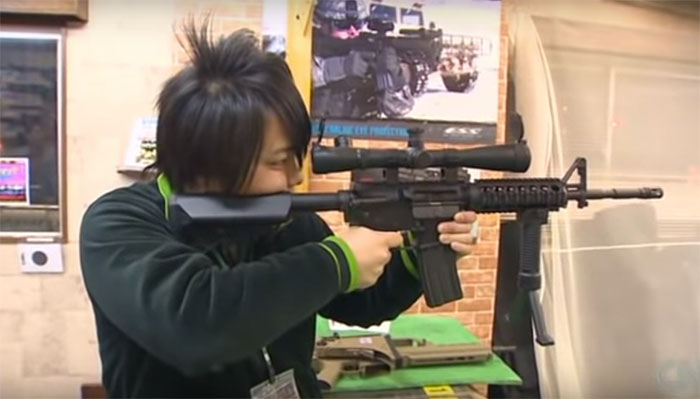
If you’ve ever wondered what it actually takes to own a gun in Japan, the short answer is that it’s almost impossible for the average person. Gun ownership in Japan isn’t just rare—it’s culturally unusual, administratively exhausting, and tightly controlled at every stage. This isn’t a country where firearms enter the public imagination the way they do in nations like the United States. Most Japanese people will go their entire lives without seeing a civilian-owned gun, let alone touching one.
Japan’s legal framework tells you everything you need to know. The country operates under the Firearm and Sword Possession Control Law of 1958, which states plainly that no one may possess firearms, swords, or even crossbows except under very limited and highly regulated circumstances. In practice, this means that handguns are banned outright, small-caliber rifles haven’t been legally obtainable since 1971, and anyone who still owns one from before that time can keep it only until they die—after which their heirs must turn it in. The only guns a private citizen can legally buy today are shotguns and air rifles used for hunting or sport shooting, and even that sliver of possibility comes with an obstacle course of requirements.
A Japanese citizen who wants to legally own a shotgun has to jump through a system that is meant, by design, to be burdensome. Prospective owners often must join a hunting or shooting club just to establish a “legitimate purpose.” They have to attend an all-day safety class, pass a written test, and achieve near-perfect accuracy on a shooting-range exam. They must then go through a mental-health evaluation at a hospital and a deep background check that covers criminal records, employment status, financial stability, and even interviews with friends, family, and neighbors. If you pass all that, you must show police exactly where your gun will be stored and where the ammunition will be stored—always separately, always locked, always accessible to inspection. That inspection happens annually, and every few years you’re required to take the class and exams all over again to renew your license.
The idea behind this system isn’t merely to regulate gun ownership. It’s to make it exceedingly rare, tightly supervised, and socially understood as a privilege granted under exceptional circumstances. Your license is tied to your specific gun, and in many cases you’re not even allowed to shoot weapons other than your own at a range. There is no fluid ecosystem of casual gun use; the entire structure is built to ensure that guns do not circulate.
These laws don’t exist in a vacuum. Japan’s relationship with weapons has deep historical roots. The country has a long tradition of regulating arms as a method of maintaining public order. In the 16th century, Japan carried out nationwide “sword hunts” to disarm civilians and prevent rebellion. After World War II, strict regulation became part of rebuilding the nation and ensuring stability in a society emerging from devastation. Over time, this evolved into a culture where weapons are seen as inherently dangerous in civilian hands, and where social harmony takes precedence over individual armament.
The effect of all this is dramatic. Civilian gun ownership in Japan sits at a tiny fraction of one percent. Gun deaths are so rare that single-digit annual numbers make national news. When a gun is used in a crime—like the homemade weapon used in the assassination of former Prime Minister Shinzo Abe—it shocks the entire nation precisely because gun violence is almost nonexistent. Even the Yakuza, Japan’s mafia-like criminal syndicates, largely avoid using guns because doing so attracts overwhelming police pressure.
So just how hard is it to own a gun in Japan? For most people, the process is strict enough that the option may as well not exist. It requires months of classes, tests, inspections, interviews, and continuous oversight. A mistake in storage procedures or a lapse in renewing your license can mean losing the gun immediately. The system is designed to filter out all but the most committed and compliant individuals.
Japan shows what a society looks like when gun ownership is treated as an exception rather than a right. Whether that model could—or should—be applied elsewhere is a separate question with cultural and political nuances. But one thing is absolutely clear: in Japan, owning a gun is not simply difficult. It is deliberately, structurally rare, and most people never bother attempting it at all.