
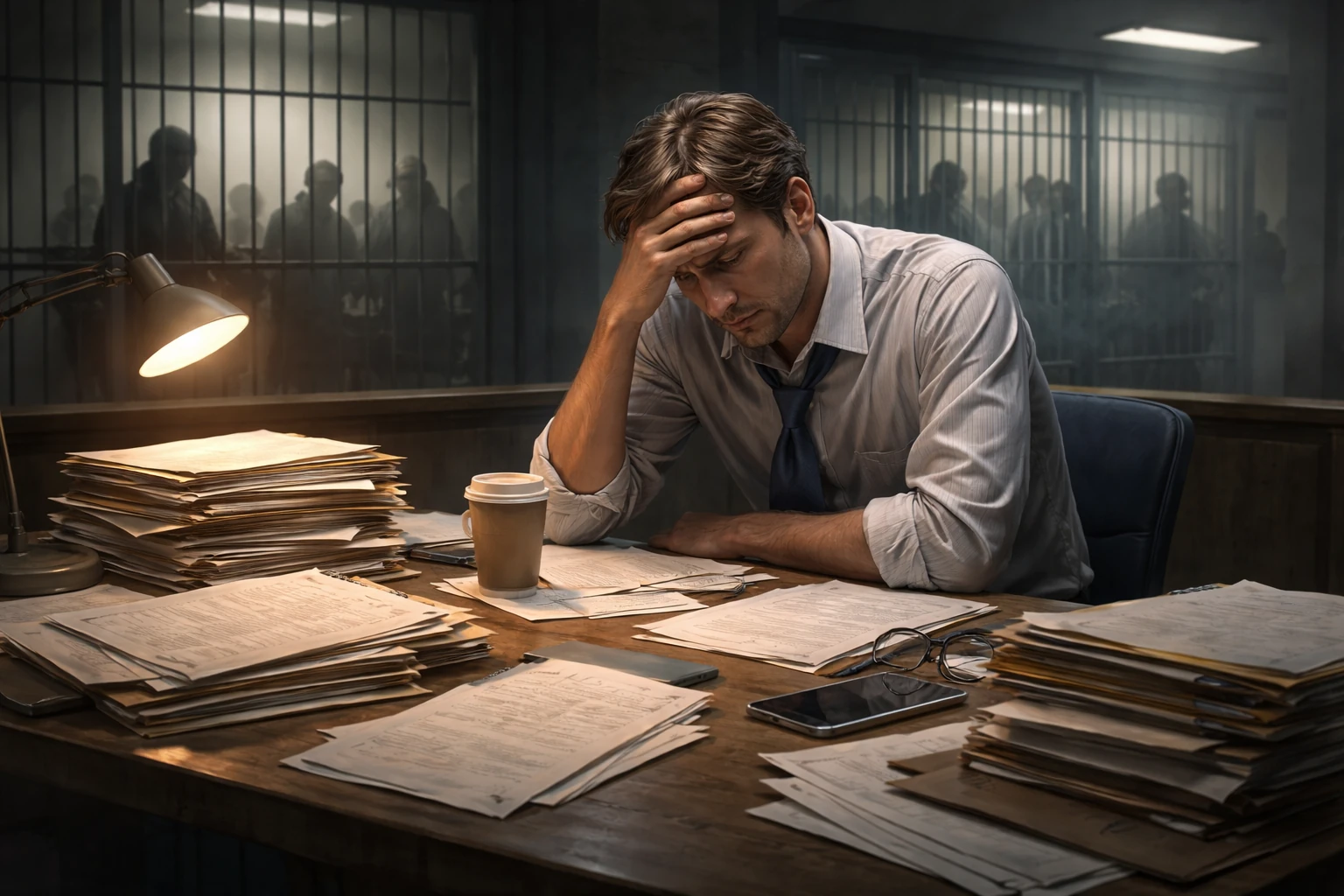
Most people don’t think about public defenders at all. When they do, it’s usually through a cartoon—either the incompetent burnout who doesn’t care, or the slick TV lawyer who wins on a dramatic speech in front of a jury. Neither of those people exist.
What exists instead is a job where you wake up every morning thinking, “Did I set that hearing for today or next week?” and fall asleep thinking about the one innocent client who didn’t make it out clean.
I’ve done this job for years in a medium-large Southern city. I’ve handled just about every type of criminal case you can imagine—from suspended licenses to violent felonies. And here’s the truth that sits underneath all of it:
The system is not built to determine truth.
It’s built to process people.
The First Lie People Believe
The first lie the public believes is that trials are where justice happens.
They aren’t.
Ninety-nine percent of cases never see a jury. They die quietly in hallways, conference rooms, and holding cells. They die in moments where a terrified person is asked to choose between two bad options:
- Fight a charge they didn’t commit and risk a harsher punishment, more charges, or a year in jail waiting.
- Or plead guilty to something smaller and go home tomorrow.
People love to say, “Well if I were innocent, I’d fight.”
They say that because they’ve never sat in a jail cell watching their job disappear while the state casually takes its time.
I’ve had innocent clients plead guilty because “time served” sounded better than another 11 months behind bars waiting for a trial date.
And there is nothing I can do to stop that.
“How Can You Defend Guilty People?”
That’s the question everyone expects me to be asked. It’s never the hardest one.
The hardest cases aren’t the guilty ones. The guilty ones usually resolve quickly. Evidence is strong. Deals are clear. Everyone knows where it’s going.
The cases that keep me up at night are the innocent ones.
The ones where a cop lies just enough to sound credible.
The ones where a jury says, “He’s guilty of something, I can feel it.”
The ones where a child is coached, a translation app mangles the truth, or a system mistake becomes someone’s life.
I once defended a man accused of raping a child—who was innocent. Truly innocent. The jury acquitted him on every major charge, but convicted him on a lesser one because one juror “just knew” he had to be guilty of something.
That verdict still sits with me.
I Don’t Tell Clients What to Do
People assume public defenders railroad clients into plea deals. Some do. They shouldn’t.
I don’t tell clients what to do.
I tell them:
- what the evidence looks like,
- what the state is offering,
- what I think will happen if we fight,
- and what I think will happen if we don’t.
Then I say, “I’ll drive you to hell if that’s where you want to go.”
Because it’s not my life on the line. It’s theirs.
That said, I am overwhelmed. All the time. Every public defender I know is. We juggle hundreds of cases. We’re in multiple courtrooms at once. We answer calls on days off. We carry stories we’re not allowed to share.
There’s a reason this job has some of the highest rates of burnout, addiction, and self-destruction.
The System Pretends to Be Neutral. It Isn’t.
If you’re poor, the system is hostile by default.
Bond money you don’t have.
Time you can’t afford to lose.
Jobs that won’t wait.
Immigration consequences that terrify people into silence.
I’ve watched non-citizens skip court—not because they’re guilty, but because showing up might get them deported.
I’ve watched domestic violence charges weaponized for custody battles.
I’ve watched people beg for mental health help and walk away in handcuffs instead.
I once represented a man charged with making a “false police report” because he called 911 during a mental health crisis and said he might hurt someone if he didn’t get help.
That charge carried 4–8 years.
That’s not justice. That’s punishment for asking.
Do I Believe in the System?
No.
It’s property-based, not human-based.
It values efficiency over truth.
It treats liberty as cheaper than $10 worth of stolen food.
If you ask me whether society works best when people don’t steal—sure. But if the response to stealing bread is jail, we’ve already admitted that human freedom is worth less than inventory loss.
And yes—there is an entire industry invested in keeping it this way.
Why I Stay
I stay because sometimes it works.
Sometimes a charge gets dismissed.
Sometimes a client goes to rehab instead of prison—and comes back to help others.
Sometimes a case collapses because someone actually follows the law.
And sometimes someone tells me years later that without a public defender, their life would have gone in a very different direction.
Those moments don’t fix the system.
But they remind me why I’m here.
I sleep fine defending guilty people.
It’s the innocent ones who never let me rest.