
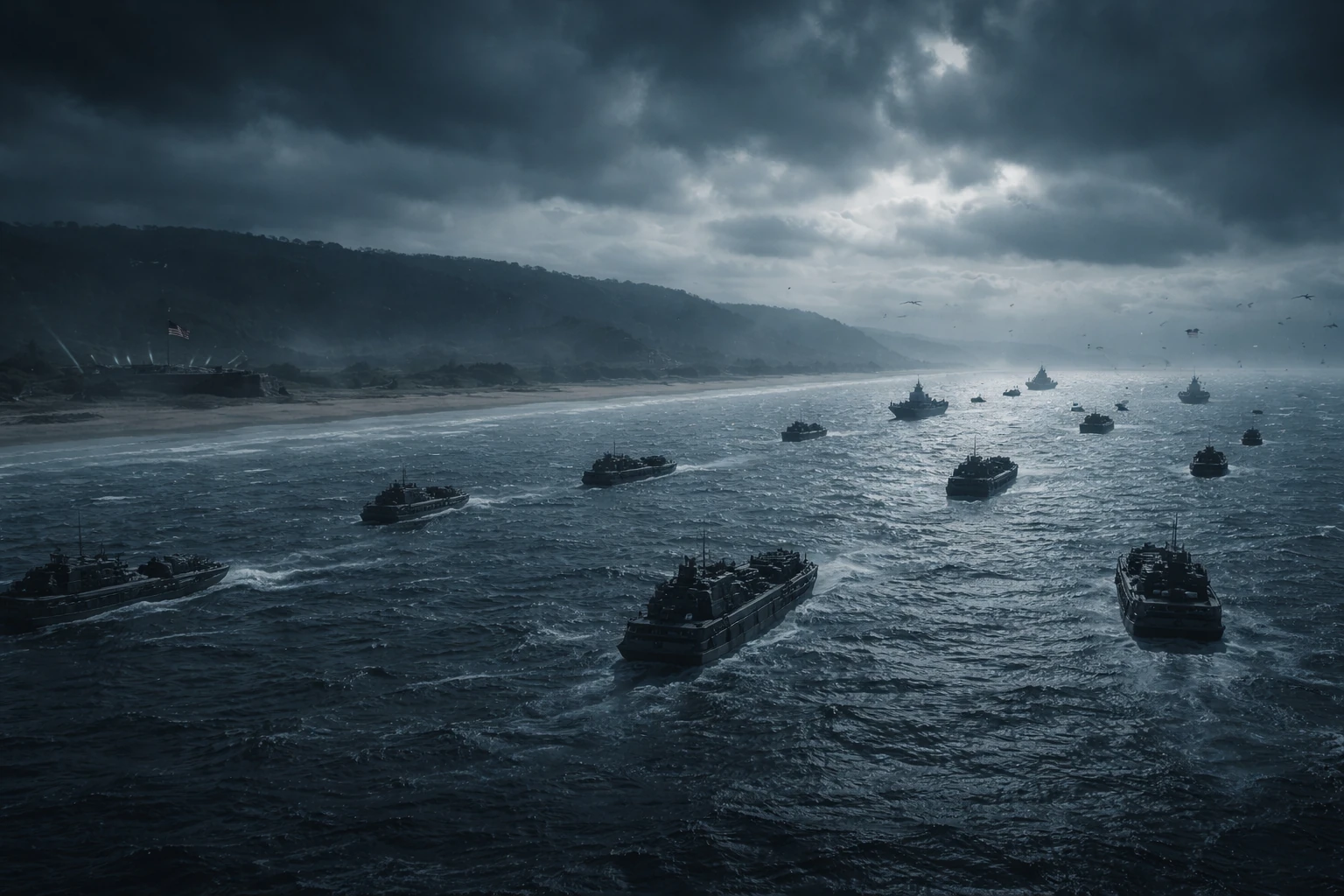
From a distance, the United States looks like a normal country. It has borders. It has cities. It has coastlines that stretch for thousands of miles and beaches that, on a clear day, look no different from anywhere else on Earth. If you were standing on the deck of a ship far out at sea, the shoreline would not look especially intimidating. It would look empty. Peaceful. Almost inviting.
But that first impression is a lie.
The United States is not merely difficult to invade. It is structurally designed to make invasion collapse under its own weight. Long before a single soldier could set foot on land, an attacking force would already be bleeding time, fuel, ships, aircraft, and political capital at a scale that modern militaries are not built to survive. This is not about patriotism or bravado. It is about math. Distance. Logistics. Geography. Industrial depth. And a defense system that begins thousands of miles from shore.
History remembers wars as clashes of armies and flags and explosions. What it often forgets is that wars are actually won and lost by freight, fuel, ports, factories, rail lines, and oceans. And in that quieter, colder version of warfare, the United States is less a nation and more a fortress disguised as a continent.
By the time an invasion fleet appears on the horizon, the outcome would already be decided.
1. The Geographic Moats: Strategic Depth
The United States benefits from what historians call “the world’s greatest moats.” To the east lies the Atlantic Ocean; to the west, the Pacific. These are not just bodies of water; they are logistical kill zones.
The Ocean Barrier
To invade a country the size of the U.S., a hostile power cannot simply march across a border. They must transport millions of troops across thousands of miles of open ocean. The Pacific Ocean alone covers nearly one-third of the Earth’s surface. An invasion fleet would be visible to satellites and radar for weeks before it ever reached the coastline, eliminating the element of surprise.
The North and South Buffers
Entering through neighbors is equally implausible:
- The Canadian Shield: To the north, Canada offers a massive strategic buffer. The terrain is rugged, heavily forested, and experiences extreme weather conditions that wreck supply lines. Furthermore, the U.S. and Canada share the longest undefended border in the world, backed by the NORAD aerospace defense alliance.
- The Mexican Terrain: To the south, the terrain is characterized by harsh deserts and mountain ranges (the Sierra Madre). Moving heavy armor (tanks and artillery) through this terrain without an established highway network capable of supporting that weight is a logistical nightmare.
2. The Logistics Nightmare: The Tyranny of Distance
Amateurs talk about strategy; professionals talk about logistics. This famous military maxim is the primary reason the U.S. is safe. An invasion is not just about landing troops; it is about keeping them fed, fueled, and armed.
The 3-to-1 Ratio
Military doctrine generally dictates that an attacking force needs a 3-to-1 advantage to dislodge a dug-in defender. The U.S. has roughly 2 million active and reserve personnel. An invader would arguably need to land 6 million troops to have a fighting chance.
The Supply Chain Problem
Modern warfare consumes resources at a staggering rate. A single armored division can consume hundreds of thousands of gallons of fuel per day. There is no nation on Earth that possesses the shipping capacity (“sealift capability”) to transport 6 million soldiers and sustain the millions of tons of daily supplies required to support them across an ocean. For context, the D-Day invasion—the largest amphibious assault in history—only crossed the narrow English Channel, and even that stretched Allied logistics to the breaking point.
3. The Naval Wall: The First Line of Defense
Before an enemy ship could even spot the American coastline, it would have to survive the United States Navy. This is not just a defensive force; it is the premier power-projection force in human history.
Carrier Strike Groups (CSGs)
The U.S. operates 11 nuclear-powered supercarriers. Each carrier is the center of a “Strike Group” that includes cruisers, destroyers, and submarines. A single U.S. Carrier Strike Group possesses more airpower than the entire air forces of many nations. These floating cities allow the U.S. to engage an enemy fleet thousands of miles away from American soil.
The Silent Service
Beneath the waves lies the U.S. submarine fleet. The Virginia and Seawolf class fast-attack submarines are designed to hunt and sink enemy shipping. If a hostile fleet attempted to cross the Atlantic or Pacific, they would face a gauntlet of torpedoes from submarines they could neither see nor detect.
4. The Air Superiority: Controlling the Sky
Modern warfare has proven one undeniable fact: you cannot win on the ground if you do not control the air. The United States maintains undisputed air superiority.
The Numbers Game
The United States Air Force (USAF) is the largest air force in the world. The second-largest air force in the world is the U.S. Navy’s aviation branch. The fourth-largest is the U.S. Army aviation branch (helicopters). The sheer volume of aircraft means the U.S. can absorb losses that would cripple any other nation.
Technological Dominance
Beyond numbers, the U.S. operates the world’s only large-scale fleets of fifth-generation stealth fighters (the F-22 Raptor and F-35 Lightning II). These aircraft can engage enemy targets before the enemy even knows they are there. An invading fleet would be targeted by long-range stealth bombers (like the B-2 and B-21) while still in the middle of the ocean.
5. The “Blade of Grass” Doctrine: A Rifle Behind Every Blade
Japanese Admiral Isoroku Yamamoto is apocryphally quoted as saying, “You cannot invade the mainland United States. There would be a rifle behind every blade of grass.” Whether he said it or not, the sentiment reflects a terrifying reality for any occupier.
Civilian Firepower
The U.S. population owns an estimated 400 million firearms. This exceeds the combined small arms stockpiles of every military and law enforcement agency on the planet. While civilians are not trained soldiers, the sheer density of armed resistance would make occupation impossible.
The Math of Occupation
Counter-insurgency doctrine suggests you need 20 soldiers for every 1,000 residents to successfully occupy a hostile territory. To occupy a U.S. population of 335 million spread across 3.8 million square miles, an invader would need a permanent garrison of nearly 7 million soldiers. This is more troops than China, Russia, and India have combined. The economic cost of such an occupation would bankrupt any empire within months.
Summary Analysis
| Defensive Layer | The Challenge | Why It Fails |
|---|---|---|
| Geography | Crossing the Ocean | Requires moving millions of troops over 3,000+ miles of open water without detection. |
| Logistics | Supply Chains | No nation has the “sealift” capacity to feed and fuel an invasion force of the necessary size. |
| Naval/Air | Approaching the Coast | Invaders must defeat the world’s #1 Navy and #1 & #2 Air Forces simultaneously. |
| Insurgency | Occupation | The 400 million civilian firearms create an impossible counter-insurgency environment. |
Conclusion
Invading the United States is not a matter of military bravery or tactical brilliance; it is a matter of hard math. No nation possesses the economic resources, the shipping capacity, or the manpower to project the necessary force across the world’s oceans against a nuclear-armed superpower. For the foreseeable future, the U.S. remains a fortress protected by geography, industry, and a population that is famously ungovernable by foreign powers.