
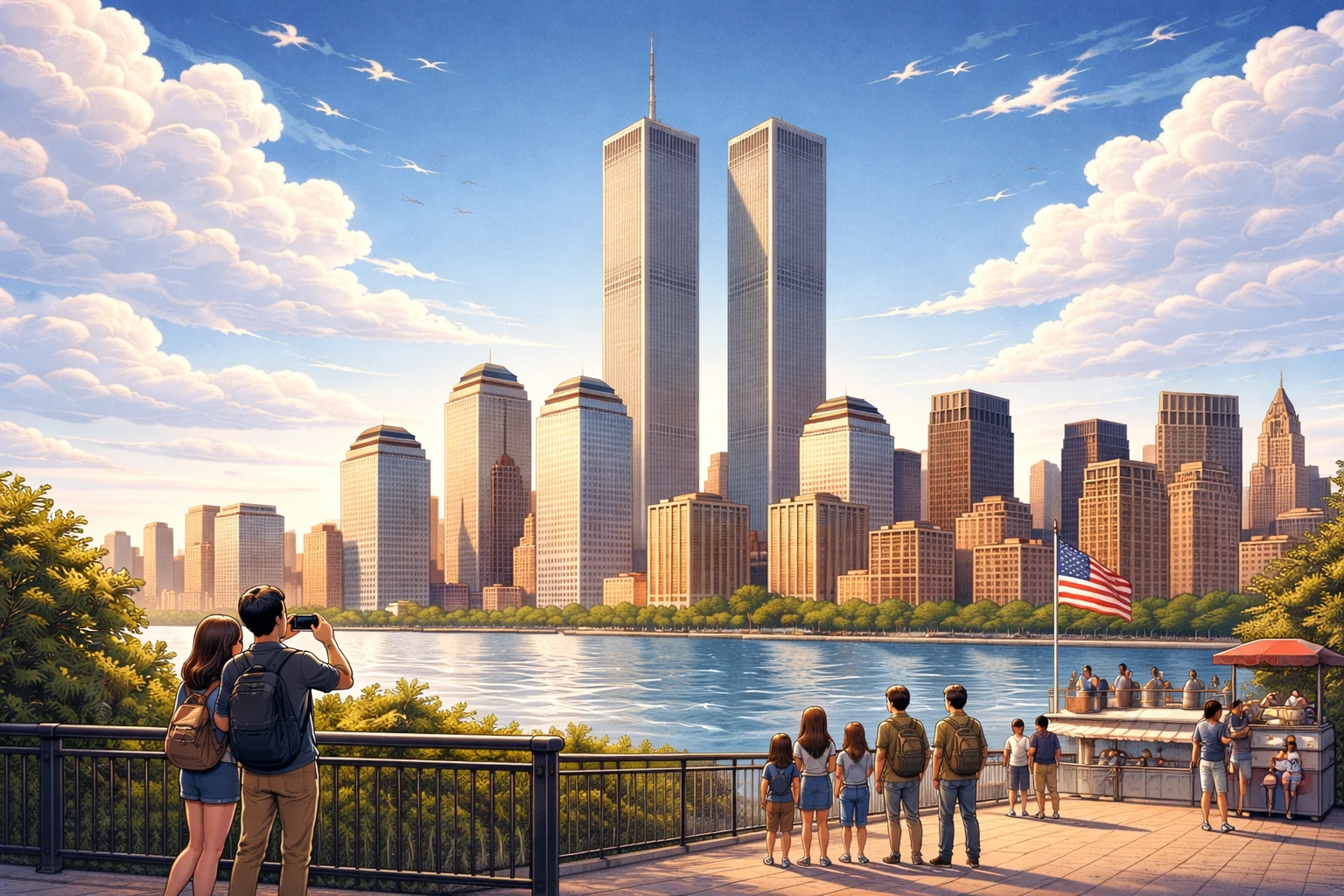
It’s one of those counterfactual questions that keeps historians up at night: What if September 11, 2001 never happened? Not delayed. Not partially foiled. Just… never happened at all.
The reason the question matters isn’t nostalgia or morbid curiosity. It’s that 9/11 didn’t just change policy—it rewired daily life, geopolitics, technology, culture, and the psychology of an entire generation. To imagine a world without it is to imagine a different 21st century.
This isn’t about pretending history could be clean or peaceful. Violence, terrorism, and conflict existed long before 2001 and would have continued. But the shape of the modern world—the trade-offs we accepted, the fears we normalized—would look profoundly different.
The Event That Never Happens
In this alternate timeline, 9/11 never occurs. Al-Qaeda either fails to execute the plot or abandons it entirely. The World Trade Center stands. The Pentagon never burns. Nearly 3,000 people go home that night.
But the absence of a single day changes everything downstream.
Air Travel: Still Annoying, But Not a Ritual of Fear
Airports are the most immediate reminder of how deeply 9/11 reshaped normal life.
Without the attacks:
- You likely walk to the gate to greet someone arriving.
- Shoes stay on. Liquids aren’t a philosophical problem.
- The Transportation Security Administration (TSA) probably never exists—or exists as a small, low-profile agency instead of a nationwide security ritual.
Flying is still stressful and inconvenient, but it’s not existential. The act of travel doesn’t come with a standing assumption that catastrophe is always one failure away.
That subtle difference—fear vs. inconvenience—matters more than we realize.
Surveillance, Privacy, and the Trade We Never Made
In our world, 9/11 provided the moral justification for a sweeping expansion of government surveillance.
Without it:
- The Patriot Act almost certainly doesn’t pass in its current form.
- Mass metadata collection is harder to sell to the public.
- Whistleblowers like Edward Snowden may never become household names—because the systems they exposed might not exist at that scale.
This doesn’t mean a privacy utopia. Governments still spy. Corporations still track. But the default balance tilts slightly more toward civil liberties, because there’s no singular trauma to override resistance with fear.
The Wars That Probably Never Happen
This is the biggest fork in history.
Without 9/11:
- There is no U.S.-led war in Afghanistan.
- There is very likely no Iraq War, which relied heavily on post-9/11 fear and momentum.
That means:
- Millions of lives not lost or displaced.
- Trillions of dollars not spent on prolonged war.
- The Middle East’s political trajectory looks very different—possibly still unstable, but altered in unpredictable ways.
It also means the presidency of George W. Bush is remembered less as a wartime administration and more as a conventional, domestically focused one.
Politics Without Permanent Emergency Mode
One of 9/11’s quietest effects was psychological: it normalized governing through crisis.
Without it:
- “National security” doesn’t dominate every debate.
- Fear-based messaging has less emotional leverage.
- The idea that extraordinary threats require extraordinary powers is harder to invoke.
Politics would still be polarized—human nature guarantees that—but the post-2001 tone of constant emergency, suspicion, and moral absolutism would likely be muted.
Culture, Media, and a Generation That Grows Up Differently
If you were a kid in 2001, 9/11 was the moment the world stopped feeling abstract.
Without it:
- News media is less saturated with terrorism imagery.
- Movies and TV don’t pivot so hard toward paranoia, torture, and apocalyptic stakes.
- Muslim Americans likely experience less suspicion and systemic profiling, changing countless individual lives in ways no statistic can capture.
An entire generation grows up without the sense that the future is permanently fragile.
Technology and the Internet: Faster, Slower, or Just Different?
This one is complicated.
Some technologies accelerated because of 9/11:
- Facial recognition
- Large-scale data analysis
- Airport scanning systems
- Predictive surveillance tools
Without the attacks, innovation still happens—but the incentives change. Tech may develop more toward convenience and commerce, less toward control and monitoring. Silicon Valley’s relationship with government is more distant, less entwined with defense and intelligence contracts.
What This World Would Not Be
It’s important to say this plainly:
- It would not be a peaceful world.
- Terrorism would not vanish.
- Authoritarianism would not magically recede.
- Inequality, conflict, and fear would still exist.
But the defining trauma of the early 21st century would be missing—and that absence would echo everywhere.
The Quietest Change of All
Perhaps the most profound difference is the hardest to measure.
In a world without 9/11:
- Fear doesn’t become a permanent background noise.
- Security doesn’t automatically outrank freedom.
- The future feels open, not conditional.
History doesn’t turn on a dime very often. But on September 11, 2001, it did.
And if that day had passed like any other—if the planes landed, the towers stood, and the world kept spinning—we would still be living with danger, uncertainty, and conflict.
We just wouldn’t have built so much of our lives around the expectation that catastrophe is always imminent.