
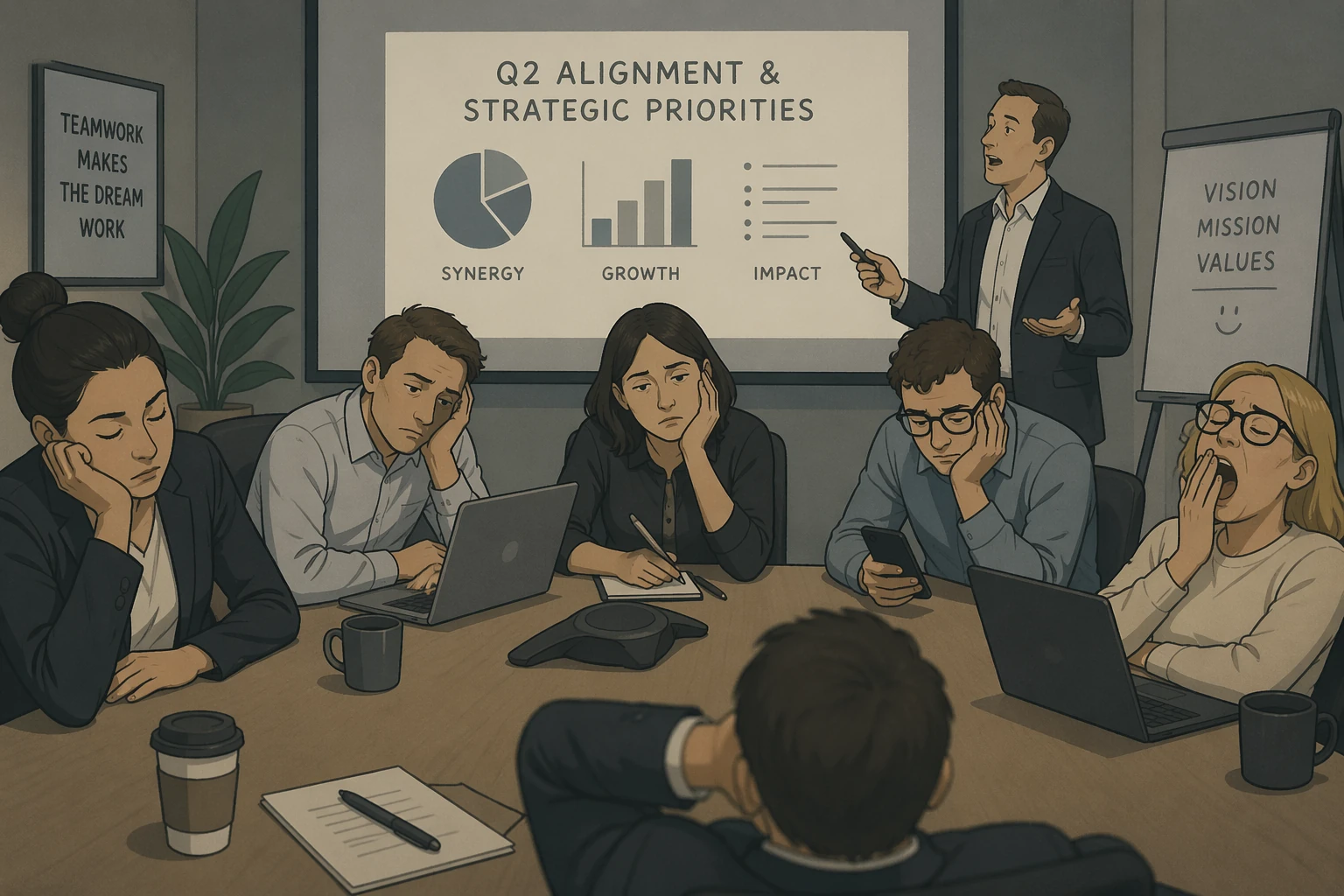
Corporate speak is one of those things everyone claims to hate, yet somehow continues to use with the quiet enthusiasm of a person refilling their own drink at a party they don’t want to be at. It’s a language that exists not to communicate ideas, but to create the feeling that ideas are being communicated. And the strange part is, it works—not because it’s clear, but because it’s familiar. It’s the linguistic equivalent of elevator music. No one listens, but everyone recognizes it.
At some point, someone decided that saying “Let’s circle back” was better than saying “I don’t want to deal with this right now.” And everyone else just accepted it, the way people accept a new app update they didn’t ask for. Suddenly, people weren’t having conversations anymore. They were “aligning,” “leveraging,” and “touching base.” Words that technically mean something, but in practice mean almost nothing.
The fascinating thing about corporate speak is that it’s not designed to clarify. It’s designed to protect. If you say something plainly, you can be wrong. If you say something vaguely, you can always reinterpret what you meant later. “We should explore synergies moving forward” is a sentence that cannot fail, because it doesn’t actually do anything. It’s preemptively immune to criticism. It’s like making a promise that never fully exists.
And nowhere does this become more obvious than when something bad happens.
Consider the internal email LinkedIn sent to employees when it announced layoffs affecting more than 600 people. It reads like a case study in how to say something devastating in a way that feels almost abstract. The message is technically transparent, but emotionally evasive. It stretches out the moment before reality lands, wrapping a very simple truth in layers of process and intention.
Team,
We did not expect to share this important update with you all in the midst of such challenging times but in the spirit of clarity, Tomer and I wanted to share some news regarding changes we are making to our orgs. As we continue to execute on our FY24 plan, we need to also evolve how we work and what we prioritize so we can deliver on the key initiatives we’ve identified that will have an outsized impact in achieving our business goals.
This means adapting our organizational structures to improve agility and accountability, establishing unambiguous ownership, and driving improving efficiency & transparency through reduced layering.
These decisions result in the reduction of 563 roles across R&D. Broken down, there are 137 Engineering management roles and 38 Product roles being reduced. Additionally, there will be 368 role reductions across our Engineering team in an effort to better align resources to our FY24 plan, and we will open a small number of new roles to fill critical gaps in our ambitious roadmap.For those who are directly affected by these changes, you will receive a calendar invitation within the next hour, titled “Required Attendance: R&D Role Reductions”. This meeting will provide you with detailed information on how we we will support you through this transition.If you do not receive this invitation, expected communication from your Product or Engineering Executive leader soon with specifics pertaining to your organization and how we will collectively navigate through these changes.
Tomer and I made these decisions with deep consideration towards the long-term needs of our business and with the acknowledgement that every affected individual has played a valuable role in the growth and success of LinkedIn. In the coming days, our focus will be on supporting each other and discussing the ways we will move forward, with our vision, mission and values as our guides. Today, it is imperative that we support our colleagues navigating this transition. Let’s continue to embrace empathy and understanding through these difficult times and use these as a cornerstone for the support we provide each other.
Stripped down to what it’s actually saying, the email is this: the company has a plan for the future, and that plan involves needing fewer people—specifically hundreds fewer people. The organization is being reshaped to move faster, cost less, and operate with fewer layers, which inevitably means jobs are being eliminated. If you’re one of the people affected, you’ll find out almost immediately through a meeting invite, delivered with the same quiet efficiency as any other calendar notification. The company wants you to know this wasn’t impulsive, that your contributions mattered, and that there’s an expectation—spoken gently but clearly—that everyone handles this with professionalism and composure, even if what’s happening is deeply personal.
What’s striking is not that the message is unclear—you can piece together exactly what’s happening. It’s that the language creates distance. It turns something human into something procedural. Losing your job becomes a “role reduction.” Being blindsided becomes “navigating a transition.” It’s not dishonest. It’s just carefully constructed to avoid the weight of what’s actually being said.
And maybe that’s the point.
Corporate speak isn’t just about sounding professional. It’s about creating a buffer between the action and the responsibility for that action. It allows people to say difficult things without fully inhabiting them. It softens reality, but not in a kind way—more like a fog that makes everything harder to see clearly, including the people standing right in front of you.
The real question isn’t why corporate speak exists. It’s why it persists, even when everyone recognizes how absurd it sounds. The answer might be that it solves a problem no one wants to admit exists: saying real things, clearly, is uncomfortable. It creates accountability. It forces people to confront what they’re actually doing.
Corporate speak removes that discomfort. It replaces it with something smoother, safer, and ultimately emptier.
It doesn’t make bad news better. It just makes it easier to say.