
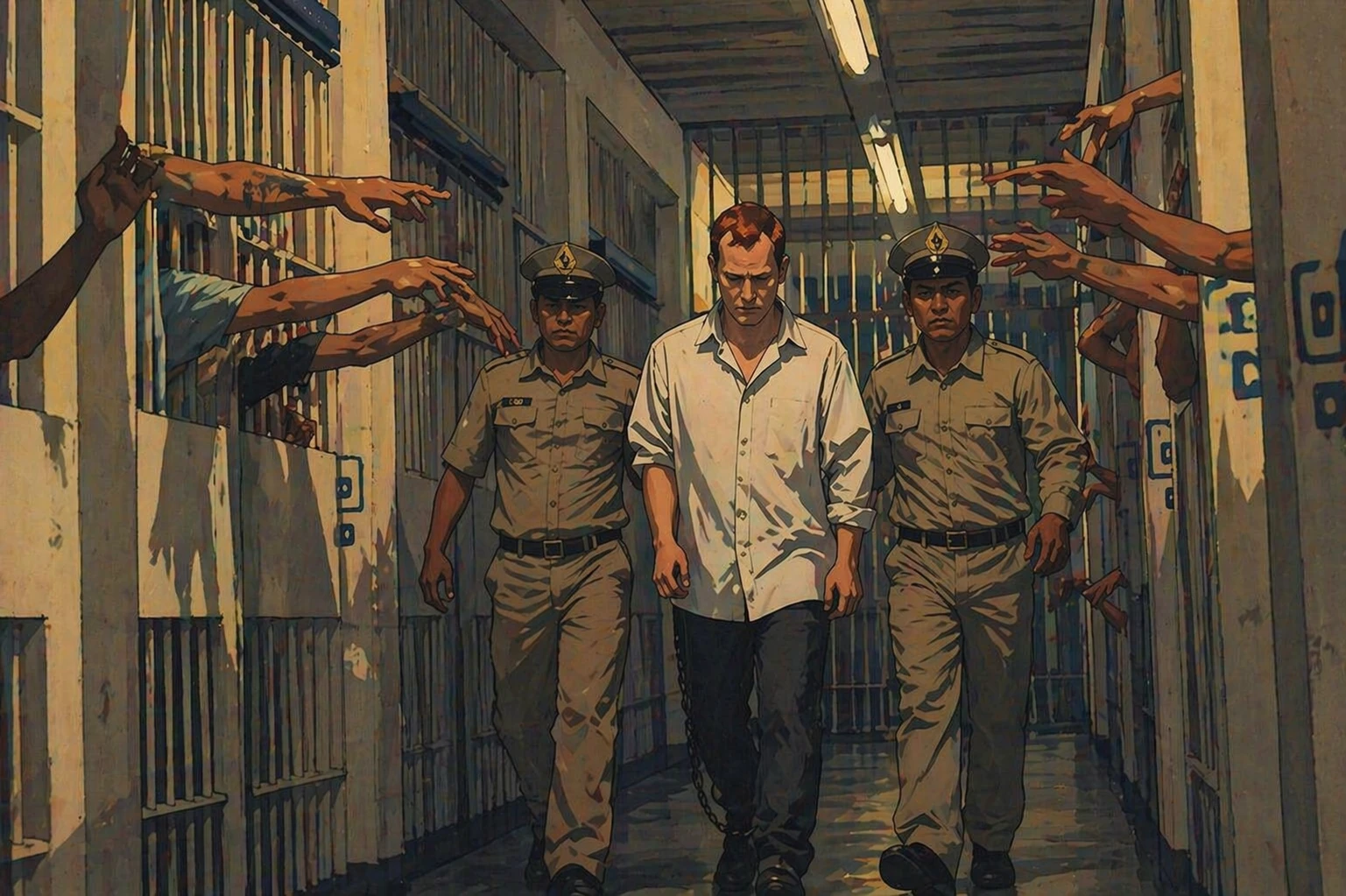
I got arrested in 1994, just as I was about to board a flight out of Thailand. One minute I was through passport control, thinking I’d pulled it off, and the next, it was over. No drama, no chase scene. Just a quiet realization that whatever life I thought I was heading back to had just collapsed into something else entirely.
I’d gone to Thailand for Muay Thai. That was the original plan. I was into martial arts back in England, karate mostly, and I wanted to immerse myself in something more real, more raw. Thailand felt like the place to do it. I stayed longer than I intended, had around fifteen fights, and somewhere along the way, the money started running out.
That’s how these things tend to begin. Not with ambition, but with a slow tightening of options.
A Nepalese friend of mine offered me a run. It didn’t feel like a life defining decision at the time. Just a way to stay a bit longer, make some money, keep things going. The drugs were hidden in my bag, lined with carbon paper to throw off the X rays. It all seemed clever enough. Looking back, I’m convinced we were set up. But that doesn’t really matter. I still said yes.
They caught us just before boarding. That detail sticks with me. If it had been earlier, maybe it would’ve felt less final. But we were already through passport control. That distinction mattered. It turned a bad decision into a very long sentence.
Fifty years.
That’s what they gave me. Fifty years in a Thai prison.
I remember understanding, almost immediately, that this wasn’t something I could fight in the way you imagine fighting things. There was no clever way out. No appeal that was going to fix it. I knew about amnesties and reductions, the way sentences could shift over time, but still, you’re staring at a stretch of life that doesn’t feel measurable anymore.
It’s not time in the normal sense. It’s something heavier.
Oddly enough, I wasn’t crushed by it.
That’s the part people don’t always understand. I didn’t spiral into despair. I think it was because I accepted, very early on, that I’d done it to myself. Once you accept that, there’s no one to rage at. No system to blame, no person to hate.
It is what it is.
And once you get there, the only real question left is: how are you going to live inside it?
The prisons were not the cinematic hellscapes people imagine, but they were not far off either. Conditions were poor. Food was worse. Soupy rice, bits of gristle, maybe some vegetables if you were lucky. You woke up at six, got out of the cell, ate, and then spent the day in a kind of loose, open routine until three in the afternoon.
After that, you were locked in until morning.
That stretch from 3 p.m. to 6 a.m. was the hardest part.
You’re in a room packed with people, sometimes so tight you can’t turn over without bumping into someone. Heat pressing down. Bodies everywhere. Air that doesn’t move. You learn to lie still. You learn not to think too far ahead.
If you had money, things got easier. Not easy, but manageable. My family helped me out, about £100 to £150 a month. That was enough to buy food, water, and basic comforts. I even paid to stay in a better cell early on, twelve of us instead of forty, with a TV and a fan.
It sounds ridiculous, paying for a cell, but that’s how it worked. Money shaped your experience inside.
Without it, it would’ve been a completely different story.
There were these things called banana visits. Tourists would come in, people backpacking through Bangkok who had seen a poster on Khao San Road telling them they could visit inmates. Total strangers. They’d sit across from you behind a wire mesh, asking questions, bringing cigarettes, toothpaste, and food.
Some of them treated it like curiosity. Others just talked to you like a normal person and told you what was happening outside. Those were the ones I appreciated.
It broke the monotony.
I found ways to keep myself together. Martial arts helped. It gave me structure when everything else felt static. I ended up setting up a sort of fighting school inside, teaching other inmates and running sessions. It became popular for a while, until the guards realized they could make money off it and tried to take a cut.
That was another constant. Everything, eventually, became transactional.
Still, it gave me purpose.
You needed that.
Because I saw what happened to people who didn’t have anything to hold onto. A lot of inmates turned to drugs. Not out of recklessness, but out of escape. When you’re trapped in a place like that, anything that dulls the edges becomes tempting.
But it destroyed people.
Overdoses. HIV from shared needles. Men who just gave up entirely.
I had my moments with it too, but I got clean. I saw where it led.
Violence existed, but it wasn’t constant. Not like you might expect. There was one gang, the Samurai. Mostly lifers, often in for murder, heavy drug users, unpredictable. You stayed clear of them. If you kept your head down, didn’t cause problems, you could get by.
And I did.
I made friends. That surprises people. But it’s true. Good people, in a strange way. Thais, Africans, Japanese, Europeans. Prison compresses everything: background, nationality, history. What you’re left with is just people trying to survive the same place.
Time changes in there.
At first, you count it. Days, weeks, months. Then it becomes something else. It stretches. It blurs. Years pass, but they don’t feel like years in the normal sense. They’re marked by routines, by small shifts, by who’s still there and who isn’t.
Eventually, the sentence starts to shrink. Amnesties come through. Reductions. Bit by bit, the impossible number becomes something finite.
Eighteen years, in the end.
When I got out, I wasn’t immediately free. I spent a few weeks in Bangkok Immigration Detention. And I’ll say this: after eighteen years in Thai prison, that place still felt awful. Worse in some ways.
Then I got on a plane.
Landing back in England was strange. Not just good. Strange. The world had moved on. Technology, especially. I went in when mobile phones were a luxury. I came out to iPhones. The speed of everything, the connectivity, it felt like I’d skipped a version of reality.
My dad and stepbrother picked me up at Heathrow.
I remember simple things feeling unfamiliar. Sleeping in a bed. Taking a hot shower. Lighting a cigarette in a pub and being told you couldn’t smoke inside anymore. That one caught me off guard.
I got a job within two weeks.
That was important to me. Moving forward. Not sitting in what had happened. I’d already spent eighteen years dealing with it. There was no point dragging it into the rest of my life.
People ask if I regret it.
Of course I do. But not in the way people think. It’s not this constant weight. It’s more like a clear understanding: that decision cost me eighteen years. That’s the trade. No point pretending otherwise.
But I don’t dwell on it.
Because if there’s one thing prison teaches you, it’s this: if you give up hope in a place like that, you’re done. Completely done.
So I never did.
And that’s probably the only reason I walked out still feeling like myself.