
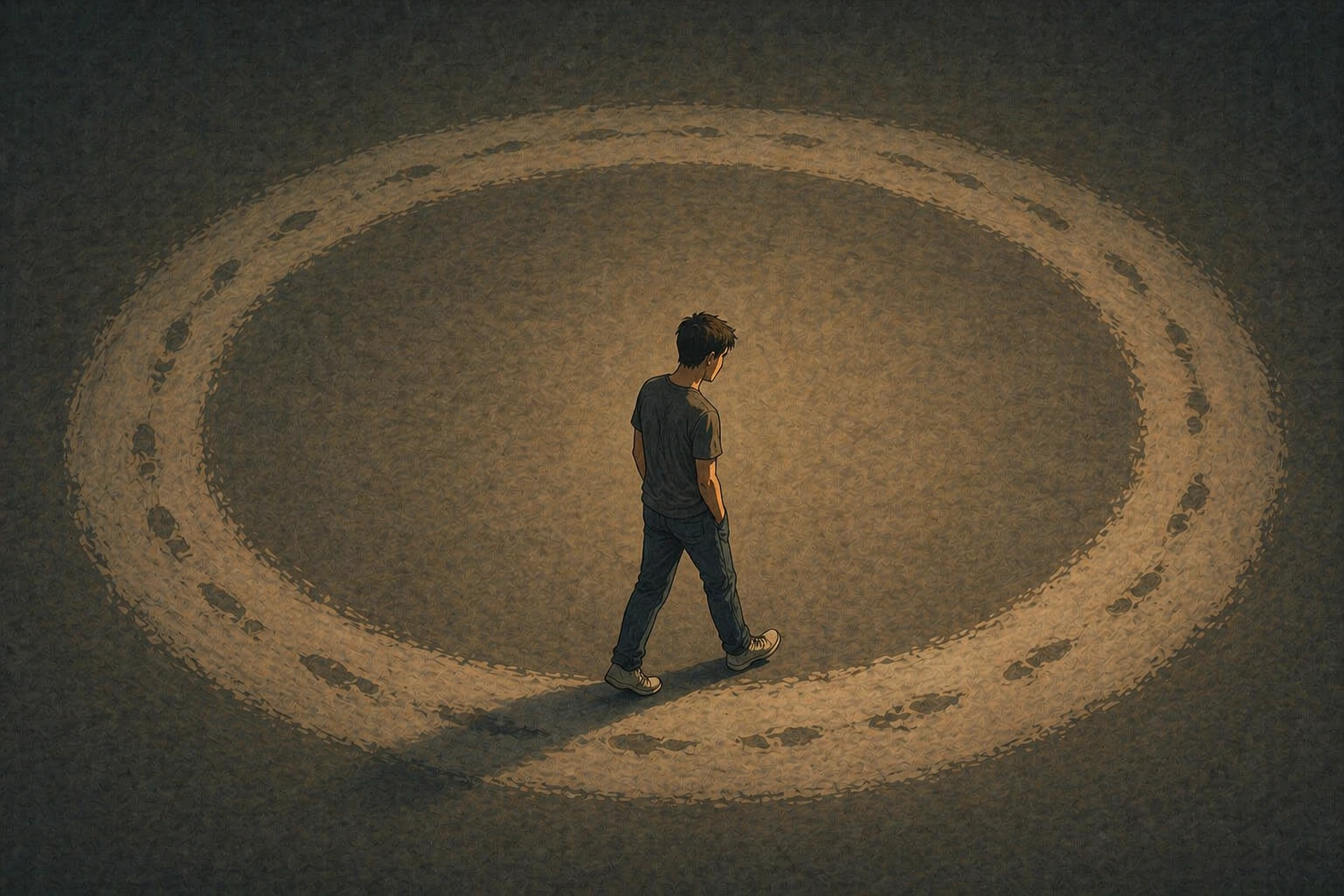
You tell yourself this is the last time.
The last text.
The last visit.
The last “maybe it’ll be different this time.”
And for a while, you believe it.
Then a few days pass. Or a few weeks. The sharp edges of the pain dull just enough. You start remembering the good parts. The laughter. The familiarity. The way it felt before it fell apart.
And before you even fully realize what you’re doing, you’re back.
Same person. Same habit. Same situation.
Same outcome.
Let’s get something straight:
You’re not stupid. You’re not weak. And you’re definitely not the only one doing this.
Humans are wired in a way that makes this almost inevitable.
We don’t chase what’s good for us.
We chase what’s familiar.
Familiarity is powerful. Way more powerful than most people realize.
If you grew up around chaos, calm can feel uncomfortable.
If you’re used to being ignored, healthy attention can feel suspicious.
If you’ve spent years in relationships where love and pain were intertwined, then guess what? Your brain starts to file that combination under “normal.”
So when something healthier shows up, something stable, consistent, and actually good for you, it doesn’t always feel right.
It feels off.
Boring. Even.
And that’s where things get twisted.
Because the thing that hurts you?
It feels right.
Not because it is right.
But because it matches what your brain has practiced over and over again.
So you go back.
Not because you enjoy the pain.
But because your nervous system recognizes the pattern.
It knows how to operate there.
There’s another layer to this too, and it’s not flattering.
Sometimes, going back is easier than facing the alternative.
Because walking away doesn’t just mean losing something.
It means sitting with:
Loneliness
Uncertainty
Self doubt
The uncomfortable question of what now?
And for a lot of people, that question is more terrifying than the pain they already know.
At least the pain is predictable.
At least it’s familiar.
At least it gives you something to hold onto, even if that something is slowly wrecking you.
Then there’s hope.
Hope is sneaky.
You tell yourself:
Maybe they’ve changed.
Maybe this time will be different.
Maybe I overreacted.
Hope convinces you to rewrite the past.
You minimize what happened.
You explain away red flags.
You cherry pick the good moments and inflate them into something bigger than they actually were.
And just like that, you’ve built a story that makes going back feel reasonable.
Even logical.
But here’s the hard truth:
If nothing has fundamentally changed, then nothing is going to fundamentally change.
Not the dynamic.
Not the outcome.
Not the way it makes you feel.
You can’t out hope a pattern.
So what actually breaks the cycle?
Not willpower.
Not motivation.
Not another promise to yourself that this time is different.
What breaks the cycle is something much less exciting:
Awareness and tolerance.
Awareness means you see the pattern clearly. No excuses. No romanticizing. No mental gymnastics.
Tolerance means you learn to sit with the discomfort of not going back.
The silence.
The boredom.
The loneliness.
The urge.
Because here’s the part nobody likes to talk about:
Walking away from what hurts you often feels worse before it feels better.
That’s the price.
Most people think the goal is to stop wanting the thing.
It’s not.
You might still want it for a while.
The goal is to stop acting on that want.
To let the urge pass without feeding it.
To choose a different action, even when it feels wrong.
Especially when it feels wrong.
And slowly, very slowly, something shifts.
The thing that used to feel irresistible starts to lose its pull.
The chaos stops feeling like home.
The quiet stops feeling like a threat.
You don’t become a completely different person.
You just become someone who doesn’t need that particular kind of pain anymore.
Because at the end of the day, this isn’t really about them.
It’s about you.
It’s about what you’re willing to accept.
What you believe you deserve.
What you’re afraid to let go of.
And until those things change, the pattern will keep repeating.
Different face. Same story.
So if you’re stuck in that loop right now, here’s something to sit with:
You don’t go back because it’s good.
You go back because it’s familiar.
And familiarity can be unlearned.
But only if you’re willing to sit through the part where everything feels uncomfortable, uncertain, and unfinished.
No shortcuts. No clean exits.
Just you, choosing differently, one uncomfortable decision at a time.