
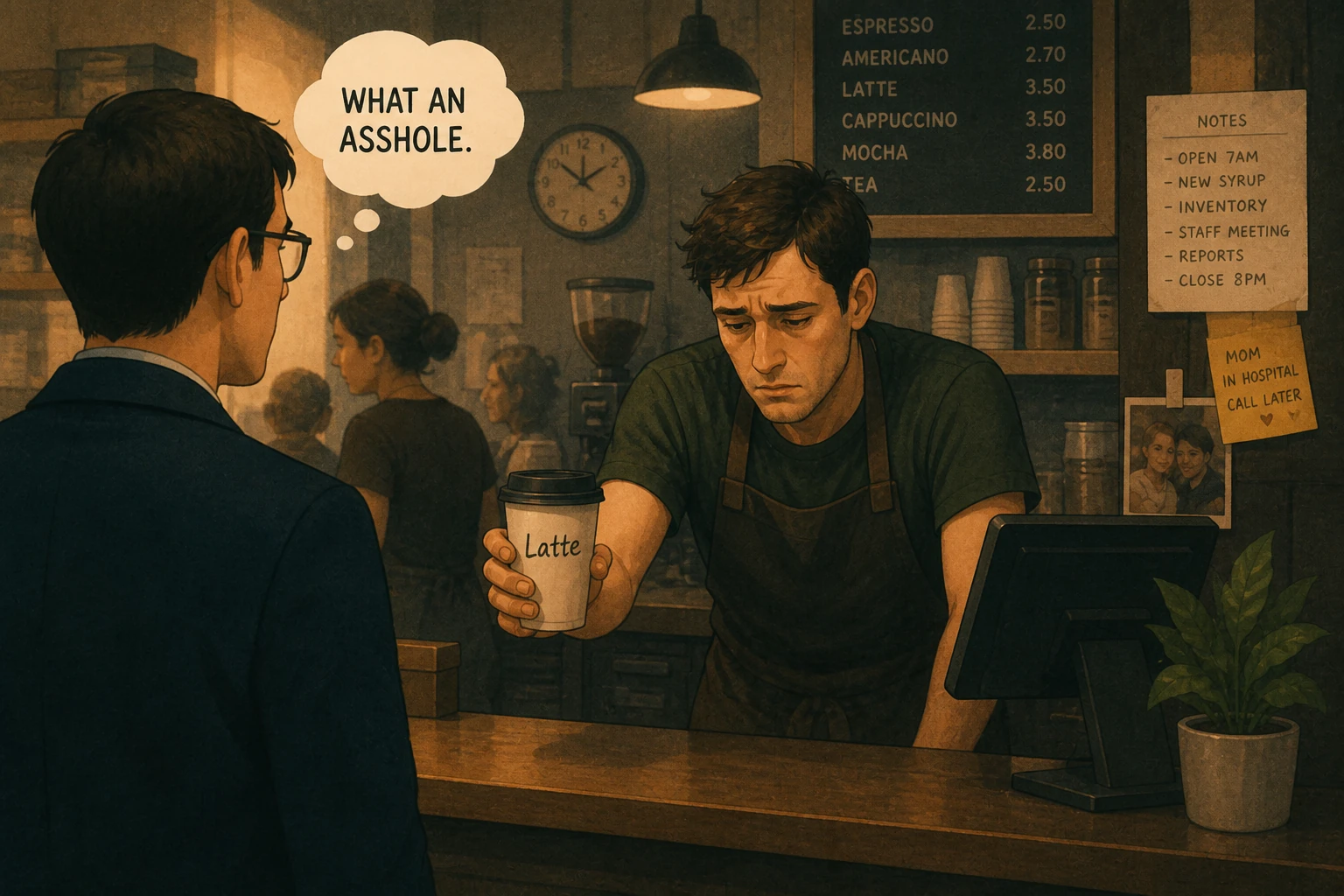
You walk into a coffee shop. The guy behind the counter barely looks at you, mutters something, and hands you your drink like it personally offended him.
Your immediate thought: What an asshole.
You don’t think: Maybe he’s been on his feet for 9 hours, got yelled at by his manager, and just found out his girlfriend is cheating on him.
No. He’s just an asshole. Case closed.
That, right there, is the Fundamental Attribution Error. And you do it all the time.
The Shortcut Your Brain Can’t Stop Taking
The Fundamental Attribution Error is your brain’s lazy habit of blaming people’s behavior on their personality while ignoring the situation they’re in.
Someone cuts you off in traffic?
They’re reckless. Selfish. Probably a bad person.
You cut someone off?
Hey, relax—you didn’t see them. You’re late. It was an honest mistake.
Same behavior. Two completely different explanations.
One is character.
The other is context.
And guess which one you reserve for yourself?
You’re the Hero. Everyone Else Is the Villain.
Here’s the uncomfortable truth: you experience your own life from the inside, but everyone else from the outside.
You know your intentions.
You know your stress.
You know your bad day.
But other people? All you see is what they did.
So your brain fills in the blanks with something simple and satisfying:
“They’re just that kind of person.”
It’s neat. It’s clean. It’s usually wrong.
Why This Makes You Terrible at Reading People
This mental shortcut doesn’t just make you judgmental—it makes you inaccurate.
You think you’re sizing people up.
You think you “read people well.”
You think you’ve got good instincts.
But what you’re often doing is confusing a moment for a personality.
One rude comment becomes “they’re rude.”
One mistake becomes “they’re incompetent.”
One bad interaction becomes “they’re toxic.”
Meanwhile, your own screw-ups get a full courtroom defense with evidence, witnesses, and a closing argument.
The Double Standard You Don’t Notice
You:
- Miss a deadline → “I’ve been overwhelmed.”
- Snap at someone → “I’m just stressed.”
- Forget something → “It’s been a crazy week.”
Other people:
- Miss a deadline → “They’re unreliable.”
- Snap at you → “They’re disrespectful.”
- Forget something → “They don’t care.”
Same behaviors. Totally different stories.
And the worst part? You don’t even notice you’re doing it.
Why Your Brain Does This
Your brain loves efficiency more than it loves truth.
Figuring out someone’s situation takes effort:
- You’d have to ask questions
- Consider possibilities
- Admit you might be wrong
That’s exhausting.
So instead, your brain goes with the easiest answer:
“This is just who they are.”
It’s quick. It feels right. It keeps your worldview intact.
And it quietly makes you worse at understanding people.
How This Screws Up Your Life
This isn’t just some quirky psychological bias. It messes with your relationships in very real ways:
- You hold grudges over things that had nothing to do with you
- You misjudge people and push away good ones
- You escalate conflicts because you assume intent instead of circumstance
- You become less empathetic without realizing it
You start living in a world full of “bad people,” when in reality, you’re just surrounded by humans having messy, complicated days.
The Slightly Uncomfortable Fix
You’re not going to eliminate this bias. Your brain doesn’t work that way.
But you can interrupt it.
Next time someone does something that annoys you, pause and ask:
“What’s another possible explanation for this?”
That’s it. Not a full psychological deep dive. Just one alternative story.
Maybe they’re tired.
Maybe they’re distracted.
Maybe they’re dealing with something you can’t see.
You don’t have to excuse bad behavior. You just have to stop pretending your first judgment is the truth.
The Bottom Line
You’re not nearly as good at judging people as you think you are.
You see a snapshot and assume it’s the whole movie.
You judge others by their actions and yourself by your intentions.
You mistake convenience for accuracy.
And once you realize that, something shifts.
You get a little less certain.
A little more curious.
A little less quick to label someone as “just that kind of person.”
And ironically, that’s when you actually start understanding people better.
Not because you became smarter.
But because you finally admitted you were wrong.