
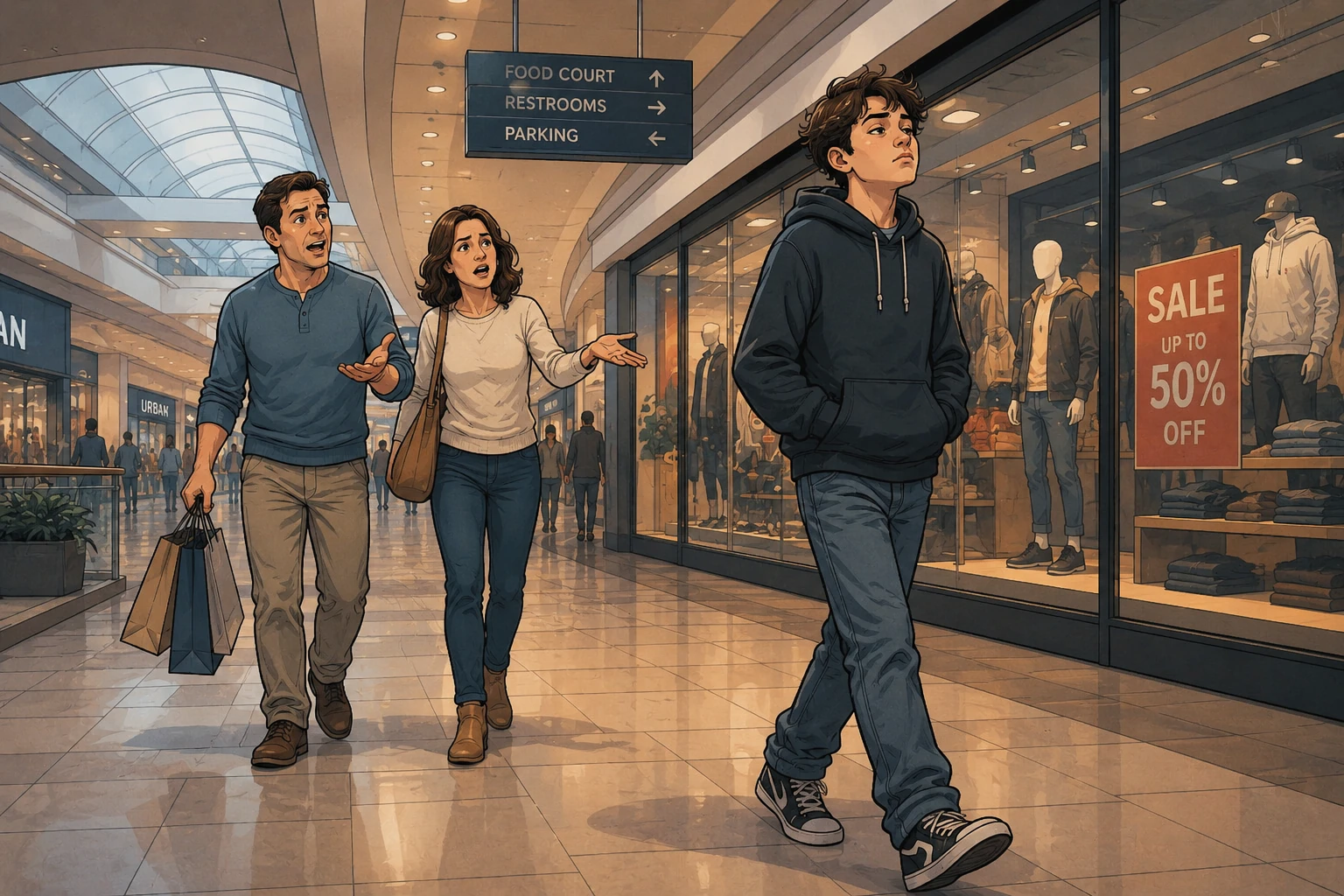
There’s a moment that happens in a lot of families that feels weirdly universal.
A teenager who used to happily wave at you in public suddenly pretends not to know you at the mall. You pick them up from school and they ask you to park “like… way over there.” You crack a joke in front of their friends and they look at you like you just detonated a bomb in the middle of their social life.
And if you’re a parent, it can feel personal.
You think: What happened to my sweet kid?
But the truth is, most teenagers aren’t trying to reject their parents. They’re trying to survive something that feels enormously important to them: the social ecosystem of adolescence.
Because being “cool” as a teenager is rarely about confidence. It’s usually about fear.
Fear of embarrassment.
Fear of exclusion.
Fear of becoming the kid who gets laughed at instead of accepted.
Teenagers exist in an environment where social standing feels like life or death. Adults tend to underestimate this because we know, intellectually, that high school popularity usually means almost nothing long term. But when you’re 15 years old, your social world is your world. Your friends, your classmates, the group chat, the lunch table — that’s the entire universe.
And in that universe, parents represent something dangerous: childhood.
Teenagers are in this awkward evolutionary stage where they desperately want independence, but they don’t fully have it yet. So they start performing adulthood before they actually understand it. That performance often looks like emotional distance, sarcasm, eye-rolling, or acting too cool for things they secretly still enjoy.
You’ll notice this in how teenagers suddenly abandon things they loved six months earlier. Music changes. Clothes change. Interests change overnight. Not always because they genuinely evolved, but because they’re trying to calibrate themselves against the social expectations around them.
A teenager might still love their goofy dad. They just don’t want their friends seeing them hug him in public because their brain interprets that as social risk.
And adolescence is basically one long experiment in minimizing social risk.
This is also why teenagers often behave completely differently around their friends than they do at home. Parents sometimes interpret this as “fake,” but it’s more accurate to say teenagers are trying on identities. They’re experimenting. Testing versions of themselves. Seeing which personalities get rewarded socially.
That’s part of growing up.
The problem is that teenagers often confuse detachment with maturity.
They think acting uninterested makes them sophisticated. They think caring less makes them look stronger. They think irony is safer than sincerity. That’s why so many teenagers default to sarcasm or apathy. If everything is “cringe,” then nothing can hurt you.
Adults do this too, by the way. Teenagers are just less subtle about it.
What’s funny is that many teenagers eventually circle back around. The kid embarrassed by their parents at 16 often becomes the 28-year-old who suddenly realizes their dad is hilarious or their mom was actually right about a lot of things.
Because adulthood changes the equation.
Once people stop organizing their entire identity around peer approval, they usually become softer. More honest. More themselves.
A lot of parents worry when their teenager becomes distant or embarrassed by them. And yes, sometimes there are deeper relational problems. But often? It’s just development. Clumsy, awkward, emotionally confusing development.
Teenagers are trying to answer one of the hardest questions humans ever face:
Who am I when other people are watching?
Unfortunately, figuring that out sometimes means acting like your parents are the least cool people on Earth.
Even when, deep down, they still need you more than they’ll ever admit.