
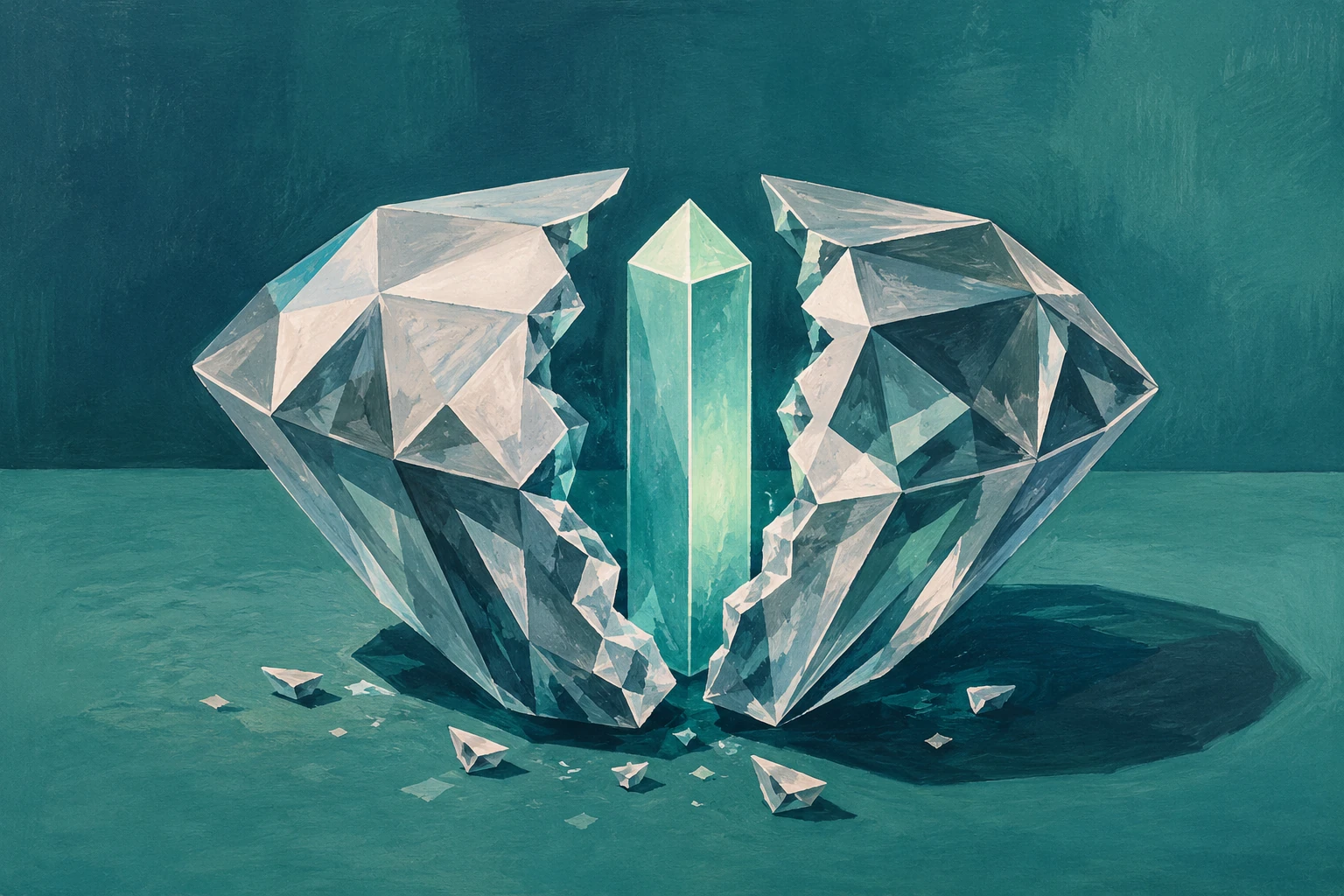
There’s a pretty significant shake-up happening in the diamond industry right now, especially in natural diamonds. “Reckoning” honestly isn’t an exaggeration.
The biggest issue is that the old diamond business model depended on three things staying true:
- Diamonds are rare
- Diamonds hold value
- Consumers emotionally care whether a diamond came from the earth
All three are getting challenged at the same time.
Lab-Grown Diamonds Changed the Game
Lab-grown diamonds are chemically and visually almost identical to mined diamonds, but they’re dramatically cheaper. Prices have collapsed over the last several years because production scaled up fast.
That’s crushing the economics of natural diamonds in mainstream categories like engagement rings.
For younger buyers, the equation often becomes:
“Why pay $8,000 for a mined 2-carat when I can get a visually identical lab-grown one for $1,500?”
That’s a very hard consumer argument to fight.
Natural Diamond Prices Are Falling Hard
Natural diamond prices have dropped substantially since the pandemic-era luxury boom peaked around 2022. Multiple industry trackers show steep declines in both rough and polished diamond pricing.
That’s especially brutal because diamonds were long marketed almost like a “store of value.” A lot of consumers are now discovering resale prices are nowhere near what they expected.
De Beers Is Struggling
This is maybe the biggest symbolic sign.
De Beers helped create the modern diamond market with campaigns like “A Diamond Is Forever.” For decades, they controlled supply and pricing psychology.
Now even they are cutting prices and dealing with weak demand.
Their parent company, Anglo American, has repeatedly written down De Beers’ value by billions of dollars and has explored exiting or restructuring ownership.
That would’ve sounded insane 15 years ago.
Younger Consumers Think Differently
There’s also a cultural shift happening.
Millennials and Gen Z are generally less attached to the “must spend three months’ salary” idea. They’re more skeptical of luxury markups, less convinced mined diamonds are ethically superior, more comfortable with alternatives, and often more interested in size and value than geological rarity.
At the same time, marriage rates are changing, luxury spending has softened in key markets like China, and more people are questioning whether diamonds were ever really investments in the first place.
But Natural Diamonds Probably Won’t Disappear
What’s more likely is a split market.
Natural diamonds may become more like luxury wine, mechanical watches, art, or rare collectibles.
Meaning: exceptional, rare stones still retain prestige. Commodity-grade diamonds get hammered by lab-grown competition.
The middle of the market is where the pain is worst.
A flawless giant blue natural diamond still has mystique. A standard 1.2-carat engagement ring? Much harder to justify at traditional prices now.
So the industry isn’t dead. But the old illusion of scarcity and automatic appreciation has definitely cracked.
The internet, resale transparency, and lab-grown technology basically pulled back the curtain on how much of diamond value was psychological and marketing-driven in the first place.