
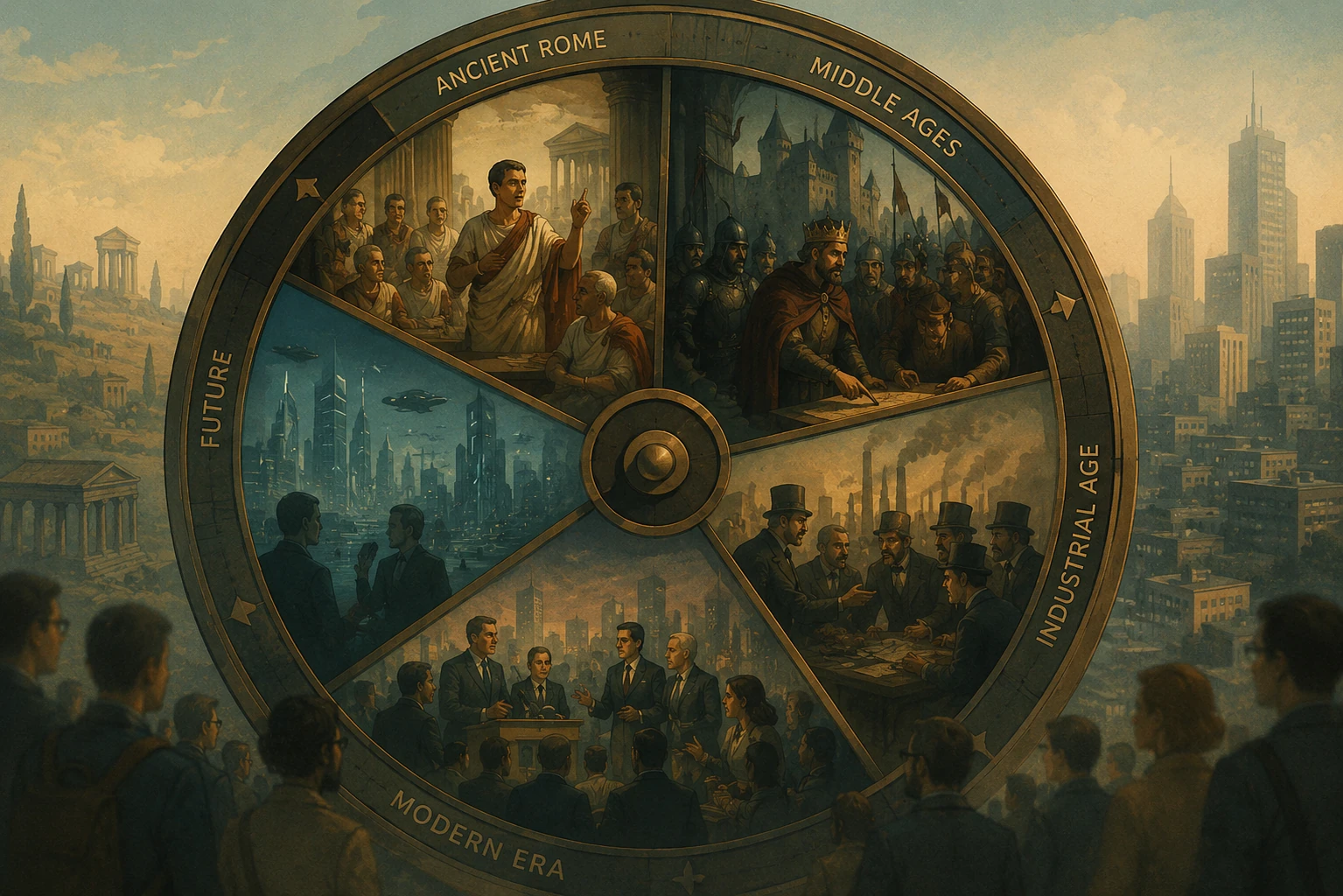
One of the most frustrating things about studying history is discovering how familiar it feels.
The names change. The maps change. The weapons, currencies, and technologies all evolve. Yet the underlying story often feels strangely recognizable.
A society becomes wealthy and powerful. Confidence grows. Success begins to feel permanent. Warnings are ignored. Problems that once seemed manageable become crises. Leaders make decisions that look reckless in hindsight. The public becomes divided. Institutions weaken. Eventually something breaks.
Then, years later, another society follows a remarkably similar path.
This has happened so many times that people have turned it into a cliché: history repeats itself.
But history doesn’t really repeat itself. Human beings do.
The greatest misconception about progress is that it changes human nature. It doesn’t. Progress changes the environment in which human nature operates.
The Romans worried about political corruption. Medieval kingdoms struggled with misinformation and rumor. Ancient rulers dealt with economic crises, immigration disputes, populist movements, and public distrust of elites.
Modern societies often treat these problems as uniquely contemporary. A historian sees something different. They see old problems wearing new clothes.
The reason history feels repetitive is that the motivations driving human behavior have remained remarkably stable.
People still seek status.
They still fear uncertainty.
They still divide themselves into groups.
They still reward confidence, even when confidence is misplaced.
They still struggle to balance short-term desires against long-term consequences.
Civilizations may become more sophisticated, but the human operating system underneath remains largely unchanged.
Success Can Create Its Own Problems
One of the most common historical patterns involves success itself.
A generation builds something through discipline, sacrifice, and hard choices. Their efforts create stability and prosperity. The next generation inherits those achievements.
Over time, however, prosperity changes people’s relationship with risk.
The memory of hardship fades.
The lessons learned through struggle become abstract.
Warnings that once carried enormous weight begin to sound old-fashioned.
This is not because people become foolish. It is because success alters perspective.
A person who has never experienced a financial collapse views debt differently than someone who lived through one. A society that has enjoyed decades of peace often thinks differently about conflict than one that remembers war firsthand.
The very success created by previous generations can make later generations less prepared for future challenges.
This pattern appears repeatedly throughout history because it is rooted in human psychology rather than politics or economics.
People naturally adapt to their circumstances. What once felt extraordinary eventually feels normal.
That adaptation is one of humanity’s greatest strengths.
It is also one of its greatest vulnerabilities.
Societies Forget Faster Than People Do
Another reason history appears to repeat itself is that collective memory is surprisingly short.
Individuals remember.
Societies forget.
The people who survive a crisis often carry its lessons for the rest of their lives. But as decades pass, those lessons become stories, then historical facts, and eventually distant memories.
Knowledge survives. Urgency does not.
A financial panic becomes a chapter in a textbook.
A war becomes a documentary.
A political catastrophe becomes something students memorize for an exam.
Future generations understand the events intellectually but rarely feel them emotionally.
That emotional distance matters.
Many historical mistakes seem obvious only because we already know the ending. The people living through those moments did not.
Most believed they were acting rationally.
Most thought they were making decisions appropriate for their circumstances.
Very few civilizations wake up one morning and decide to decline. They simply continue making choices that seem reasonable in the moment.
Only later do those choices form a pattern.
The Past Is a Mirror
Perhaps that is the most important lesson history offers.
The people who came before us were not fundamentally different from us. They were not uniquely wise, nor uniquely foolish. They operated with limited information, competing interests, personal ambitions, and imperfect institutions.
Just like everyone today.
History is valuable not because it predicts the future. It doesn’t.
What it does provide is perspective.
It reminds us that many of the challenges we face have appeared before in one form or another. It shows how easily confidence can become complacency, how prosperity can create blind spots, and how quickly societies can convince themselves that old rules no longer apply.
The past rarely tells us exactly what will happen next.
What it does reveal is the range of things human beings are capable of doing—both good and bad.
And after several thousand years of recorded history, that range remains remarkably consistent.
That is why history seems to repeat itself.
The events are new.
The people are new.
But the impulses driving them are often the same ones that have been shaping human affairs since the first civilizations began recording their stories.