
For most of my life, I assumed everyone experienced memory the way I did.
When teachers gave us tests in elementary school, I genuinely didn’t understand the point. Why not just remember the textbook? Why not pull up the page in your head and read the answer?
I wasn’t trying to be smart. I thought that was how memory worked.
It wasn’t until I was around eight years old that I started realizing other people struggled to remember things I’d consider obvious. Then, when I was twelve, I had a conversation with my twin sister that completely changed how I viewed my own mind.
We’re fraternal twins, and while she has an incredible imagination, her memory is pretty normal. We were talking about a book we’d both read in school, and I couldn’t understand how she had mixed up parts of the story with the movie adaptation we’d watched years earlier.
To me, they were completely separate things. I could replay both versions in my head whenever I wanted.
That’s when she explained that she couldn’t do that.
I remember sitting there stunned.
People couldn’t just mentally pull up everything they’d read?
Apparently not.
The closest description for what I experience is probably hyperphantasia mixed with an unusually strong memory. “Photographic memory” isn’t technically the correct term, but it’s the easiest shorthand.
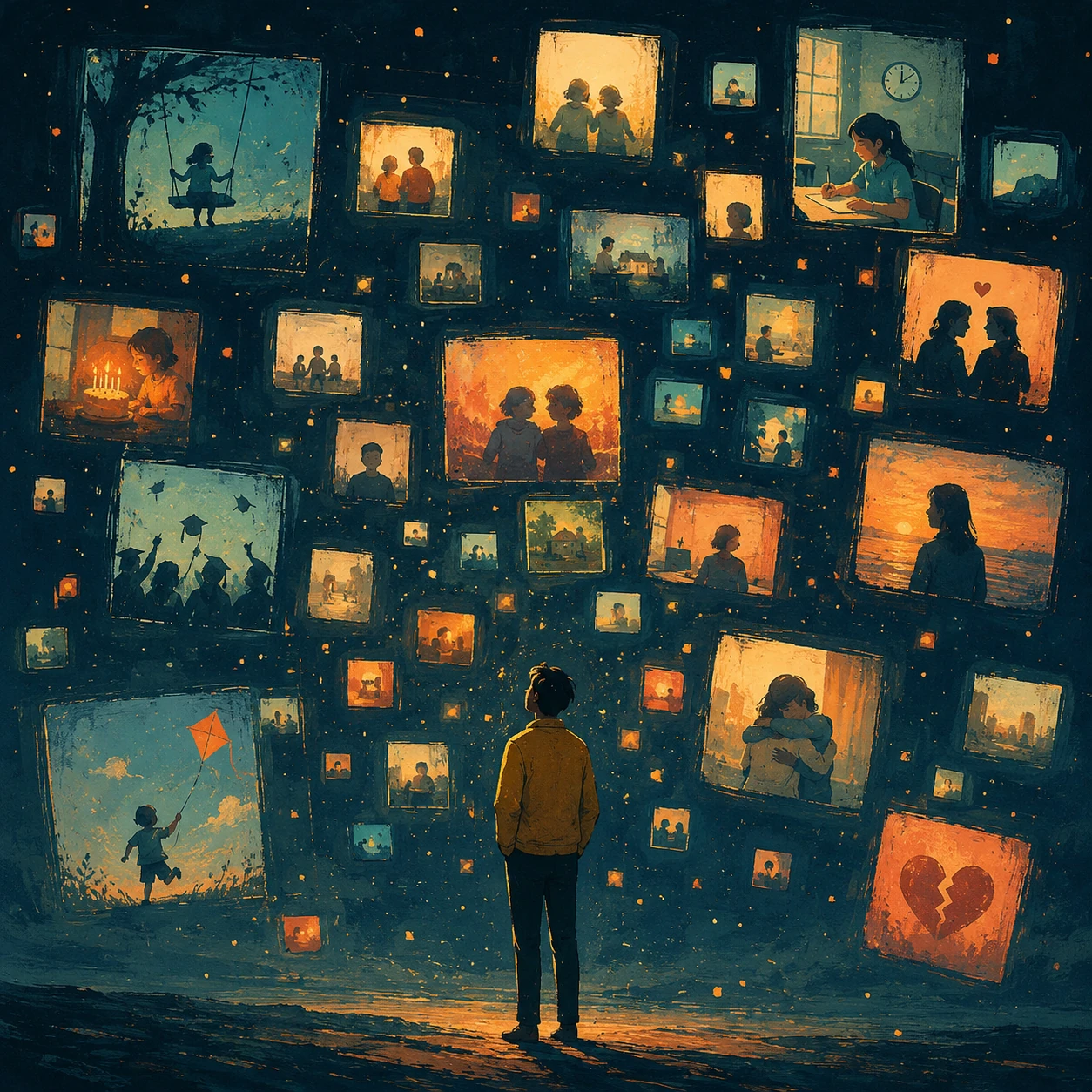
When I remember something, I’m not recalling a list of facts. I’m reliving it.
A memory isn’t a paragraph in a notebook. It’s a movie.
Sometimes it’s more than a movie.
I can remember the sights, sounds, emotions, physical sensations, and even smells associated with an experience. If I think about a conversation from years ago, I can often place myself back in the room where it happened. I remember where people were sitting. I remember the lighting. I remember how I felt.
The good memories are wonderful.
The bad memories are another story.
People often ask whether having a memory like this is a gift.
It is.
They also rarely ask whether it’s a burden.
It absolutely is.
When I was five years old, something happened that caused my entire school district to go into lockdown. My class was locked inside a storage closet for hours.
Most of the kids who were there barely remember it today. Some don’t remember it at all.
I remember everything.
The fear.
The confusion.
The feeling of being trapped.
The way the room looked.
The way it smelled.
For years I would bring it up to classmates and be shocked by how little they remembered. It was one of the first times I realized that memory isn’t shared equally. Two people can experience the exact same event and carry away completely different versions of it.
That’s something I’ve seen repeatedly throughout my life.
People forget arguments.
People forget promises.
People forget heartbreaks.
I don’t.
Or at least I don’t forget them as easily.
The hardest part isn’t remembering facts. It’s remembering feelings.
A few years ago, I went through a painful breakup. While most people slowly lose access to the emotional texture of old relationships, I could replay entire moments almost perfectly. I could remember the feeling of holding someone’s hand. The sound of their voice. The emotions attached to specific days.
It’s like having an emotional time machine that you can’t always turn off.
People imagine that perfect memory would make life easier.
Sometimes it does.
College, for example, feels almost unfair.
When I study, I can often picture pages from textbooks in my head. During exams, I can mentally revisit sections I’ve read and retrieve information directly from memory. I’ve memorized pages simply by reading them carefully.
I scored well on standardized tests.
Languages come naturally to me.
Math was often easy because I could hold multiple pieces of information in my head at once.
Ironically, I also have ADHD.
People assume a great memory means effortless focus, but they’re completely different things.
My memory only works at its best when I’m actually paying attention. If something doesn’t interest me, I struggle just like anyone else. Sometimes more.
That’s one reason I don’t see memory as intelligence.
They’re related, but they’re not the same thing.
I’ve met people with average memories who are far smarter than I am.
One thing my memory does make easier is debate.
Unfortunately, I learned that lesson a little too well.
When I was twelve, I got into an argument with a teacher at Hebrew school. The discussion turned into a full-scale debate about religion, and I started quoting Bible verses that I’d memorized.
Not the comforting ones.
The weird ones.
The disturbing ones.
The ones that tend not to appear on inspirational posters.
The conversation escalated quickly.
I was eventually expelled.
To this day, I still don’t regret it.
One of the strangest aspects of my mind isn’t the memory itself. It’s visualization.
I can construct entire environments in my head.
Cities.
Forests.
Fantasy worlds.
Sometimes they’re inspired by books or games. Sometimes they’re completely original.
I don’t see them with my eyes. They’re not hallucinations.
They’re more like a second visual space that exists entirely inside my mind.
For me, imagination feels almost physical.
What’s fascinating is that my twin sister can visualize nearly as well as I can, but her memory isn’t remotely the same. That’s one reason I’ve become convinced that visualization and memory are connected but not identical.
You can be imaginative without remembering everything.
You can remember things without being imaginative.
The overlap just happens to be strong in my case.
The experience becomes even stranger when I talk to people who have aphantasia—the inability to create mental images.
Some people literally see nothing when they close their eyes.
No pictures.
No scenes.
No faces.
Just darkness.
The first time I learned that, I felt like I was discovering an entirely different species of human consciousness.
How do you think without pictures?
Apparently they do.
And they ask me the opposite question.
How do you think with them?
The truth is that neither of us can fully understand the other’s experience.
We’re all trapped inside our own minds.
We assume everyone else’s works the same way.
Then one conversation comes along and reveals that what feels universal is actually unique.
Despite everything, I wouldn’t trade my memory away.
There are days when I wish painful memories weren’t so vivid.
There are moments when I wish embarrassing experiences would finally fade.
There are times when I’d love to forget.
But memory isn’t just a storage system.
It’s part of who I am.
The same ability that lets me relive trauma also lets me revisit some of the happiest moments of my life. I can return to childhood memories that other people lost years ago. I can revisit places that no longer exist. I can replay conversations with people who are gone.
Most memories eventually become blurry photographs.
Mine stay closer to films.
And while that can be exhausting, it also means I’ve never really stopped carrying the people and experiences I love with me.
They’re all still there.
Waiting to be replayed.