
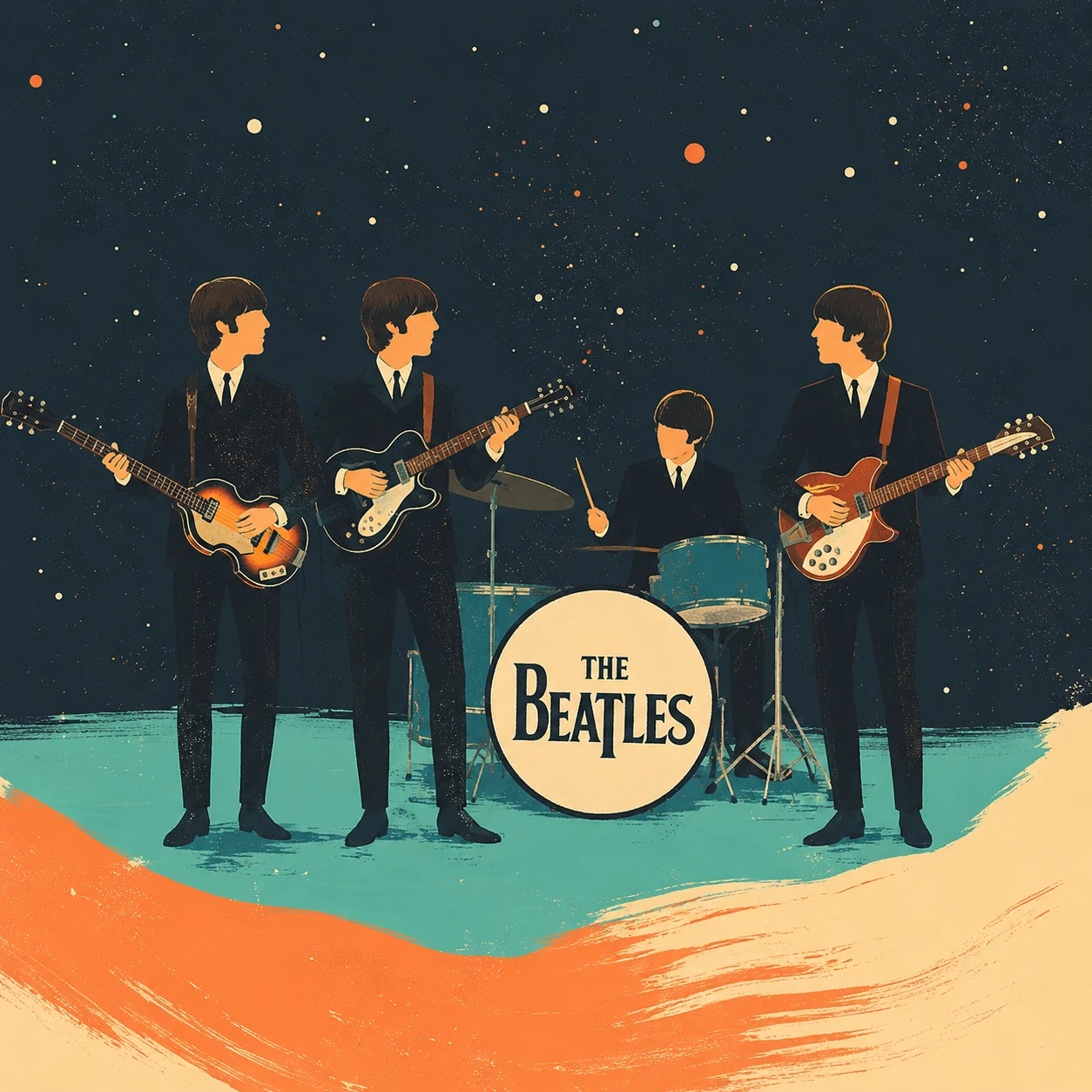
To understand why The Beatles were revolutionary, it helps to remember what popular music sounded like before they arrived.
Listen to many of the biggest hits from the late 1950s and early 1960s and you’ll hear talented singers performing polished, carefully controlled songs. The music was professional, clean, and often designed to appeal to the broadest possible audience. Even early rock and roll had begun to lose some of its danger as record labels searched for safer, more marketable acts.
Then The Beatles showed up.
What strikes modern listeners isn’t necessarily how different they sound from today’s artists. It’s how different they sounded from their contemporaries. Compared to much of the music on the radio, The Beatles sounded younger, rougher, and far less concerned with behaving themselves. They weren’t polished crooners. They sounded like four friends who had spent years playing noisy clubs and somehow carried that energy into the recording studio.
Even their accents stood out. At a time when many performers softened or concealed their regional backgrounds, John, Paul, George, and Ringo sounded unmistakably like working-class kids from Liverpool. They weren’t trying to imitate sophistication. They were bringing their own world into popular music.
Their appearance mattered too.
It’s difficult to appreciate today, but their haircuts were controversial. To adults in the early 1960s, The Beatles looked rebellious. They occupied a strange space between masculine and feminine at a time when cultural expectations were far more rigid. Parents worried. Teenagers loved them. The generation gap suddenly had a soundtrack.
Musically, The Beatles were drawing from sources that many mainstream listeners had barely encountered. They were obsessed with American rock and roll, rhythm and blues, and soul music. Artists like Little Richard, Chuck Berry, and the Isley Brothers shaped their sound. While those influences are obvious now, they were far less familiar to many white audiences at the time.
The Beatles didn’t invent those styles. What they did was bring them to millions of people.
Just as important was their songwriting.
Before The Beatles, it was common for performers to sing songs written by professional songwriters. The Beatles helped popularize the idea that a band should write its own material. The Lennon-McCartney partnership produced hit after hit, proving that musicians could be both performers and creators.
That helped establish a new standard for authenticity in popular music, one that still exists today.
But perhaps their greatest contribution was their refusal to stand still.
Most successful artists find a formula and repeat it. The Beatles seemed determined to abandon every formula as soon as it worked. Their music evolved at a staggering pace. Compare their early recordings to what they were creating just a few years later and it feels like the work of entirely different bands.
Albums such as Rubber Soul, Revolver, and Sgt. Pepper’s Lonely Hearts Club Band expanded the possibilities of what popular music could be. Listeners began hearing backwards guitar parts, tape loops, manipulated voices, Indian instruments, orchestral arrangements, and sounds that seemed to come from another world entirely.
What’s remarkable is that The Beatles didn’t invent most of these techniques.
Experimental composers and avant-garde musicians had been exploring many of these ideas for years. The difference was that hardly anyone heard those artists. When The Beatles incorporated similar ideas into their music, millions of people listened.
That may be their most important legacy.
The Beatles acted as a bridge between the underground and the mainstream. They took ideas that existed on the fringes of culture and introduced them to ordinary listeners. Once The Beatles embraced a new sound or technique, countless other musicians followed.
Their influence spread so widely that it became almost invisible. Modern listeners hear echoes of The Beatles everywhere because generations of artists borrowed from them. In many ways, The Beatles became the blueprint for what a modern band could be: self-contained songwriters, ambitious recording artists, cultural trendsetters, and restless innovators.
The Beatles didn’t invent rock music. They didn’t invent the recording studio. They didn’t invent experimentation.
What they did was convince the world that all of those things could exist together in popular music. They changed what audiences expected from artists, what artists expected from themselves, and what the music industry believed was possible.