
For people who have no idea what a saturation diver is, what do you actually do?
We work on underwater oil and gas infrastructure. We live in a pressurized chamber on a ship and every day we’re transferred to the seafloor in a diving bell. Most of my work involves connecting pipelines and heavy construction underwater.
So you don’t actually live on the ocean floor for a month?
No. That’s probably the biggest misconception. We live in chambers on the ship. The diving bell takes us down to work for about six hours a day and then brings us back up.
What exactly does “saturation” mean?
Right now your body is saturated at one atmosphere. Ours becomes saturated at much higher pressures. Once your tissues absorb all the gas they can, you can stay at that pressure indefinitely. The trick is that you can’t just come back to the surface. You have to decompress very slowly.
How long are you down there?
Usually 28 days at a time. Out of those 28 days, maybe 15 to 23 are actual diving days. The rest can be weather delays and decompression.
What does it feel like to work 650 feet underwater?
It’s not the place to be if you’re claustrophobic. The chamber is small. The diving bell is even smaller. Then you put on a helmet and work in total darkness. I’ve done jobs where I never saw a thing and did everything entirely by feel.
Is it dangerous?
Much safer than it used to be. A lot of divers died in the early days. Safety regulations are extremely strict now. But if something goes wrong, you’re in trouble because you can’t just leave. There is no emergency ascent.
What’s the scariest thing that can happen?
Losing the diving bell. If we lost the bell, it would likely be a slow death from exposure. That’s the nightmare scenario.
Have you ever had a moment where you thought, “This is it”?
Nothing that serious personally, but everyone in the industry knows the horror stories. Explosive decompression is one of them. In the old days there were accidents that killed people instantly.
What’s the weirdest thing you’ve seen down there?
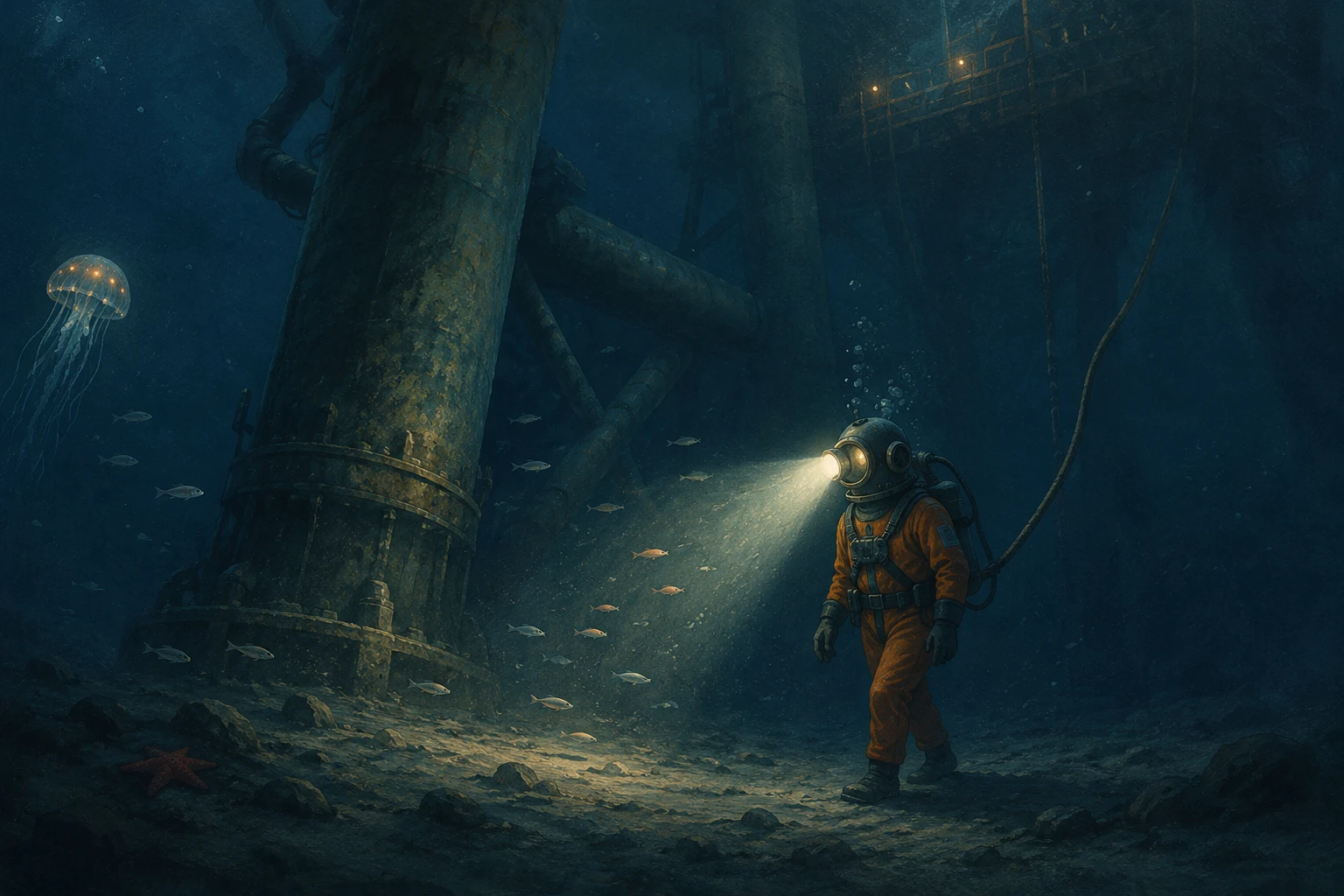
A giant jellyfish the size of a beach ball with lights glowing inside it.
Anything ever sneak up on you?
A seal bumped into me at about 200 meters. That scared the hell out of me because I didn’t even know seals could dive that deep.
That’s surprisingly wholesome.
The conger eel that grabbed my leg wasn’t quite as wholesome.
Wait. What?
I was working under a pipeline and felt something grab my leg. I assumed it was the other diver messing with me. Then I came out from under the pipe and realized he was back at the bell. Turns out it was probably a giant conger eel.
Do sharks bother you?
Not really. There are sharks around, but they mostly ignore us. There’s so much noise and activity around the vessel that they don’t seem interested.
How does the pressure affect your body?
You definitely feel it. At 200 meters my hips and back ache for days. Even your gear changes. I’ve watched Crocs shrink noticeably under pressure.
Wait, your shoes shrink?
Yep. Bring a vacuum-sealed coffee cup down there and it’ll get crushed.
How much of your year is spent like this?
Usually three 28-day stints a year. Some guys do more but most are happy with three or four.
What’s the pay?
Around $1,250 a day while you’re in saturation. Most people assume it’s much more than it actually is.
What do you do when you’re not working?
Eat, sleep, watch movies, read books, and work out. A decompression can last over a week and there’s not much else to do.
Can you call home?
You can, but when you’re breathing helium your voice sounds ridiculous. Family members sometimes think it’s a prank call and hang up.
Has the job made relationships difficult?
Definitely. You’re gone for long stretches and completely disconnected from normal life. It works best if your partner is very independent.
What’s the biggest misconception people have about saturation diving?
That it’s a young man’s game. Most guys don’t even get enough experience to start saturation diving until their late twenties. The average diver is probably in his forties.
What would surprise people most about the job?
That we’re basically underwater construction workers. People imagine some kind of elite aquatic astronaut. Most of the time it’s rigging, pipe fitting, lifting heavy things, and solving problems.
Do you ever have moments where you stop and appreciate where you are?
Absolutely. On a rare day with good visibility, seeing the marine life and looking up at a giant oil platform towering above you is incredible. It makes you feel very small.
Last question. What happens if you fart at 300 meters?
You don’t. The gas gets compressed so much that all you can manage is a tiny little micro-fart.