
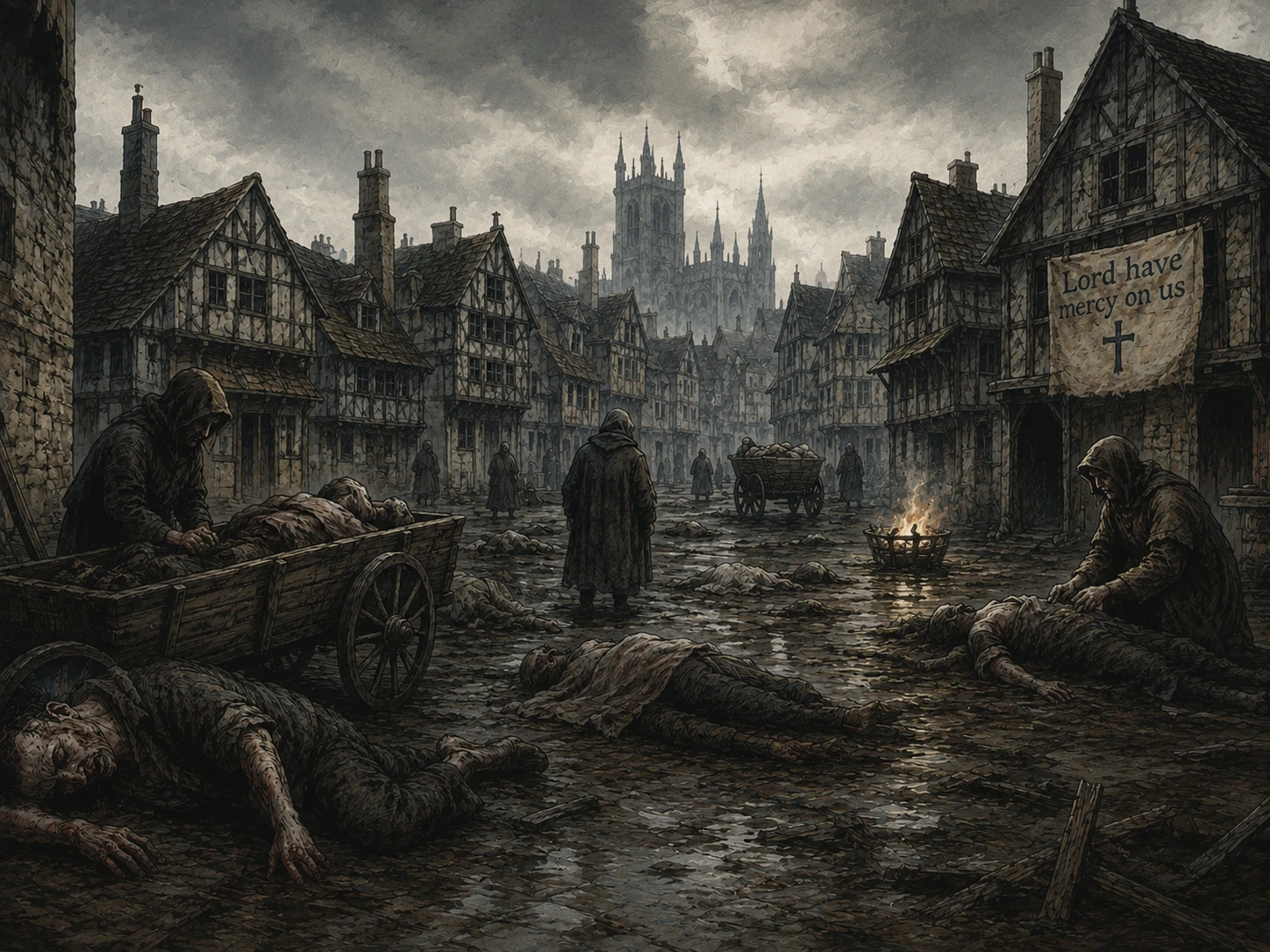
If you’re living in London when the Black Death arrives in 1348, your chances of surviving are little better than a coin flip.
Historians estimate that between 30 and 50 percent of England’s population died during the plague, while London, one of Europe’s largest and most crowded cities, was hit especially hard. Some estimates suggest the city lost as many as half of its residents in just a couple of years.
Your odds depended on when you were exposed.
The plague reached England through the southern ports in 1348 before making its way into London later that year. Once it arrived, deaths climbed rapidly. Entire neighborhoods were emptied within weeks, and the city’s cemeteries quickly filled beyond capacity.
If you managed to avoid infection during the first wave, your chances improved dramatically, but there was no guarantee. The plague would return repeatedly over the next three centuries.
Your social class mattered less than you might think.
The wealthy could sometimes flee to country estates, reducing their exposure. Those who remained in the city, however, were nearly as vulnerable as everyone else. The plague killed merchants, priests, laborers, nobles, and even members of the royal court.
The poor had it worst.
Most Londoners lived in cramped wooden houses with large families sharing a single room. Streets were narrow, sanitation was poor, and livestock often wandered freely. While medieval people blamed bad air or divine punishment, these conditions made it easier for rats and fleas, the primary carriers of the disease, to thrive.
The first sign was often a fever.
Within a day or two, victims developed painful swellings known as buboes, usually in the groin, neck, or armpits. Many also suffered vomiting, delirium, and dark patches on the skin caused by internal bleeding.
Once symptoms appeared, the outlook was grim.
For the most common form of the disease, bubonic plague, modern researchers estimate the fatality rate without treatment was roughly 50 to 70 percent. More aggressive forms, such as pneumonic plague, were even deadlier and could spread directly from person to person through coughing.
Medicine offered little help.
Doctors prescribed bloodletting, herbal mixtures, or fragrant flowers to ward off the poisoned air. Some advised carrying sweet smelling herbs or burning incense. None of these treatments stopped the infection.
Your best chance was simply not catching it.
People who could isolate themselves or leave the city sometimes escaped the first outbreak entirely. Others survived because they were never bitten by an infected flea or exposed to someone with the pneumonic form of the disease.
Daily life collapsed around you.
Markets struggled to stay open. Churches held funeral after funeral until there were too many dead to bury individually. Mass graves became common. Many priests, doctors, and caregivers died while tending to the sick.
Ironically, surviving the plague could improve your future.
With so many workers dead, labor suddenly became scarce. Wages rose, land became more available, and survivors often found themselves with opportunities their parents could never have imagined. The demographic shock helped reshape England’s economy and weakened the old feudal system.
So what were your chances?
If you’re an average Londoner in 1348, there’s a very real possibility you won’t live to see 1350. Depending on where you lived and how heavily your neighborhood was affected, your odds of surviving the first outbreak may have been only about 50 to 60 percent. Survival had less to do with age, strength, or courage than with simple luck, whether the infected fleas, rats, or sick neighbors ever reached your doorstep.