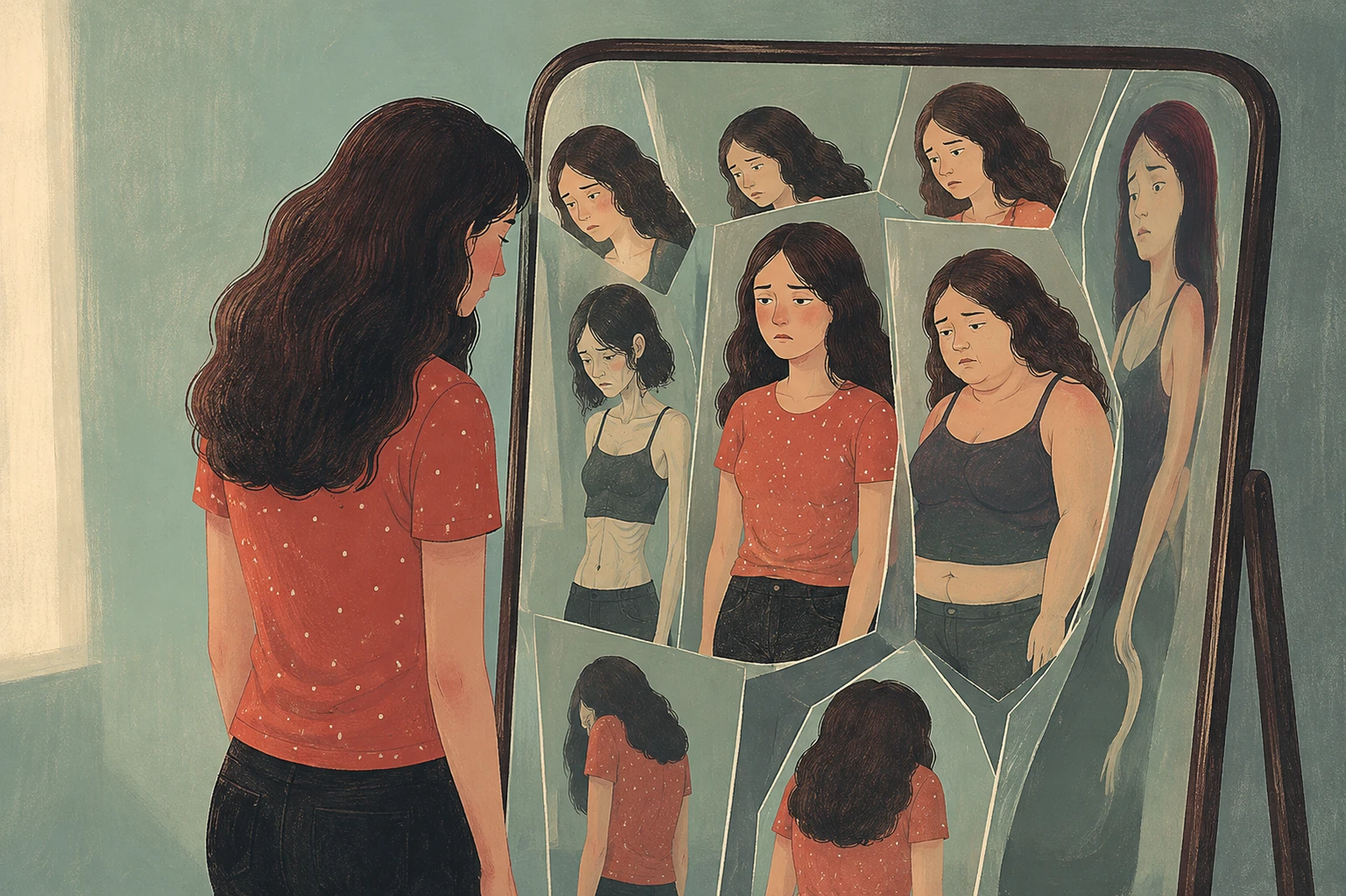
I don’t know how to qualify the way I viewed myself. There were days I knew I was too thin and others where I viewed myself as desperately in need of losing weight. Sometimes those two thoughts existed at the exact same time. I could look at my ribs and know they should not stick out like that, then turn slightly and see a fold of skin and immediately think I had let myself go.
Small things. A skin roll when sitting. Bloating after eating. The softness of my stomach when I pinched it between my fingers. The way my body looked from one particular angle. Things that probably would have meant absolutely nothing to anybody else became evidence to me. Proof that something was wrong and that I needed to correct it.
I obsessed over every ounce of fat as though it said something about who I was.
I don’t think I viewed myself as fat or obese, necessarily. That’s the strange part. I was aware and unaware of being thin. I knew my ribs stuck out. I knew my clothes hung differently. I knew I looked ill sometimes because people told me I did, and there were moments when I could see it too. I could look into the mirror and recognize, for maybe a few seconds, that the person looking back at me was too thin.
But knowing it didn’t change anything.
Because the need, the will, the absolute triumph I felt when my weight dropped trumped everything else.
That feeling mattered more to me than the consequences.
There was something intoxicating about succeeding at it. It made me feel important. It made me feel good. Most importantly, it made me feel in control.
And seeing and feeling my ribs, my hip bones, having a thin waistline, it was both soothing and comforting. I craved the touch of my fingers over the bones. There was reassurance in knowing they were still there. Sometimes I would touch them almost absentmindedly, the same way someone might fidget with a ring or run their fingers over a scar. Except I was checking. Always checking.
Are they still there?
Can I still feel them?
Did something change?
I could somehow know I was too thin while also being terrified that I would wake up one morning and suddenly not be thin anymore.
And seeing my weight go up even by a pound was an experience so… traumatic, each time.
I know how ridiculous that sounds now. A pound. Something that can change because you drank water or ate something salty or because bodies are bodies and they fluctuate. But there was no “it’s just a pound” in my head.
It felt enormous.
It felt like failure.
I felt like a worthless pig who had no control over herself. I would immediately start mentally retracing everything I had done. What had I eaten? What mistake had I made? Where had I gotten weak? I treated my body like a crime scene and myself as both the detective and the criminal.
And then came the punishment.
Not eating, enduring the hunger, became my quest for control back in a period where I felt I had very little of it.
Hunger was strangely reassuring because hunger meant I was doing something. It meant I was fixing the mistake. There was something almost comforting about knowing my body was asking me for something and I could tell it no.
I thought that was strength.
I genuinely thought that.
When my stomach hurt and I ignored it, I thought I was strong. When I was hungry and went to sleep anyway, I thought I was strong. When food was in front of me and I could refuse it, I thought I had accomplished something.
Because eating was instinctive. Hunger was primitive. Everybody had to eat.
And somehow I had convinced myself that being able to ignore one of the most basic instincts of being alive made me exceptional.
I genuinely thought myself better than other people.
And God, I was so jealous of them.
That contradiction lived inside me constantly.
I could watch somebody eat without hesitation and judge them for it while desperately wishing I could do the same thing. I could think horrible things about somebody else’s body and then envy the fact that they seemed capable of simply existing inside it.
They could eat.
They could laugh afterward.
They could order something because they wanted it.
They could be hungry without turning hunger into a moral test.
They could apparently live without constantly negotiating with themselves.
I hated them for having something I desperately wanted.
And then I comforted myself by deciding that actually, I was better than them.
They needed food. I could refuse it.
They gave in. I had discipline.
They were weak. I was strong.
What an unbelievably miserable kind of superiority.
Because underneath all of it was envy. I wanted to be able to sit down and eat and not hear that voice. I wanted food to just be food. I wanted my body to just be my body. I wanted to stop calculating and checking and bargaining and promising myself that tomorrow I would be better.
I was miserable in a twisted form of happiness that just shattered over time.
Because there were happy moments.
That is something I think is difficult to explain.
It wasn’t misery every second.
There was euphoria.
There was accomplishment.
There was pride.
There was the little rush when something fit more loosely. There was seeing a number and feeling like I had won something. There was touching my waist and feeling reassured. There was this private little world where I had rules and goals and achievements and punishments, and everything seemed incredibly important.
Until that world started swallowing the real one.
And then, even when you realize you’re too thin, you can’t stop.
That is the part that makes the least sense from the outside and somehow made perfect sense from inside my own head.
You would think realizing it would fix it.
Okay. I’m too thin. I need to stop.
Except by then the vanity of being thin is such a small part of the whole thing.
It’s not about your appearance anymore.
At some point I stopped caring whether I was beautiful.
I didn’t care about looking attractive. I didn’t care about looking healthy. I didn’t care about feeling good. I didn’t even particularly care about the body itself anymore.
The body had become a scoreboard.
It told me whether I had been good or bad.
Strong or weak.
In control or out of control.
I cared about what other people saw in me, but even that wasn’t really about them. It was about what I imagined they saw.
And to the me of that time, they saw fat.
They saw ugly.
They saw bad.
They saw awful.
They saw every single thing I was terrified of being.
I could have someone tell me I looked thin and somehow translate it into an insult. Someone could tell me I looked sick and part of me would be horrified while another part would take it as reassurance that what I was doing was working.
There was no correct thing anyone could say because I wasn’t really listening to them.
I was listening to myself through their mouths.
I projected every thought I had about myself onto other people and then reacted to those thoughts as though they had actually said them.
And I comforted myself by believing I was a superior being who could ignore instincts.
Oh how I envied them and hated them.
I hated how free they looked.
I hated that they could have something I had turned into forbidden fruit and not seem afraid of it.
I hated that they could exist without earning their right to exist that day.
But mostly I hated myself.
That was the thing underneath everything.
And somehow I had constructed this entire system where hating myself felt like taking care of myself.
There’s nothing logical in this thinking process.
That is why explaining it logically always feels inadequate.
You can tell someone that bodies need food. You can explain weight fluctuation. You can explain nutrition and organs and hormones and muscles and all the consequences. You can put facts in front of them until the table collapses beneath the weight of them.
But facts are trying to answer a question that was never really being asked.
It wasn’t, “What is healthy?”
It was, “How do I make this feeling stop?”
It was the visceral desire of introducing control into your life when everything else feels uncontrollable.
And for a while, it works.
That’s the horrible thing.
For a while you really do feel in control.
You create rules and follow them. You watch numbers move. You endure things. You deny yourself things. You get this concrete, measurable evidence that you can still command something.
Except slowly, without realizing it, the rules stop being rules you made.
They become rules you obey.
The thing you used to feel powerful becomes the thing you are terrified to disobey.
You wanted control, and somehow control became another word for fear.
It’s like believing you can extinguish fire with oil.
You see the flames and panic, so you pour oil over them.
For one strange second, doing something feels better than doing nothing.
Then the flames get bigger.
So you panic more.
And because oil is the only thing you have learned to reach for, you pour more.
Again.
And again.
And again.
You keep repeating the process, completely unable to see how violent the inferno has become because you are too busy staring at the tiny patch of fire directly in front of you.
You tell yourself the next time will work.
Just a little more.
Just a little thinner.
Just a little more discipline.
Just one more number.
Then I’ll stop.
Then I’ll be happy.
Then I’ll have control.
But there is no number where the fire politely extinguishes itself.
There is no moment where the thing destroying you turns around and congratulates you for finally doing enough.
The goal moves because it has to move.
If you ever reached it, you might stop.
And this thing does not want you to stop.
So the circle around you becomes smaller.
Your world becomes smaller.
Your choices become smaller.
Until eventually you look around and realize the fire you thought you were confronting in front of you has made a full circle.
And you’re trapped inside it.
That was the cruelest realization.
I had spent so long believing I was proving how much control I had that I couldn’t recognize how completely controlled I had become.
I wanted out.
I genuinely wanted out.
But by then, I only had oil in my hands.
The same behaviors I had used to soothe myself were the only behaviors I knew how to use when I became frightened. So every attempt to regain control sent me back toward the exact thing that had taken it away.
I would become scared of what I was doing and respond by doing more of it.
I would hate how thin I had become and panic at the thought of gaining weight.
I wanted my body back while being terrified of what having my body back would require.
I wanted freedom while still wanting every rule that had imprisoned me.
That is the contradiction I remember most.
You know the fire is burning you.
You know you cannot live inside it forever.
You can finally see what it has taken from you.
And still, there you are, holding the oil.
Still terrified to put it down.