
The middle class is easy to take for granted because, when it is healthy, it is almost invisible.
It is the family that owns a modest house, takes one vacation a year, replaces the car when it gets old, saves a little for retirement, and occasionally goes out to dinner without checking the bank account first. It is the teacher, electrician, nurse, accountant, small-business owner, technician, and office worker who may never become wealthy but reasonably expects that decades of work will produce a comfortable life.
For much of the modern era, that expectation has been one of the foundations of stable societies.
But imagine that expectation slowly disappears.
Not because everyone becomes poor. In some ways, that would be a simpler problem.
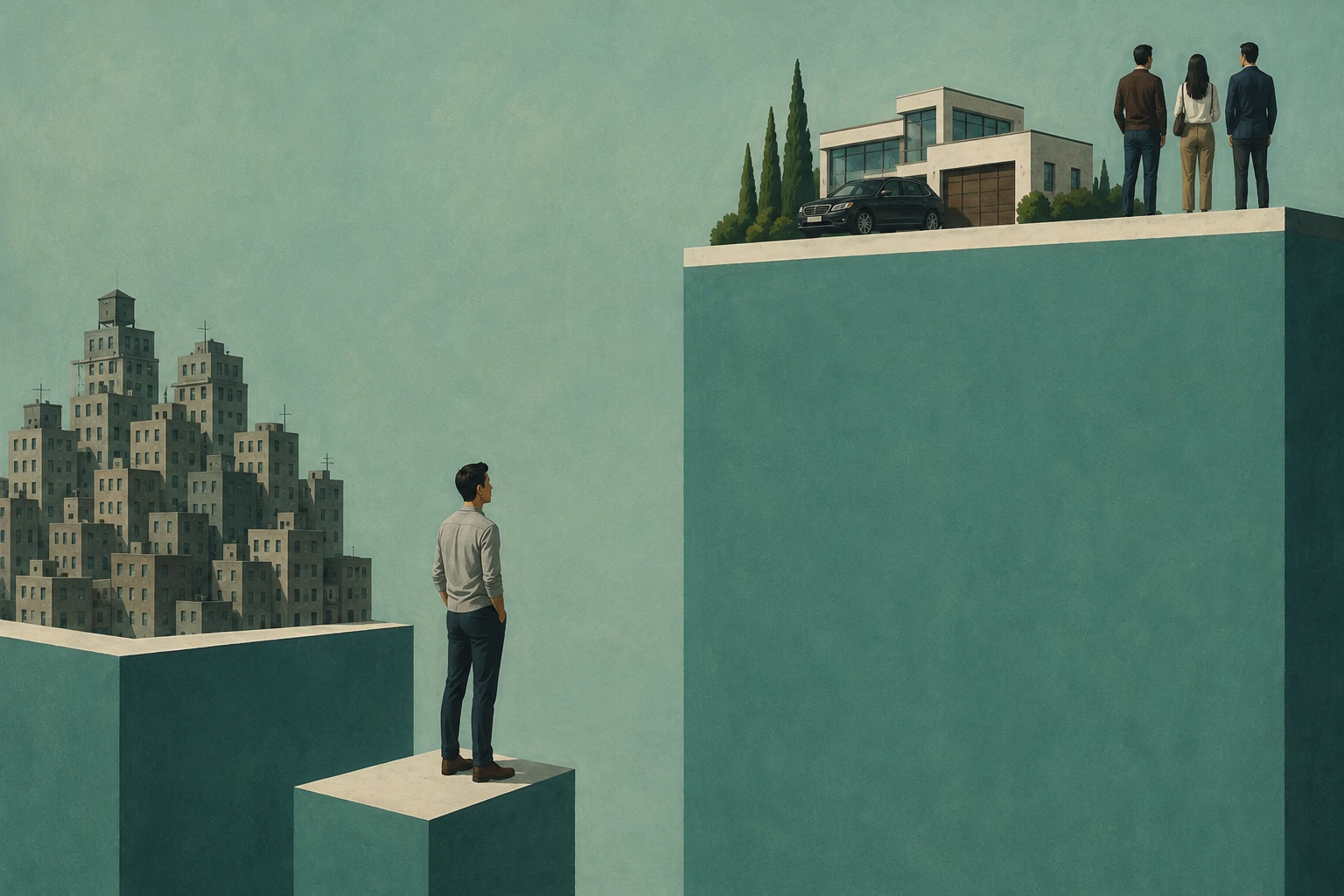
Instead, society splits.
At the top is a relatively small group of people who own valuable assets: businesses, stocks, real estate, intellectual property, and increasingly the technology that produces economic growth.
At the bottom is a much larger population that still works, still earns money, and may even own smartphones and televisions, but has very little financial security.
And between them, the middle gets thinner and thinner.
That changes far more than people’s bank accounts.
The Economy Starts Looking Richer Than People Feel
One of the strange things about a shrinking middle class is that the country can continue becoming wealthier on paper.
GDP can rise. Stock markets can hit records. New restaurants can open. Luxury homes can sell for astonishing prices. Companies can report enormous profits.
Yet millions of ordinary people can simultaneously feel that they are falling behind.
The reason is that economic growth and economic security are not the same thing.
If the value of stocks and homes rises dramatically, people who already own those assets become wealthier. Someone without substantial assets may receive a raise and still discover that buying a house has moved further out of reach.
The economy grows, but the ladder gets taller.
Eventually, people stop asking, “How do I move up?”
They start asking, “How do I avoid falling down?”
That is an important psychological shift.
Ordinary Life Becomes More Fragile
A strong middle class does not necessarily mean everyone is comfortable all the time. It means a large portion of the population has some margin for error.
The transmission breaks.
The roof leaks.
A child needs braces.
Someone loses a job.
A parent needs help.
These things are unpleasant, but they don’t necessarily destroy the household.
When that financial cushion disappears, ordinary problems become potential catastrophes.
A $2,000 emergency is no longer an inconvenience. It goes on a credit card.
Losing a job doesn’t mean dipping into savings for a few months. It means wondering how next month’s rent will be paid.
This creates a society filled with people who may look prosperous but are financially brittle.
They have jobs. They have cars. They have phones. They have streaming subscriptions.
What they don’t have is room to breathe.
Homeownership Becomes a Dividing Line
Perhaps nowhere is the disappearance of the middle class more visible than housing.
For generations, homeownership functioned as one of the primary wealth-building machines for ordinary families. You bought a house, slowly paid down the mortgage, and decades later possessed an asset worth considerably more than you originally paid.
But when housing prices rise much faster than wages, something fundamental changes.
The economy begins dividing into people who bought assets early enough and people who didn’t.
Imagine two families earning similar salaries.
One bought a house fifteen years ago.
The other rents.
Their incomes might look almost identical, but their financial lives can be completely different. The homeowner may have hundreds of thousands of dollars in equity while paying a mortgage based on an older purchase price. The renter faces current market prices every time the lease is renewed.
Over decades, that difference compounds.
Eventually wealth depends increasingly on what your parents owned, when you entered the housing market, or whether you inherited something.
That is how an economy based on work can slowly begin resembling an economy based on inheritance.
Marriage and Children Become Economic Decisions
When the middle class weakens, family formation changes too.
People still want relationships and children.
But the financial threshold for feeling “ready” keeps rising.
Housing is expensive. Childcare is expensive. Healthcare is expensive. Education is expensive.
So people delay marriage.
They delay children.
They have fewer children than they originally wanted.
Some decide they cannot afford them at all.
What once seemed like a normal stage of adulthood begins to feel like a luxury purchase.
There is something historically unusual about a society in which highly educated, fully employed adults in their thirties can look at having a second child and wonder whether they can financially survive it.
The Consumer Economy Begins Eating Itself
There is another problem.
Middle-class people are extremely important customers.
They buy appliances, cars, furniture, restaurant meals, vacations, home renovations, children’s clothing, electronics, and countless other products.
The wealthy spend enormous amounts of money, but there aren’t very many wealthy people.
A broad middle class creates broad demand.
If more income and wealth concentrate near the top, businesses eventually encounter a problem: Who is supposed to buy everything?
One answer is debt.
Credit cards, auto loans, buy-now-pay-later services, longer mortgages, student loans, and other forms of borrowing can temporarily allow consumption to continue even when incomes aren’t keeping pace.
But debt can disguise economic weakness only for so long.
You can borrow purchasing power from your future.
You cannot do it forever.
Society Splits Into Different Worlds
Perhaps the most profound effect is social.
A strong middle class forces people from different economic backgrounds to share institutions.
Their children attend the same schools.
They use the same parks.
They shop in the same neighborhoods.
They interact with the same public services.
As inequality grows, wealthy people increasingly purchase private alternatives.
Private schools.
Private security.
Private healthcare.
Gated communities.
Exclusive clubs.
Premium transportation.
Even separate forms of entertainment and travel.
This creates a dangerous feedback loop.
When affluent citizens depend less on public institutions, they have less personal incentive to maintain them.
A deteriorating public school doesn’t matter much if your children attend private school.
Poor public transportation matters less if you never use it.
An unsafe public park matters less if your neighborhood has private amenities.
Eventually, people can live in the same city while experiencing completely different civilizations.
Politics Gets Angrier
The disappearance of the middle class also creates fertile ground for political instability.
People can tolerate inequality surprisingly well when they believe the system is basically fair and that their children have a reasonable chance of doing better than they did.
What becomes corrosive is the feeling that the game is rigged.
If working hard no longer seems sufficient to buy a home, raise children, retire comfortably, or move upward, people begin looking for explanations.
Someone must be responsible.
Corporations.
Immigrants.
Billionaires.
Government.
Foreign countries.
Landlords.
Banks.
The political left and right usually identify different villains, but they can be responding to the same underlying anxiety:
The deal isn’t working anymore.
That is when politics becomes less about marginal tax rates or infrastructure spending and more about identity, resentment, punishment, and restoring a lost sense of control.
The Rich Aren’t Necessarily Safe Either
It might seem as though extreme inequality is wonderful for the people at the top.
Financially, it often is.
Socially, the picture is more complicated.
Wealth becomes increasingly valuable partly because it allows people to insulate themselves from the society around them.
Better neighborhoods.
Better schools.
Better security.
Better healthcare.
But that insulation has a cost.
You end up spending enormous amounts of money recreating privately what a functioning society once provided collectively.
And history suggests that societies with extreme concentrations of wealth can become politically unpredictable.
Populist movements grow.
Governments become unstable.
Taxes can swing dramatically.
Crime and social disorder can increase.
Political extremism becomes more attractive.
Capital begins protecting itself from the society that produced it.
That isn’t exactly a healthy equilibrium.
The Most Dangerous Thing That Disappears Is Hope
The greatest loss, however, may not be economic.
It is psychological.
The middle-class dream has never really been about owning a particular size house or earning a particular salary.
It is about believing that effort produces progress.
Work hard.
Learn something useful.
Save money.
Build a career.
Buy a home.
Raise a family.
Retire with dignity.
Give your children a slightly better starting point than you had.
That story gave millions of people a reason to participate in the system even when they were nowhere near the top of it.
A society does not need everyone to become rich.
But it does need enough people to believe that playing by the rules leads somewhere.
When that belief disappears, something much larger than the middle class disappears with it.
Trust disappears.
Patience disappears.
People become less willing to sacrifice today for a future they no longer believe will arrive.
And eventually the question stops being:
“How do I succeed within this system?”
It becomes:
“Why should I believe in this system at all?”
That is why the disappearance of the middle class isn’t simply an economic problem.
It is a stability problem.
The middle class acts as the shock absorber between enormous wealth and genuine poverty. It gives ordinary people something to protect, something to aspire to, and evidence that improvement is possible.
Remove that middle, and you don’t necessarily get a society divided neatly between rich and poor.
You get something more unsettling:
A society full of people who can see extraordinary prosperity all around them but increasingly believe that none of it is meant for them.