
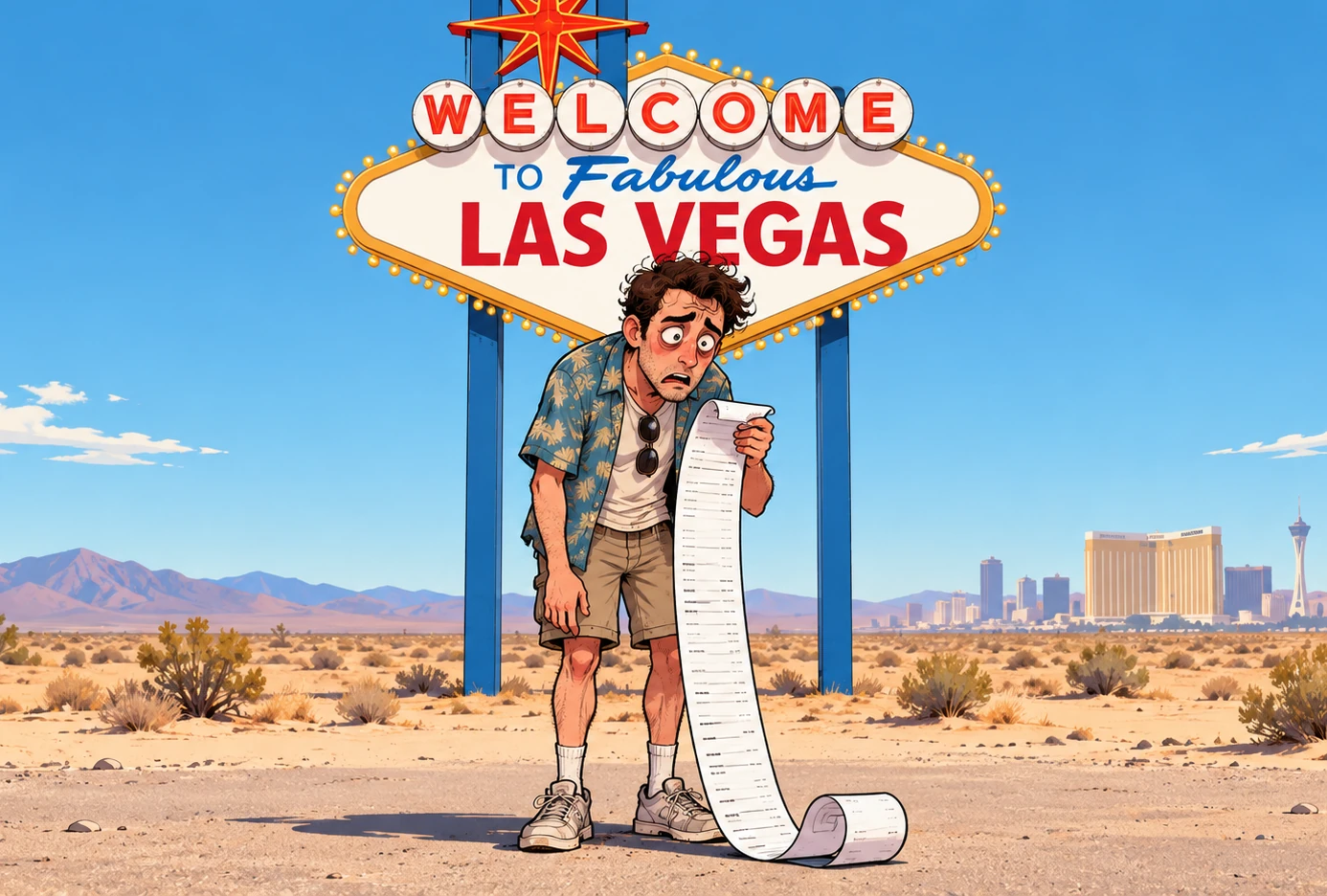
Las Vegas used to have an honest arrangement with its visitors.
You came to behave badly. The city gave you a cheap room, a reasonably priced steak, a few free drinks, and the intoxicating possibility that you might go home richer than you arrived. Vegas understood that the best way to separate you from your money was to make the separation feel like fun.
That arrangement is dead.
Modern Las Vegas doesn’t seduce you anymore. It invoices you.
The Room Price Is a Lie
The screwing begins before the plane lands. You find a hotel room advertised for $79, congratulate yourself on scoring a deal, and then discover that the room has reproduced several additional charges while you weren’t looking.
Taxes. A nightly resort fee approaching $50 or more. Parking. An early check-in fee if you have the audacity to arrive before the precise minute assigned to you by the revenue-management software.
The resort fee supposedly covers amenities such as Wi-Fi, gym access, and local phone calls, which is wonderful news for anyone planning to fly to Las Vegas in 2026 and spend the weekend calling landlines from a hotel room.
It is not a resort fee. It is part of the room price wearing a fake mustache.
Vegas hotels advertise one number because that number gets you through the door. Then, once you’re emotionally committed to the trip, they show you the real number. New federal pricing rules have made hotel costs more transparent than they once were, but transparency doesn’t make the fee less absurd. It merely allows the hotel to rob you while maintaining eye contact.
Your Car Has a Hotel Bill Too
And God help you if you brought a car.
Many major Strip resorts now charge approximately $20 to $25 a day for self-parking. Valet can run $40 or $50. In other words, after paying to sleep at the hotel, you must pay the hotel again for your car to sleep there.
At Caesars Palace, self-parking can reach $25 while valet is listed at $50. MGM’s Strip properties commonly charge $20 to $25 for self-parking and around $40 for valet. Even Resorts World charges $21 to let an automobile occupy a rectangle of concrete.
See current Las Vegas parking rates
Remember when free parking was part of the Vegas sales pitch? Casinos wanted you inside because they assumed they would eventually get your money.
Now they want your money before you reach the casino.
Every Convenience Has Become a Toll Booth
That distinction describes almost everything wrong with Las Vegas today. The old city played the long game. The new one wants to monetize every bodily movement between your hotel room and the blackjack table.
You want coffee? That can be $10 or more.
You want a cocktail? Some visitors have reported drinks around $30.
You want a bottle of water in a city constructed inside an oven? Prepare to negotiate financing.
You want to check in a little early because your flight arrived at noon? That convenience may cost $30, $40, or $50, even if the room is already sitting there empty, clean, and experiencing no apparent hardship.
You want to use the refrigerator? Be careful. Some minibars have sensors that interpret touching an item as a binding purchase agreement. The empty space inside the refrigerator isn’t necessarily for your food, either. That would interfere with the lucrative business of selling you eight ounces of water for the price of a municipal utility bill.
The Mysterious Fee at the Bottom of the Menu
Then you go downstairs for dinner and discover that certain restaurants have invented entirely new categories of money.
Not taxes. Not tips. Not food.
Just money.
Around 20 Strip restaurants have been identified as charging additional fees of roughly 3% to 5%, hidden in menu fine print under names such as “concession fee,” “CNF fee,” “supplementary fee,” or “employment surcharge.” These names are designed to sound official enough that you’ll assume the money has somewhere important to be.
Often, it goes directly to the business, and some establishments will remove it if you notice and ask.
See the Las Vegas restaurant surcharge tracker
This is perhaps the purest expression of modern Vegas: a fee that exists largely because management believes you won’t read the bottom of the menu.
And after the surcharge comes the tip screen, which may offer you the convenient choices of 22%, 25%, and “I personally hate service workers.”
The workers aren’t the villains here. They are trapped in the same extraction machine, dealing with angrier customers, reduced hours, and shrinking tips while executives discover exciting new ways to charge $12 for lemonade. When visitors finally stop coming, the housekeeper and cocktail server feel it long before the people who approved the resort fee.
Even the Gambling Has Gotten Worse
But surely the gambling is still fun. That is the entire point of Las Vegas, right?
Not necessarily.
Traditional blackjack pays 3-to-2 when you’re dealt a natural blackjack. Bet $20 and you win $30. But 6-to-5 blackjack has spread across lower-limit Strip tables. On the same $20 bet, you receive $24.
Six dollars disappears.
That may seem minor until you realize the casino has changed one of the game’s central rules solely to make a bad bet considerably worse. Industry explanations estimate that 6-to-5 payouts can multiply the house’s advantage several times over compared with otherwise favorable traditional blackjack.
See how 3-to-2 and 6-to-5 blackjack compare
Vegas Added Another Way to Lose at Roulette
Roulette has undergone a similar mutation. American roulette already added a double zero to increase the casino’s advantage. Vegas then looked at this perfectly functional method of losing money and asked: What if there were another zero?
Thus, triple-zero roulette.
A traditional single-zero wheel has a house edge of about 2.7%. Double-zero roulette raises it to 5.26%. Triple-zero roulette pushes it to approximately 7.69%.
The casino didn’t improve the game, add entertainment, or give the player anything meaningful in return. It painted one more losing space on the wheel and collected the difference.
See current Las Vegas roulette odds
Table minimums have climbed, favorable games are harder to find, loyalty programs have become stingier, and even “free” casino drinks may depend on machines tracking whether you are gambling fast enough to deserve one. The famous Vegas comp has gradually transformed from hospitality into a performance bonus.
Drink faster. Bet faster. Lose faster.
The Cheap Fun Is Disappearing
The cheap buffets are mostly gone. The inexpensive shows have been displaced by residencies, major sporting events, and “experiences” priced as if you are purchasing partial ownership of the performer. Ticket service fees pile onto already expensive seats.
Poolside shade has become a luxury product. Cabanas can range from relatively modest sums at cheaper resorts to hundreds of dollars at upscale properties, sometimes with food-and-beverage minimums, rental fees, and automatic gratuities waiting in the fine print.
See current Las Vegas cabana pricing
The Strip Is an Obstacle Course
Even walking around is unpleasant.
The Strip looks compact in photographs because photographs do not communicate heat, pedestrian bridges, escalators, dead ends, casino labyrinths, or the fact that the building appearing to be “next door” is actually a 25-minute walk through six acres of slot machines and a luxury shopping mall selling $900 sandals.
Everything is designed to interrupt your movement and expose you to another purchasing opportunity. You cannot simply enter a hotel. You must pass a steakhouse, a nightclub, a celebrity burger restaurant, three blackjack pits, and a store that sells bedazzled skulls.
Vegas Has Become a Corporate Airport Terminal
Vegas has always been artificial, but it once possessed a kind of magnificent vulgarity. The fakery was joyful. Here was Paris. There was Venice. Across the street was ancient Egypt. None of it was convincing, and that was the charm.
It was a city built by maniacs who asked what would happen if a shopping mall, a casino, and a cocaine dream were given access to unlimited concrete.
Now the Strip increasingly resembles an airport terminal owned by private equity.
The individual weirdness has been sanded away. The Mirage volcano is gone. Cheap attractions disappear. Independent businesses give way to familiar luxury brands and celebrity-chef outposts.
Enormous corporations control multiple resorts, creating the illusion of choice while prices, policies, and fees remain remarkably similar from one property to the next.
You are no longer exploring casinos. You are circulating through a portfolio.
Vegas Decided Ordinary Visitors Don’t Matter
Vegas’s response to complaints has generally been that the customer is still paying. As long as occupancy remained high and wealthy visitors kept buying $28 cocktails, there was no reason to reconsider.
The middle-class tourist became less important than the convention account, the bachelor party prepared to go into debt, and the high-income traveler who regards a $500 cabana as an Instagram prop.
Except customers have begun staying home.
Las Vegas received roughly 3.1 million fewer visitors in 2025, a 7.5% annual decline and the sharpest non-pandemic drop since record-keeping began in 1970.
International travel, economic uncertainty, and political tensions contributed, so the decline cannot be blamed entirely on $14 coffee and resort fees. But reporting also consistently identifies deteriorating value as part of the problem: middle-income visitors are pulling back while the city depends increasingly on affluent customers.
Read Reuters’ report on the tourism decline
Vegas appears shocked by this, as if visitors failed to appreciate the privilege of paying $25 to park outside a building specifically designed to take the rest of their money.
Las Vegas Broke Its Side of the Deal
The tragedy is that Las Vegas could still be great. There is nowhere else quite like it. The restaurants can be extraordinary. The shows can be spectacular. The people-watching remains unmatched. A good night in Vegas can make ordinary life feel impossibly far away.
But escapism requires a certain suspension of disbelief. You have to feel that you are participating in the fantasy rather than being processed by it.
Today’s Vegas makes that increasingly difficult. Every fee breaks the spell. Every surcharge reminds you that the fantasy has a billing department. Every degraded blackjack table tells you the casino no longer believes entertainment alone is sufficient—it must also quietly worsen the math.
Las Vegas used to take your money and give you a story.
Now it takes your money, charges you a convenience fee for taking it, and asks whether you would like to leave a 25% tip.
Fuck Las Vegas.