
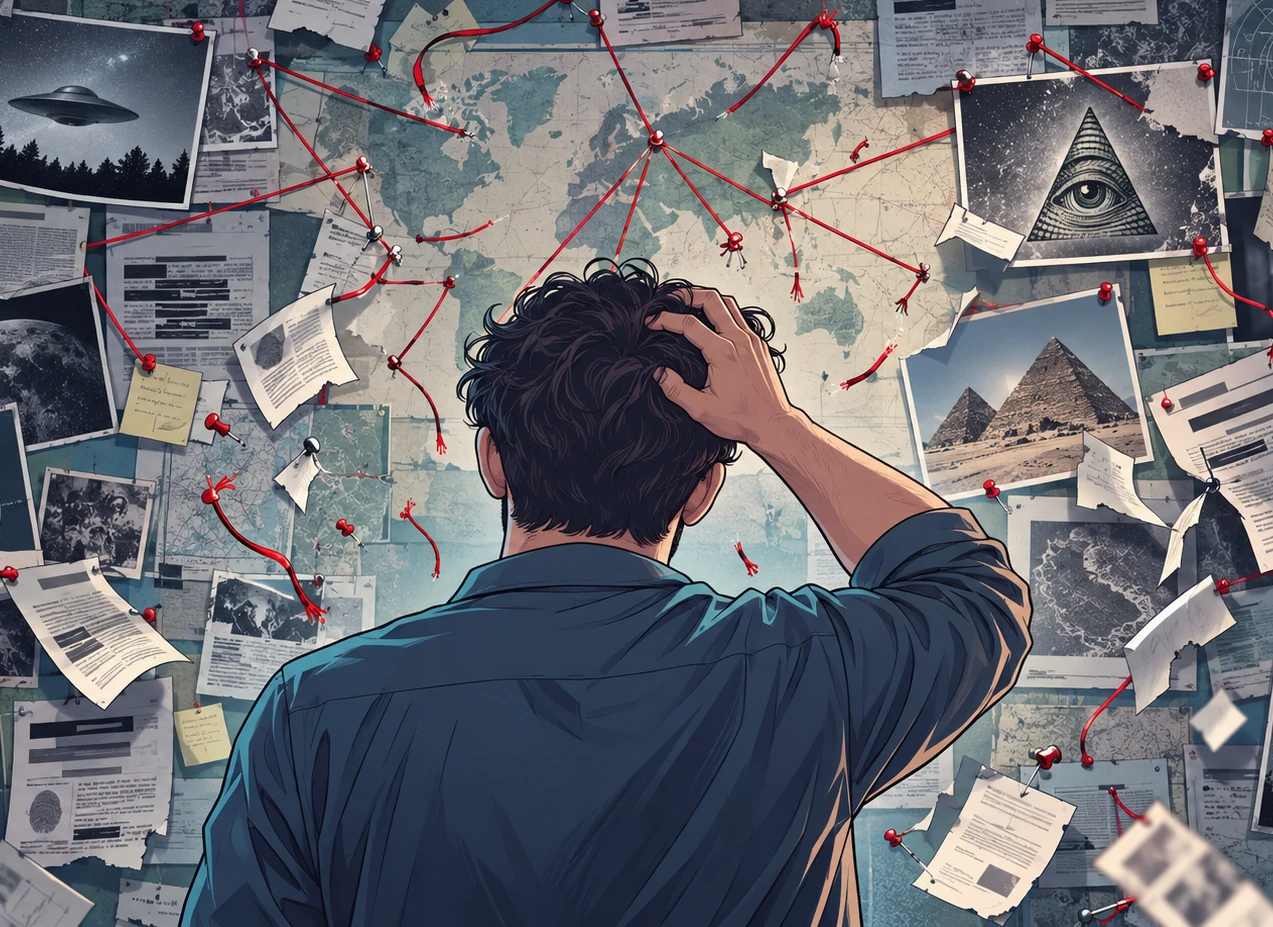
I didn’t make plans for my life after 2012 because I genuinely wasn’t sure the world as I knew it would still exist.
I didn’t necessarily believe everyone would die on December 21. My expectations were more nebulous than that. Maybe a hidden planet called Nibiru would pass through the solar system and cause a catastrophic pole shift. Maybe aliens would reveal themselves. Maybe humanity would experience a metaphysical transformation and enter a higher state of consciousness.
Whatever happened, I was convinced it would permanently change everything. College, careers, retirement plans—all of it seemed irrelevant when the existing world was about to be replaced by something else.
I had been falling down conspiracy-theory rabbit holes for years.
The first one I remember sincerely believing was that the moon landing had been faked. I had watched a television documentary questioning the official story, and it seemed persuasive to me. Once I accepted that something as enormous as the moon landing could have been staged, almost anything became possible.
I grew up with an abusive, narcissistic parent, which left me deeply suspicious of authority. I was already inclined to believe that powerful people were dishonest and that institutions claiming to protect us were probably concealing something.
Conspiracy theories fit that worldview perfectly. They told me that my distrust wasn’t merely justified—it was evidence that I could see what other people couldn’t.
After 9/11, I became a Truther. Alex Jones was one of the main figures who pulled me into that world. I believed the official account was a cover story and that the government either allowed the attacks to happen or participated in them.
From there, the theories multiplied.
I believed the Bilderberg Group was using George W. Bush as a puppet. I worried about Agenda 21. I warned people about fluoride in drinking water. I watched videos claiming that governments, corporations and secret societies were working together to control the population.
For a while, I even drifted toward sovereign-citizen beliefs. I watched a video claiming that when your name appears in capital letters on a legal document, it refers to a corporate entity rather than you as a human being. Supposedly, if you understood that distinction and used the correct legal phrases in court, you could escape the government’s authority.
It sounds ridiculous to me now. At the time, it felt like discovering a hidden cheat code.
That feeling was a huge part of the appeal. Conspiracy theories made an overwhelming and unfair world seem understandable. Nothing happened by accident. Every disaster had an architect. Every contradiction was part of the cover-up. Every person who disagreed with me was either asleep, brainwashed or too frightened to confront the truth.
I didn’t think of myself as gullible. I thought I was unusually skeptical.
But my skepticism only traveled in one direction. I relentlessly questioned governments, scientists and mainstream journalists while accepting the claims of conspiracy filmmakers and internet personalities with almost no scrutiny. If someone confirmed what I already suspected, I rarely investigated where their information came from.
The year 2012 became the point where many of these beliefs converged. People connected the end of a cycle in the Mayan calendar with Nibiru, ancient aliens, spiritual awakening and various predictions of catastrophe.
I was interested in the Maya and believed they possessed knowledge modern society had lost. I imagined that their connection to nature had allowed them to understand the universe in ways we no longer could. Other believers claimed aliens had given them that knowledge.
The details varied, but I believed something was coming.
Then 2012 arrived.
And nothing happened.
There was no pole shift. No alien contact. No mass awakening. The world remained frustratingly ordinary, and I was still responsible for figuring out what to do with my life.
That was when I finally went to college.
Learning how to conduct proper research forced me to recognize how I had been processing information. I had been cherry-picking evidence, accepting other people’s conclusions and ignoring anything that threatened my beliefs. Ironically, I had spent years mocking religious fundamentalists for doing exactly the same thing.
Once I applied the same scrutiny to my own worldview, pieces of it began to crumble.
One particularly embarrassing realization involved Osama bin Laden. I encountered a video explaining that conspiracy theorists can accept mutually incompatible claims because each one challenges the official story.
I realized I believed both that bin Laden had died before 9/11 and that he had never been killed and might still be alive.
Those claims couldn’t both be true. Yet I had accepted each of them because neither required me to reconsider my central belief that the government was lying.
That realization didn’t instantly cure me. There was no dramatic moment when every conspiracy disappeared from my mind. It was a slow process of noticing contradictions, questioning sources and admitting that I had been wrong.
That last part was the hardest.
Conspiracy theories become part of your identity. Believing you possess forbidden knowledge makes you feel important. Walking away means surrendering that feeling and acknowledging that the people you dismissed as sheep may have understood the world better than you did.
It also means losing a community. If everyone around you shares the same beliefs, questioning those beliefs can feel like betraying your friends. That is why mockery usually doesn’t work. Humiliation makes people retreat further into the only group that still accepts them.
You cannot simply tell someone like that they are stupid and expect them to thank you. The change has to come from within.
What can sometimes help is asking sincere questions. Ask them to explain the theory in detail. Ask what evidence would prove it false. Ask how two contradictory claims can both be true. The goal isn’t to corner them or score points. It is to plant a small seed of doubt they can examine later when no one is watching.
Today, I don’t think elaborate conspiracy theories are necessary to explain what is wrong with the world. There is already plenty of corruption, greed and collusion happening in plain sight. The problems are real; the imaginary puppet masters are not required.
Looking back, I understand why I believed what I did. Beneath all the talk about secret societies and hidden planets was a feeling of powerlessness. I knew something about society was broken, but I didn’t have the tools to understand it. Conspiracy theories gave me simple villains and made me feel as though I had discovered the answer.
I don’t hate the people who remain trapped in that world. I recognize them.
I used to be one of them.