
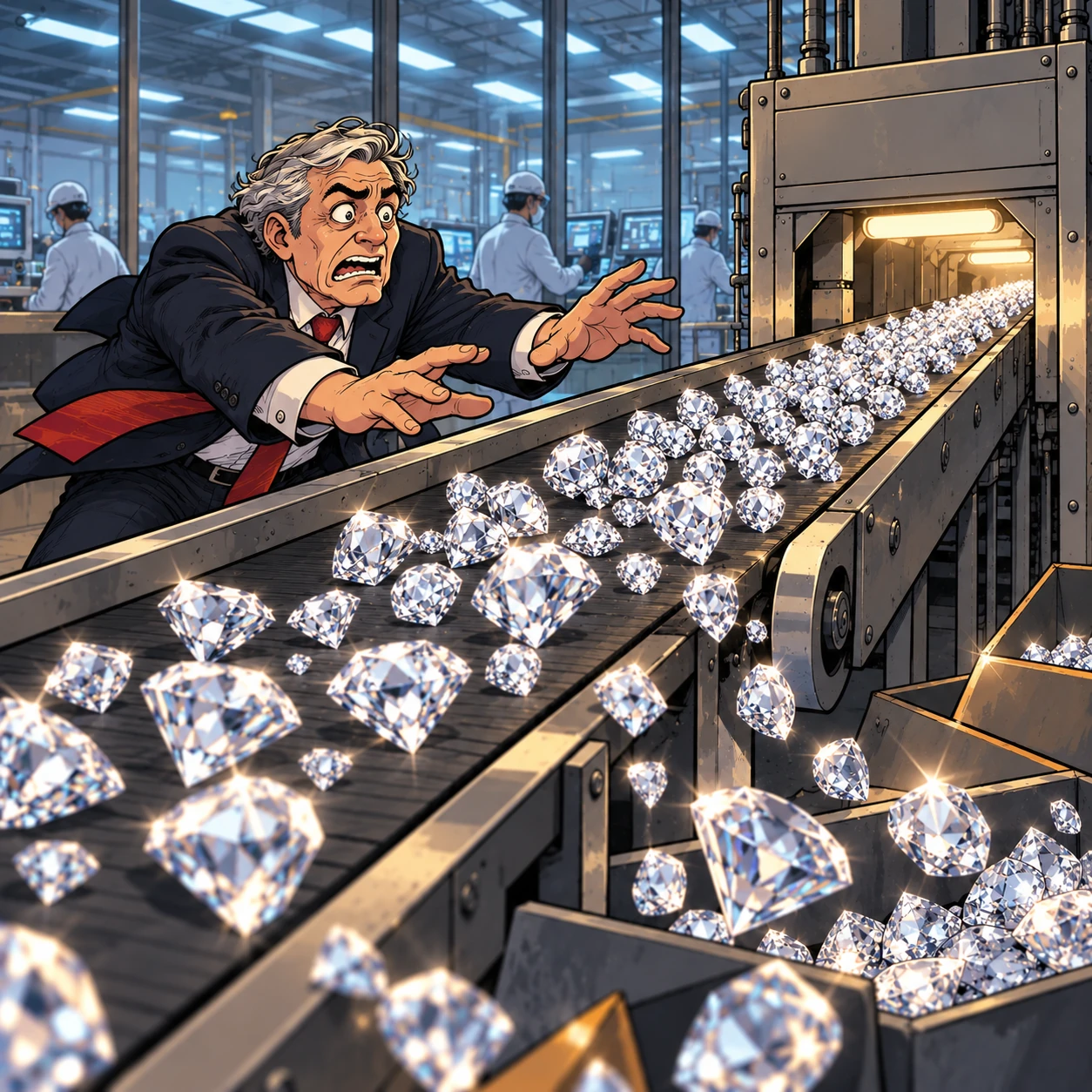
There are few things more satisfying than watching an industry that spent generations selling scarcity suddenly discover what happens when scarcity disappears.
Natural diamond prices have fallen roughly 60 percent in five years.
In March 2022, a one-carat natural diamond hit an all-time high of around $10,000. Since then, prices have cratered.
And the primary reason is beautifully simple:
We figured out how to make diamonds.
Not fake diamonds. Not cubic zirconia. Actual diamonds.
Lab-grown diamonds have the same chemical composition and essentially the same physical and optical properties as diamonds pulled out of the Earth. They’re created by taking a tiny diamond seed and growing carbon around it under controlled conditions before cutting and polishing the resulting stone.
Put a good lab-grown diamond next to a comparable natural diamond and the average person isn’t going to know which one came out of Botswana and which one came out of a vacuum chamber.
There is, however, one difference anybody can identify immediately.
The price.
Lab-grown diamonds can cost a fraction of what comparable natural diamonds cost.
And American consumers have responded exactly as you would expect.
In 2026, lab-grown stones reportedly accounted for 61 percent of U.S. engagement-ring sales, up 239 percent since 2020.
More than half the market.
People are walking around with enormous diamonds now. Three carats. Four carats. Five carats.
Stones that would’ve once advertised either generational wealth or an absolutely catastrophic financing decision can now appear on the hand of somebody who drives a Hyundai.
This is apparently alarming to the traditional diamond industry.
It is extremely funny to everyone else.
Because for much of the twentieth century, the diamond business—particularly De Beers—benefited enormously from controlling scarcity.
De Beers once controlled the overwhelming majority of the world’s rough-diamond trade. Its Central Selling Organisation bought diamonds from producers, accumulated stockpiles and carefully controlled how much supply reached buyers.
When demand weakened, diamonds could be withheld. When supply increased, diamonds could be stockpiled.
Keep the market tight.
Keep prices high.
There’s a reason the old De Beers system has so often been described as a cartel.
And this wasn’t merely aggressive capitalism that later acquired an unfortunate nickname.
In 2004, De Beers Centenary pleaded guilty in U.S. federal court to conspiring to fix the price of industrial diamonds. The company admitted its representatives exchanged future pricing information as part of an agreement to raise prices and paid a $10 million criminal fine.
So you’ll forgive me if I don’t shed a tear now that the diamond market has discovered competition.
Because De Beers has encountered a problem its old playbook cannot solve.
You can restrict the number of natural diamonds coming out of a mine.
You cannot restrict the number of diamonds coming out of factories you don’t own.
That’s the whole beautiful fucking joke.
The defining feature of the traditional diamond business was scarcity.
Now somebody can make another diamond.
And another.
And another.
As manufacturing improves, production gets cheaper. More companies enter the market. Supply increases. Prices fall.
It’s Economics 101 arriving approximately a century late with a baseball bat.
And lab-grown prices haven’t merely declined.
They’ve been annihilated.
De Beers itself launched a lab-grown jewelry company called Lightbox in 2018, initially pricing its stones at $800 per carat.
Seven years later, De Beers shut it down after wholesale lab-grown diamond prices had fallen roughly 90 percent.
Imagine being De Beers and watching a diamond you once thought should cost $800 per carat become dramatically cheaper because manufacturers got too good at making diamonds.
It’s almost poetic.
The company that spent generations benefiting from scarcity entered a market with effectively unlimited supply and discovered that unlimited supply is terrible for margins.
Even major jewelers are reconsidering mined diamonds. Pandora stopped using newly mined diamonds in 2021 and moved its diamond offering toward lab-grown stones.
There are potential environmental advantages too. One estimate puts the carbon footprint of a one-carat lab-grown diamond around 90 percent below that of a comparable mined diamond, although that varies considerably depending on the energy source and production method.
And then there’s the considerably uglier history attached to the diamond trade.
Conflict diamonds mined in war zones were sold to finance armed groups and brutal conflicts, particularly in Africa. At one point they were estimated to represent roughly 4 percent of global diamond production.
The Kimberley Process was introduced in 2003 to choke off that trade and represented real progress, although critics have argued its definition of a conflict diamond remains too narrow.
That doesn’t mean every natural diamond is unethical, or that De Beers was responsible for every conflict diamond.
But it makes the industry’s carefully polished mythology of purity, eternity and romance a little harder to swallow.
Especially when you add cartel-like supply control and actual price fixing to the résumé.
Which brings us back to De Beers.
The company now plans to pause production at Venetia, its flagship South African mine, for more than two years as it cuts costs and responds to the weakened market.
Think about that.
This isn’t some Etsy jewelry shop realizing people aren’t buying enough necklaces.
This is De Beers slowing down an enormous diamond mine because the world has too many diamonds and not enough people willing to pay yesterday’s prices for them.
And that’s what makes this moment so fascinating.
For decades, the industry had a wonderfully convenient economic story:
Diamonds are rare.
Therefore diamonds are expensive.
Diamonds are expensive.
Therefore diamonds are valuable.
Then somebody figured out how to manufacture the exact material.
Suddenly consumers could ask the question the industry really didn’t want them asking:
What exactly am I paying all this extra money for?
Consider two diamonds.
Both are two carats.
Both have excellent cuts.
Both have excellent color and clarity.
Both sparkle beautifully.
One costs thousands of dollars more.
Why?
Well, the expensive one formed underground.
And if that matters to you, wonderful. Buy it.
People pay enormous premiums for provenance all the time. A mechanical watch can cost $30,000 despite keeping worse time than your phone. Luxury isn’t rational.
But something fundamental has changed.
Natural-diamond sellers now have to justify the premium.
The diamond itself used to be the premium product.
Now natural origin is the premium product.
That’s a much harder sales pitch.
And then there’s resale value, perhaps the funniest remaining defense of natural diamonds.
People will warn you that lab-grown diamonds don’t retain their value.
Correct.
But here’s another useful piece of financial advice:
Don’t buy a natural diamond as an investment either.
Most ordinary retail diamonds lose substantial value after purchase. The fact that your $10,000 natural diamond may someday be worth more than your $1,000 lab diamond doesn’t mean either was a good investment.
Buy jewelry because you want jewelry.
Buy stocks because you want investments.
Meanwhile, consumers can buy an enormous lab-grown diamond and put the thousands they saved toward a honeymoon, a house, an index fund or a truly irresponsible television.
Natural diamonds aren’t going to zero. Truly exceptional stones—huge diamonds, rare colors, historically important gems—will remain genuinely scarce luxury objects.
But the ordinary diamond market has changed.
De Beers can cut production.
It can pause mines.
It can spend millions advertising authenticity, provenance and billions of years of geological history.
What it can’t do is uninvent the lab-grown diamond.
After more than a century of telling consumers how valuable diamonds are because they’re scarce, the industry has finally encountered its nightmare:
More diamonds.
De Beers spent decades helping control the faucet.
Now there are faucets everywhere.
And they can’t turn them off.
Good luck with that.