






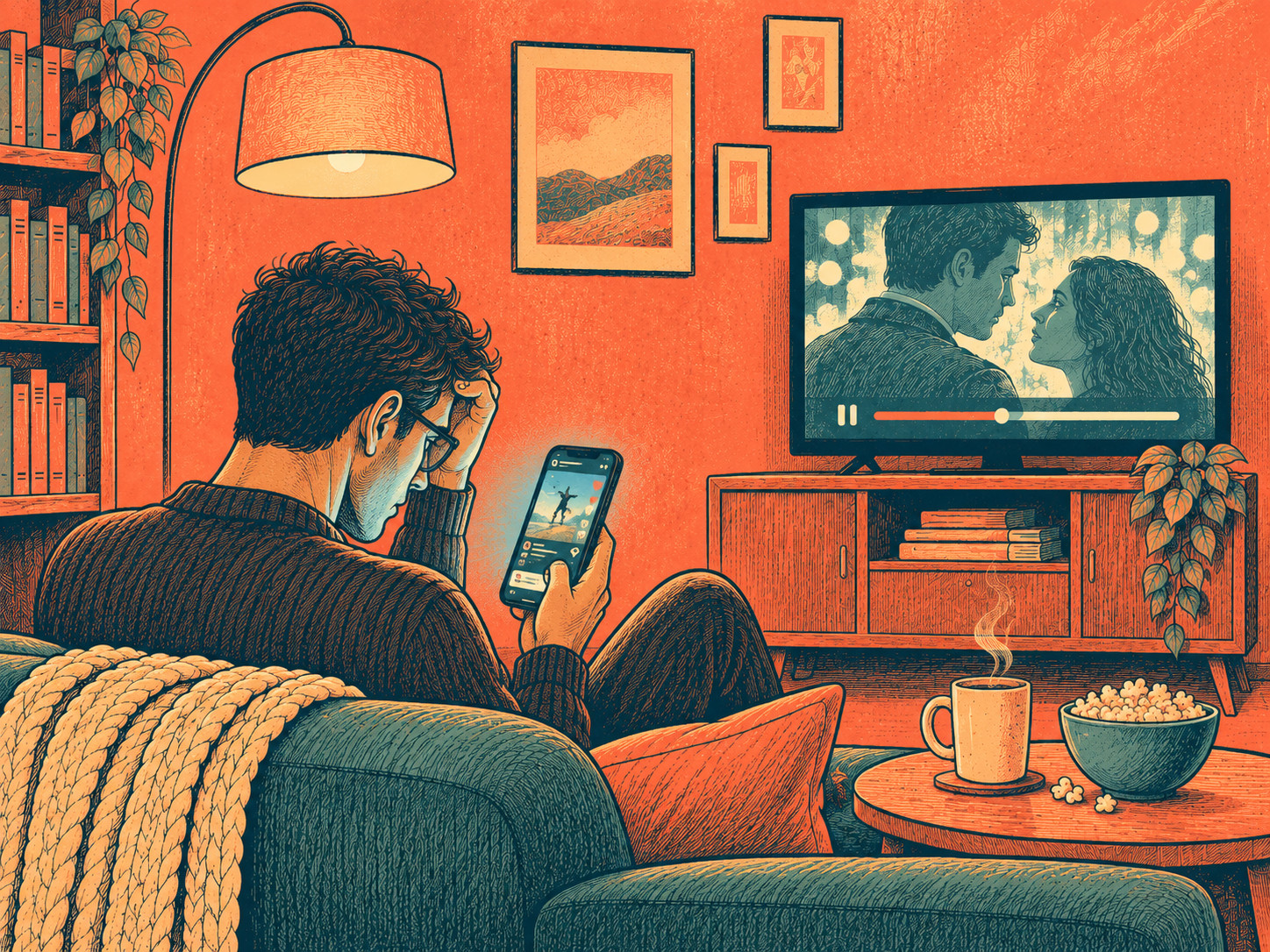
There is something strange about a person who considers watching a two-hour movie an unreasonable use of time but has no problem spending three hours looking at their phone.
The distinction seems important to this person. The movie is a commitment. The phone is relaxation. One requires a decision, while the other apparently just happens.
But this raises an interesting question: Why does voluntarily choosing to spend two hours doing something feel more burdensome than accidentally spending three hours doing something else?
The obvious explanation is attention span. We’ve become accustomed to short videos, instant gratification, and entertainment that changes every few seconds. A movie asks us to concentrate on one thing for an extended period, which increasingly feels like work.
But I suspect there’s something else happening.
Watching a movie requires accepting the possibility of boredom. You might spend twenty minutes with characters you don’t particularly like. There might be a scene where nothing happens. The story might take an hour to become interesting. And you have to trust that this investment will eventually mean something.
Scrolling requires no such faith.
If something is boring, you leave. If something is confusing, you leave. If something doesn’t immediately reward your attention, you leave. There is always another option, and the cost of switching is practically zero.
In a sense, scrolling allows us to avoid the experience of being disappointed by our own choices. We never really choose anything. We just keep accepting whatever comes next.
And perhaps that’s why a movie feels exhausting before we’ve even started it. It’s not necessarily the two hours that bother us. It’s the idea of surrendering control over those two hours.
The irony is that this supposed freedom often leaves us with less control over how we actually spend our time.
A movie has a beginning, a middle, and an end. When it’s over, you’ve experienced something complete. You might have loved it or hated it, but at least you can explain what you did with your evening.
Three hours of scrolling rarely offers the same satisfaction. You can watch hundreds of things without feeling like you’ve experienced anything in particular.
Maybe our problem isn’t that we’ve lost the ability to pay attention.
Maybe we’ve become so accustomed to having an escape route from every moment of boredom that we’ve started confusing commitment with inconvenience.
And that’s a strange trade to make, considering how much of what makes life worthwhile requires staying with something long enough for it to become interesting.
Was this worth your time?
What missed? (optional)