



Sometime in the mid-1960s, a man walked into the 596th McDonald’s franchise on South Willow Street in Manchester, New Hampshire, with his step-grandson. The restaurant had opened in 1964, about a block from the man’s childhood home. According to GeekExtreme’s McDonald’s characters guide, this was right after the company phased out its original hamburger-headed chef mascot Speedee in favor of Ronald McDonald in 1963. He waited in line, ordered, and paid full price. Nobody behind the counter had any idea he was Richard McDonald.
As the Old Money Dynasty video essay “The Forgotten Story of the McDonald Brothers Who Invented Fast Food” recounts, brothers Richard and Maurice McDonald created McDonald’s in America. They built the fast-food kitchen system, put their family name on the sign, and insisted on the golden arches. Ray Kroc scaled the business into a global empire and claimed the founder title on the corporate plaques. Kroc died with a $600 million fortune. Richard McDonald left a $1.8 million estate and paid retail for his own burgers.
Key Takeaways
- Brothers Richard (“Dick”) and Maurice (“Mac”) McDonald created McDonald’s in San Bernardino, California, opening their original restaurant in 1940 and inventing the 30-second Speedy Service System in October 1948.
- Multi-Mixer salesman Ray Kroc joined as national franchising agent in 1955 and bought the brothers out in 1961 for $2.7 million ($1 million each after taxes), while denying a disputed handshake deal for a 0.5% perpetual royalty.
- Kroc’s corporate history credited his 1955 Des Plaines, Illinois location as the “original McDonald’s” and propelled him to a $600 million fortune by his 1984 death, while the original 1940 San Bernardino building was torn down in 1971.
Who Created McDonald’s: Brothers, Salesman, Credit
Richard (“Dick”) McDonald and Maurice (“Mac”) McDonald are the creators of McDonald’s, the working-class New Hampshire brothers who opened the original San Bernardino restaurant in 1940 and engineered the modern fast-food assembly line in 1948. The McDonald brothers invented the kitchen system, the name, and the golden arches. Ray Kroc was a 52-year-old milkshake-machine salesman who visited their store in 1954 and became their franchising agent in 1955. He bought them out for $2.7 million in 1961 to build the global corporation.
- Richard (“Dick”) James McDonald and Maurice (“Mac”) McDonald (Founders and Creators): Sons of a Manchester shoe-factory worker who opened a Monrovia hot dog stand in 1937, launched McDonald’s Bar-B-Que in 1940, invented the Speedy Service System in 1948, and sold the first franchises in 1953.
- Ray Kroc (Franchising Agent and Corporate Builder): Multi-Mixer salesman who took over national franchising in 1955, enforced system-wide standardization, bought the company in 1961, and built a $600 million fortune.
- Harry Sonneborn (Financial Architect): Kroc’s finance partner who formed the Franchise Realty Corporation, turning McDonald’s into a real-estate engine that leased land and buildings to franchisees.
The confusion over who founded McDonald’s comes down to three separate jobs: inventing the machine, multiplying it across the map, and writing the history books afterward.
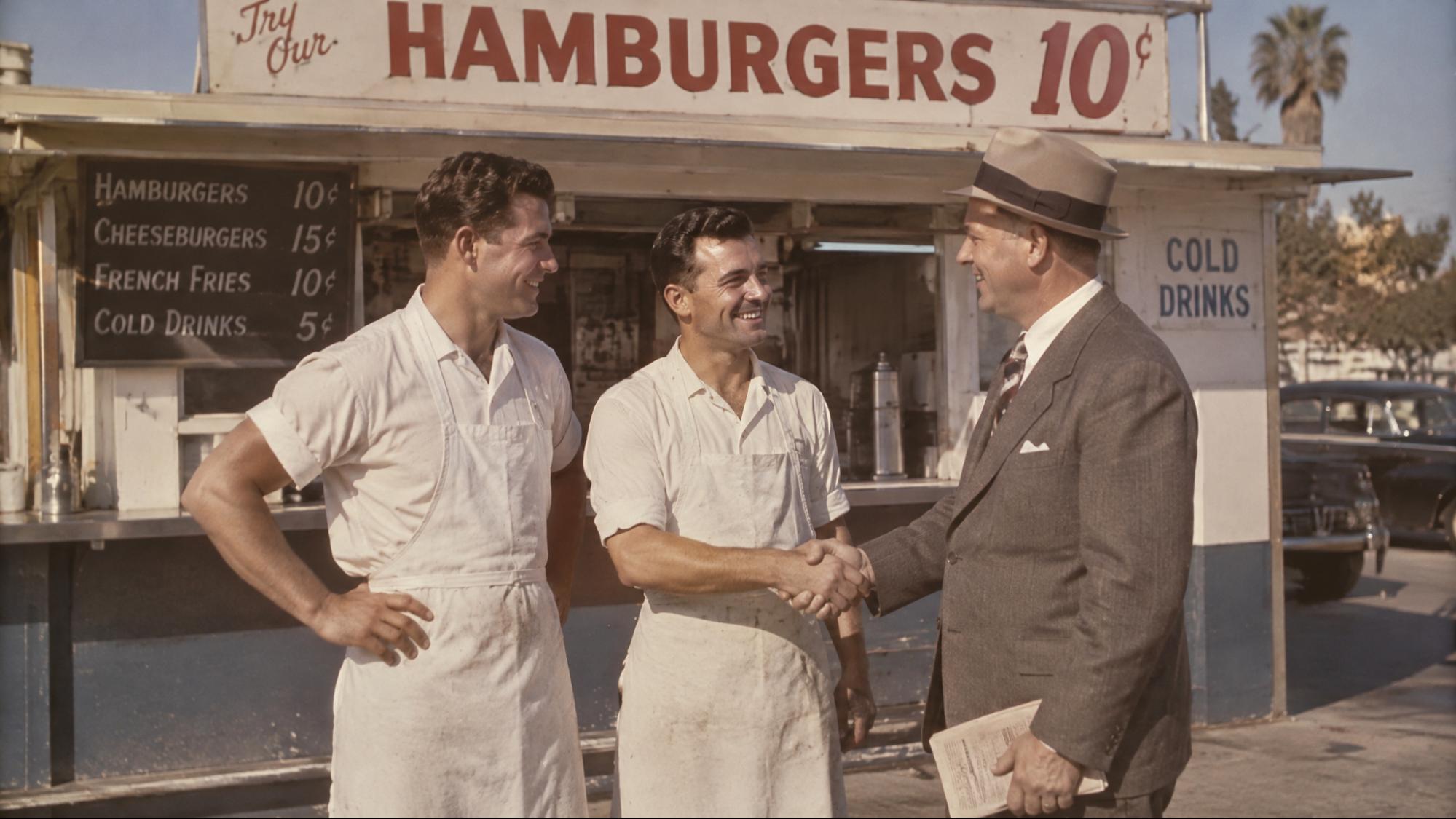
Dick and Mac were methodical builders. They spent years trimming waste, testing kitchen layouts, and protecting their local margins. They even started franchising before Kroc showed up, but they had zero desire to live on airplanes or manage hundreds of distant operators. After the 1961 buyout, they went in opposite directions: Dick retired quietly to New Hampshire, while Mac stayed in Palm Springs.
Kroc, meanwhile, had the salesman’s hunger to put a store in every city in America. Once he owned the name, his autobiography, restaurant wall plaques, and the company museum in Des Plaines, Illinois, cast the scaler as the founder and wrote the brothers out of the picture.
Patrick McDonald’s Firing and the $1 Million Promise
Patrick James McDonald, an immigrant from Ireland, spent 42 years working at the G.P. Crafts shoe factory in Manchester, New Hampshire. The plant was a 20,000-person operation in a gritty mill city on the Merrimack River, and Patrick worked his way up to shift manager overseeing part of a roughly 20,000-person workforce. Then the company let him go for his age. He walked out with no severance and no pension.
Patrick and his wife, Margaret Curran McDonald, raised five kids in Manchester, including Maurice, born in 1902, and Richard, born seven years later in 1909. Mac went to Central High and Dick went to West High, sitting in the same Manchester classrooms as the Revson brothers, who later founded Revlon.
Dick and Mac promised each other they would never depend on an employer and set a concrete target: make $1 million each before turning 50. That exact after-tax number later dictated the price of their 1961 buyout.
McDonald’s 1940: The Barbecue Drive-In Before Fast Food
McDonald’s opened in 1940 as McDonald’s Bar-B-Que at 14th and E Streets in San Bernardino, California, about a mile south of Route 66, operating as a traditional carhop drive-in whose leaking margins eventually forced the brothers to reinvent the restaurant from scratch. Put up with roughly $5,000 in capital and a 25-item menu, the place brought in money, but the operational math was ugly. Carhops spent time flirting for inflated tips, customers walked off with silverware, and dishes constantly ended up shattered in the parking lot. Worse, the lot turned into a noisy teenage hangout that kept families away.
After moving to California in the late 1920s, they worked as movie studio stagehands and bought a movie theater in Glendora that never turned a profit during the Depression. In 1937, they pivoted to food by opening a small Monrovia hot dog stand close to the Santa Anita Racetrack, which did fine during racing season and went dead the rest of the year.
How the McDonald Brothers Invented Fast Food in 1948
By 1948, Dick and Mac were tired of replacing broken plates and managing carhops, so they treated their San Bernardino kitchen like an engineering problem.
The Books Said Hamburgers: The October 1948 Closure
When Dick went through the sales ledgers, he found that hamburgers accounted for roughly 80% of total sales. The barbecue ribs, pulled pork, and elaborate sandwiches barely moved. In October 1948, the brothers shut the doors for three months and fired every carhop. They gutted the kitchen and cut the menu from 25 items down to 9. Locals thought they had lost their minds, and during the rocky early months after reopening, fired former employees stood across the street heckling them.
A Kitchen Drawn in Chalk on a Tennis Court
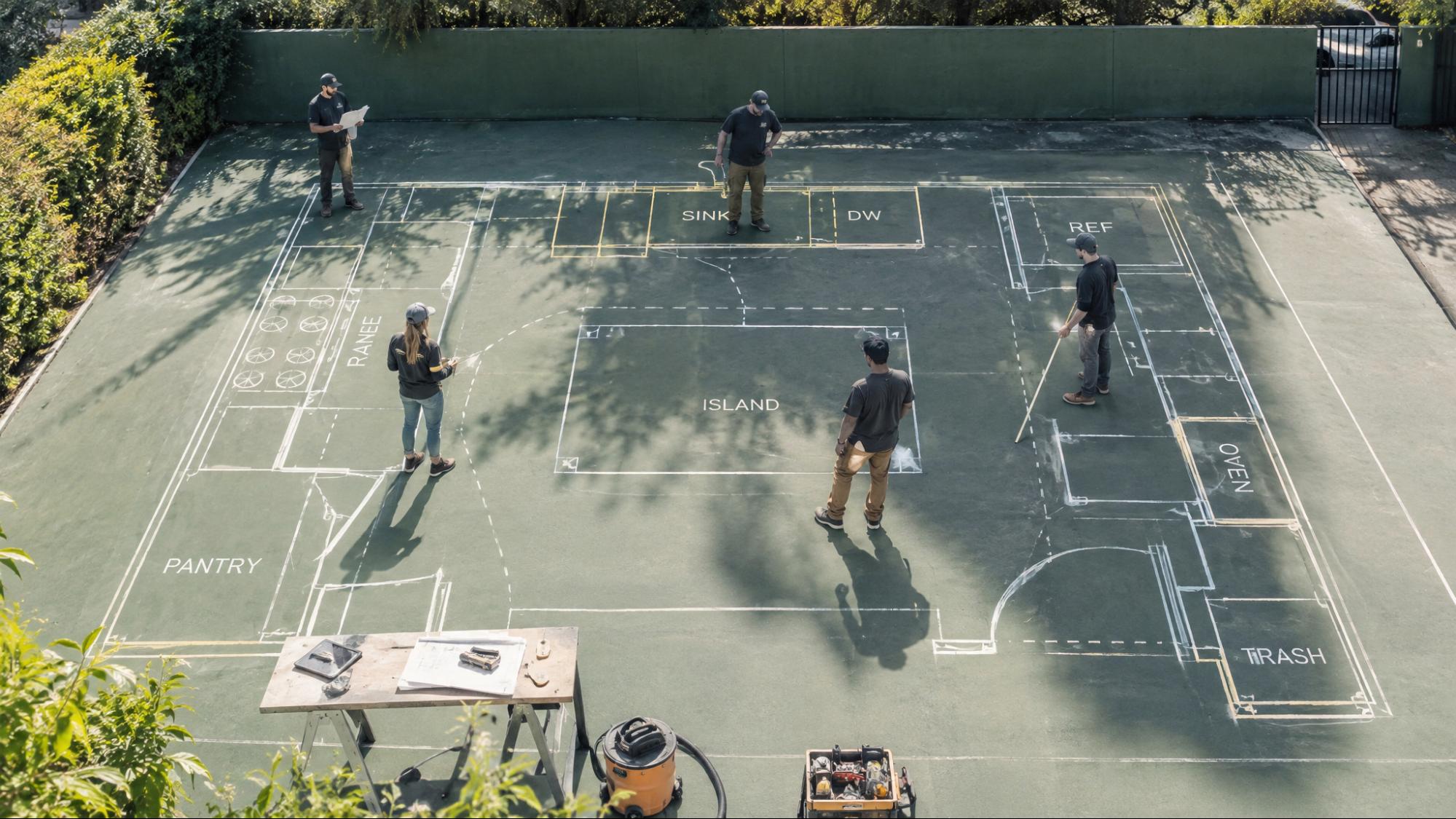
Before ordering new steel equipment, Dick walked out to his backyard tennis court with a piece of chalk and drew a full-scale kitchen layout on the pavement. He brought the staff over to rehearse orders in pantomime, redrawing the stations every time two workers bumped elbows. When a rainstorm washed the lines away overnight, they came back the next morning and drew the whole thing again. They used the same tennis-court chalk method in 1952 to map out equipment dimensions for their architect.
The Speedy Service System: 15 Cents, 30 Seconds
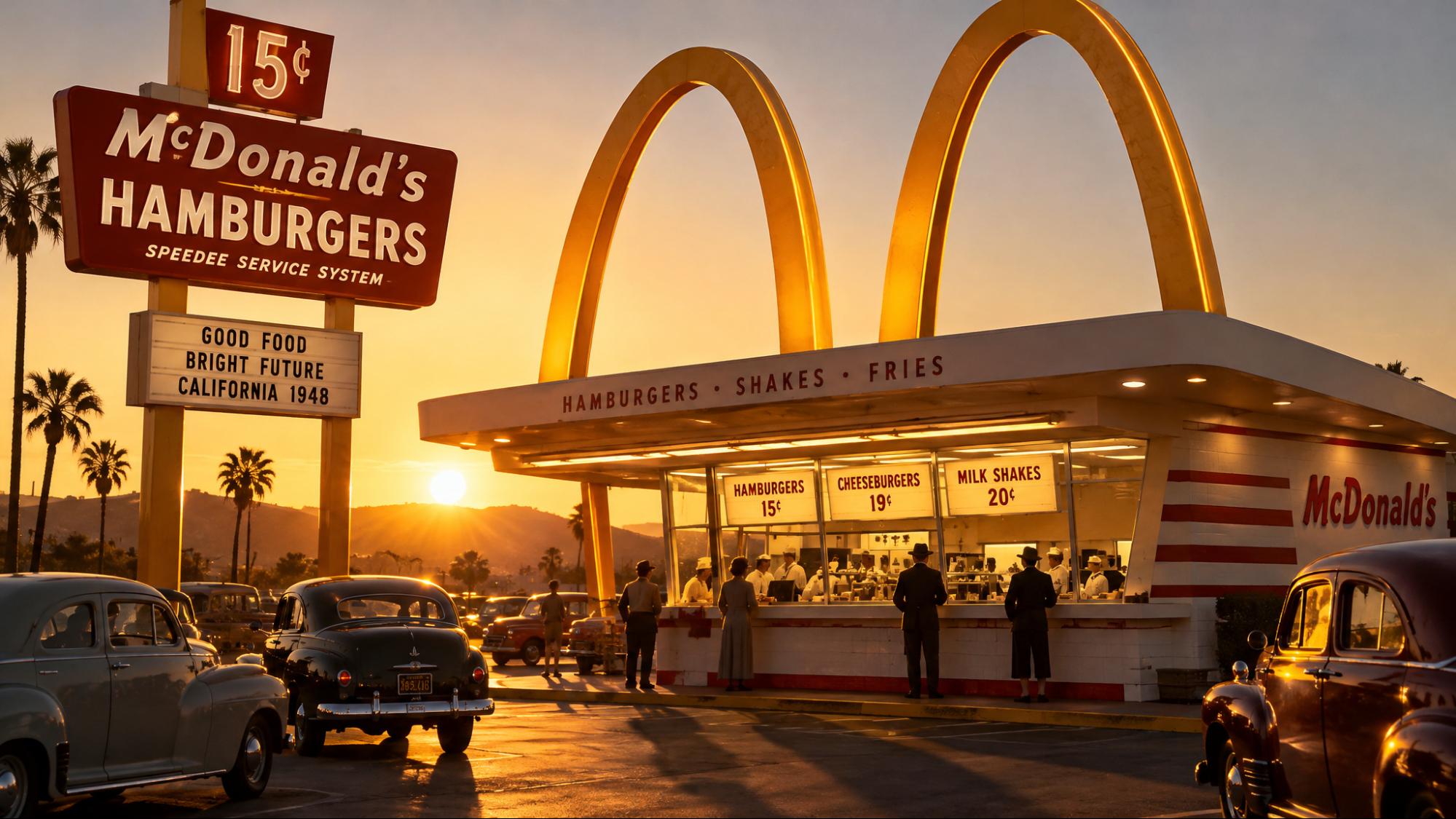
The reopened restaurant ran on what the brothers called the Speedy Service System, an operation with 9 menu items, no plates, no silverware, and no waitresses. Customers got a 15-cent hamburger handed through a walk-up window in a paper wrapper within 30 seconds. The kitchen ran like a factory floor where each employee handled a single step, applying Henry Ford’s factory assembly line to food.
Golden Arches and the First Franchises Before Kroc
Once the San Bernardino kitchen was printing money, the brothers designed a building that drivers could spot from blocks away and started licensing the concept themselves.
The Arches Dick Refused to Lose
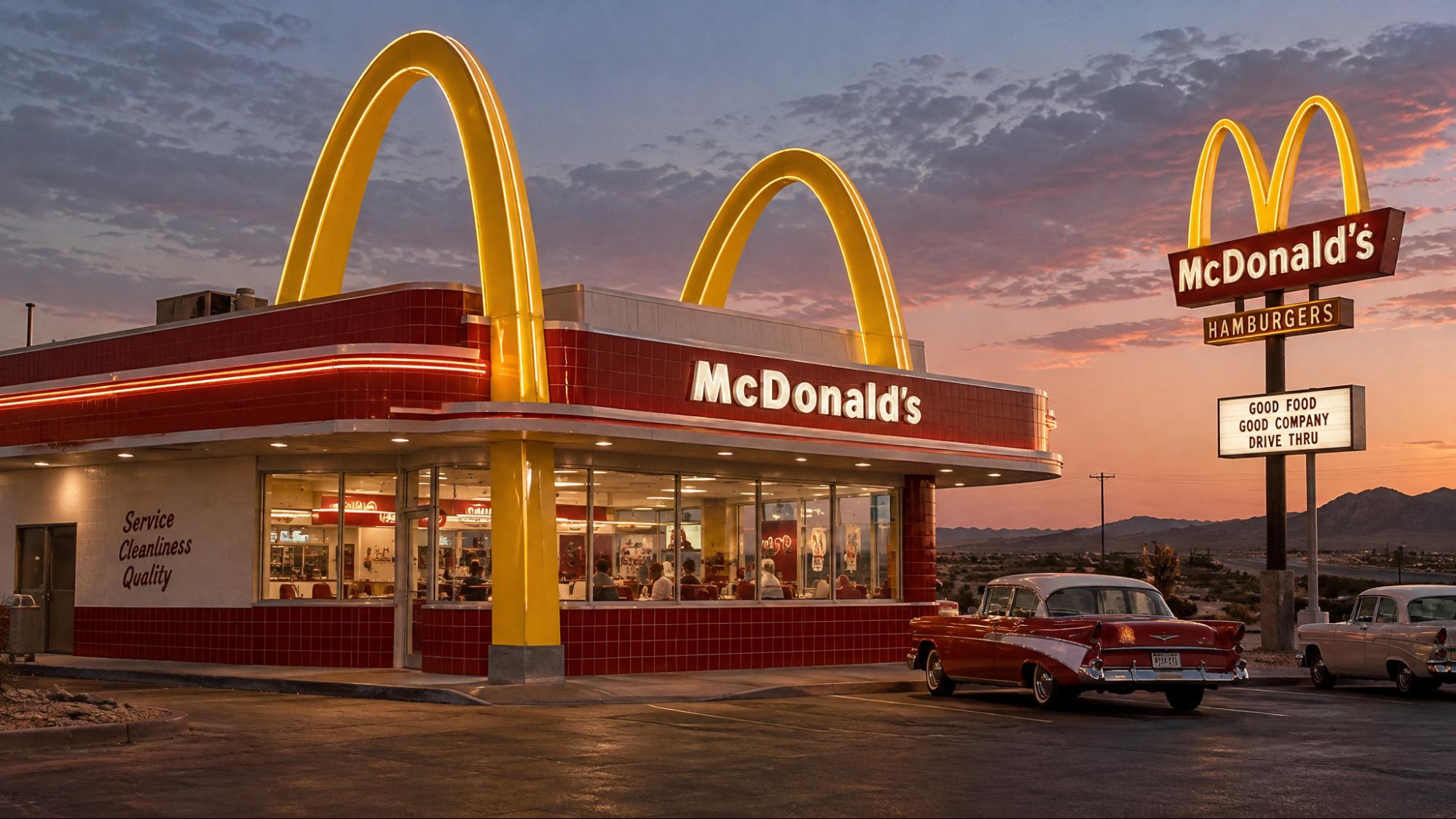
In 1952, the brothers hired architect Stanley Clark Meston and his assistant Charles Fish to design a new building. The result combined red and white ceramic tile, stainless steel, pulsing neon, and two 25-foot yellow sheet-metal arches slicing right through the roofline. Meston hated the golden arches. He thought they ruined the design and reportedly asked the brothers not to tell anyone he built it, but Dick refused to take them out.
The First Franchises: Phoenix, Downey, and the $1,000 Fee
The brothers started franchising a year before Ray Kroc ever saw the place. They sold their first franchise in 1953 in Phoenix, Arizona, to a gasoline distributor named Neil Fox for a flat $1,000 fee. In 1953, they sold the second in Downey, California, to Fox’s brother-in-law, a location that still operates as the oldest surviving McDonald’s in the world. Selling stores for a flat fee taught the brothers a hard lesson: keeping quality tight from hundreds of miles away was a headache, which made them deeply protective of their veto rights when Kroc came knocking.
Ray Kroc’s Arrival: 52 Years of Failure, One Big Order
In 1954, a single hamburger stand in San Bernardino ordered eight five-spindle Multi-Mixers, enough machinery to blend 40 milkshakes at the exact same time. For Ray Kroc, that order looked like a typo, so he flew out to California to see who needed that much capacity.
Kroc was born in Oak Park, Illinois, in 1902, the exact same year as Maurice McDonald, to Czech immigrant parents. His father, Alois Kroc, made a fortune speculating on land in the 1920s and lost all of it in the 1929 crash. Ray quit school at 15, lied about his age to drive a World War I Red Cross ambulance alongside a young Walt Disney, and spent the next three decades hustling. He sold Florida real estate, played piano in jazz bands, and worked his way up at the Lily-Tulip Cup Company before betting his career on the Multi-Mixer.
By the early 1950s, Kroc was 52, deep in debt, and watching Hamilton Beach eat into his mixer sales. Standing in the San Bernardino parking lot, watching a line wrap around the building, he saw his way out.
Inside Ray Kroc’s Scaling Machine
Kroc scaled McDonald’s by pairing strict operational cloning with a land-lease model, driven by a 1955 contract that gave him 1.9% of franchise gross sales while the brothers took 0.5% with almost zero overhead and kept veto power over menu, building, and procedure changes. He opened his first store in Des Plaines, Illinois, in April 1955, standardized everything down to the exact thickness of a pickle slice on a burger, and passed 100 US locations by 1959. He also opened Hamburger University in an Elk Grove Village restaurant basement in 1961 to award “hamburgerology” degrees, and took the Big Mac national in 1968 as the top seller after fries.
Even with that expansion, Kroc netted just $77,000 in 1960 while the brothers’ one store cleared over $100,000. Harry Sonneborn fixed the math through the Franchise Realty Corporation, buying restaurant land and leasing it to franchisees on sales-tied rent; the company now owns 70% of its buildings and 45% of the land underneath.
The 1961 Sale and the Handshake That Was Never Written Down
Ray Kroc didn’t steal McDonald’s from the McDonald brothers in the legal sense. He bought the company in 1961 for $2.7 million in cash. Whether he cheated Dick and Mac comes down to a disputed handshake deal for a 0.5% perpetual royalty that never made it into the written contract. Under their 1955 franchising agreement, the brothers already collected 0.5% of gross sales, and they claimed Kroc verbally promised to continue that 0.5% cut forever during buyout talks before denying the promise existed.
| Buyout Term | 1961 Written Contract | Disputed Handshake Deal |
|---|---|---|
| Upfront purchase price | $2.7 million ($1 million each after taxes) | $2.7 million ($1 million each after taxes) |
| Total cost to Kroc with loan interest | $14 million | $14 million |
| Ongoing 0.5% royalty on gross sales | No (terminated at closing) | Yes (perpetual 0.5% on all future sales) |
| Annual value on $130B+ modern sales | $0 | Approximately $650 million per year (unverified counterfactual) |
| Brand name and trademark rights | Yes (transferred to Kroc) | Yes (transferred to Kroc) |
| Original San Bernardino real estate | Partial (retained by brothers, without the name) | Partial (retained by brothers, without the name) |
The $2.7 million price tag wasn’t random. The brothers sized the number so that after paying taxes, Dick and Mac would each walk away with exactly $1 million, finally checking off the promise they made after their father was fired from the shoe factory. Kroc reportedly called the price outrageous. Harry Sonneborn raised the capital from institutional lenders, and by the time the loans were paid off, interest pushed Kroc’s true buyout cost to $14 million.
According to the brothers’ side of the story, Kroc told them his backers would never sign the loan papers if a perpetual royalty was on the page, so he offered a handshake on the 0.5% instead. Kroc denied that conversation ever happened.
McDonald’s generates over $130 billion in annual system-wide sales; 0.5% of that is roughly $650 million a year. The brothers sold the entire company for less than three days’ worth of that hypothetical royalty check. Still, that $650 million figure is a counterfactual built on an unverified handshake, not money legally owed. Anyone who has watched a long-term business partnership go sideways knows the trap: when two sides have worked together for years, it’s easy to treat the paperwork as a formality right up until the moment one side holds all the leverage.
The Big M: Two Restaurants, One Street, One Name
The original McDonald’s restaurant in San Bernardino isn’t open anymore because it was demolished in 1971 after losing a same-street turf war with Ray Kroc, leaving the 1953 franchise in Downey, California, as the oldest McDonald’s still operating today.
When Dick and Mac signed the 1961 buyout, they kept the land and building at 14th and E Streets, planning to hand the business over to their long-time employees. Because Kroc now owned the family name, the brothers had to take “McDonald’s” off the roof. They sharpened the golden arches into a giant letter M and reopened the place as The Big M.
Kroc wasn’t in the mood to let them coexist. He opened a brand-new McDonald’s just a few blocks away. That left two restaurants on the same street selling the exact same 15-cent burgers and fries, except only one of them had the McDonald’s sign out front. The Big M folded within six years. The original building was torn down in 1971, turning into a parking lot and later a small museum, while Kroc’s 1955 Des Plaines store was promoted by the company as its official museum piece.
How Ray Kroc Wrote the Brothers Out of the Story
Kroc erased the brothers from company history by naming his 1955 Des Plaines, Illinois store the “original McDonald’s” in his autobiography and hanging plaques across the chain that credited his own vision, persistence, and leadership without mentioning Dick or Mac. In the early 1960s, the company also retired Speedy, the hamburger-headed chef mascot Dick had helped create, and replaced him with the clown Ronald McDonald, never acknowledging that the brothers’ actual nephew was named Ronald McDonald.
What Happened to the McDonald Brothers After the Sale
Richard McDonald died in 1998 with a $1.8 million estate and Maurice McDonald died in 1971 after clearing $1 million after taxes in the 1961 buyout, meaning the McDonald brothers died rich by the standard of their childhood $1 million goal but held a tiny fraction of Ray Kroc’s $600 million fortune. While Richard’s $1.8 million estate and three-bedroom house in Bedford, New Hampshire, are on record, no final estate figure for Maurice is public beyond his $1 million after-tax payout from the sale.
Dick in New Hampshire: The No-Regrets Line and a $1.8 Million Estate
After 1961, Dick packed up and moved back to New Hampshire because he disliked California’s constant sun and preferred cloudy days. He lived in a modest three-bedroom house in Bedford, never sued McDonald’s, and kept his rare interviews brief and polite. When a reporter asked if he regretted selling, Dick joked that holding on would have landed him in a skyscraper with four ulcers and a team of eight tax attorneys scrambling to handle his income taxes. Dick died on July 14, 1998, in a Manchester nursing home at age 89; his wife Dorothy died six months later, and both were buried at Mount Calvary Cemetery in Manchester.
Mac in Palm Springs: Recognition, Not Money
Mac stayed in California after spending more than 30 years there, settling in Palm Springs with no second career and no role at the company. According to his nephew, Ronald McDonald, Mac’s real grievance was never the money; it was the total lack of recognition, and watching the erasure tore him apart from the inside. On December 11, 1971, Mac suffered fatal heart failure at his desert home at age 69; his gravesite is in Cathedral City, California, at Desert Memorial Park.
Ray Kroc’s $600 Million and Where the Fortune Went
Ray Kroc was worth $600 million when he died on January 14, 1984, leaving behind over 7,500 McDonald’s locations, the San Diego Padres, and a 554-acre Santa Ynez Valley ranch before his widow Joan gave nearly the entire fortune away.
Ray Kroc’s Death and the $600 Million Fortune
Following a stroke in 1980 and a stay in alcohol rehabilitation, Kroc died of heart failure in San Diego on January 14, 1984, at age 81. By then, McDonald’s had grown past 7,500 locations. Kroc had also bought the San Diego Padres in 1974 for $12 million. During a season opener in front of 39,000 fans, he famously grabbed the public-address microphone and told the stadium he had never seen such stupid ball playing.
The J and R Double Arch Ranch: Headquarters Disguised as a Home
In 1966, Kroc paid $600,000 for a 554-acre property in the Santa Ynez Valley near Santa Barbara, naming it the J and R Double Arch Ranch for himself and his third wife, Joan, whom he met in 1957 and married in 1969. Its 17,000-square-foot lodge with over 20 bedroom suites functioned as half home and half corporate headquarters, and the Egg McMuffin was developed in its test kitchen. In 1972, Kroc built Joan a circular hilltop house that locals nicknamed “the hamburger.” The ranch was later listed at $29 million and never sold at that price.
Joan Kroc Gave Nearly All of It Away
Joan Kroc inherited the fortune and spent the rest of her life giving nearly all of it away, including $100 million to Ronald McDonald House and $25 million to a peace institute at the University of San Diego. When she died of brain cancer in 2003, her will left more than $200 million to National Public Radio and $1.5 billion to the Salvation Army for community centers across America, the largest single charitable bequest recorded at the time.
The Founder, 40,000 Restaurants, and a Plain Gravestone
The Founder is the 2016 biographical film starring Michael Keaton as Ray Kroc that brought the McDonald brothers’ 1948 kitchen invention and the brutal math of the 1961 buyout back into public view. By dramatizing how Kroc visited San Bernardino, took over national franchising, and bought out Dick and Mac before sidelining them from company history, the movie put the brothers’ role back in front of audiences who only knew the plaques.
Today, the machine those three men built operates over 40,000 restaurants across more than 100 countries, feeding tens of millions of people every day and bringing in over $130 billion in annual system-wide sales. The corporation still runs on Harry Sonneborn’s real-estate play, owning 70% of its restaurant buildings and 45% of the land underneath them.
Up on a hill at Mount Calvary Cemetery in Manchester, New Hampshire, Richard McDonald’s gravestone has no corporate title, no slogan, and no golden arches. It just has his name, carved into stone in the same mill town where two brothers decided to build something an employer could never take away.
Frequently Asked Questions
Did Ray Kroc Steal McDonald’s From the McDonald Brothers?
Legally, no. Kroc paid the brothers $2.7 million in cash in 1961 to buy out their company, name, and trademarks. The accusation of theft comes from a disputed handshake agreement for a 0.5% perpetual royalty on gross sales, which the brothers claimed Kroc promised to keep off the loan paperwork and then refused to honor. Kroc denied the verbal deal ever happened, and after taking control, he actively wrote Dick and Mac out of the official corporate history.
What Was Richard McDonald’s Net Worth?
Richard McDonald left behind a $1.8 million estate when he died in 1998 at age 89. He had initially cleared $1 million after taxes from the 1961 buyout, fulfilling a youth pact he made with his brother Maurice after their father Patrick was fired from the G.P. Crafts shoe factory after 42 years without a pension. He spent his retirement living quietly in a three-bedroom house in Bedford, New Hampshire, and claimed he had zero regrets about walking away from the corporate grind.
Did the McDonald Brothers Die Rich?
By the standard of their childhood goal to make $1 million each, yes, though their wealth was a tiny fraction of Ray Kroc’s $600 million empire. Both brothers netted $1 million after taxes from the $2.7 million sale in 1961. Richard died in 1998 with a $1.8 million estate, while Maurice died of heart failure in 1971 in Palm Springs with no public estate figure recorded beyond his initial $1 million payout.
What Is the Ray Kroc Movie?
The 2016 biographical drama The Founder, starring Michael Keaton as Ray Kroc, tells the story of how the struggling milkshake-mixer salesman took over McDonald’s. The film dramatizes the brothers’ 1948 kitchen engineering, including their tennis-court chalk layout, alongside Kroc’s 1955 franchising push and the ruthless 1961 buyout. It put Dick and Mac’s contributions back in front of the public.
How Does the McDonald’s Real-Estate Model Work?
Engineered by Kroc’s finance partner Harry Sonneborn through the Franchise Realty Corporation, the model turns McDonald’s into a landlord rather than just a burger licensor. Before the real-estate pivot, Kroc netted just $77,000 in 1960 because his 1.9% franchise sales cut barely covered expansion overhead. By buying restaurant land and leasing the properties to franchisees for rent tied to sales, the corporation secured wider margins and owns 70% of its buildings and 45% of the underlying land.
Was this worth your time?
What missed? (optional)