
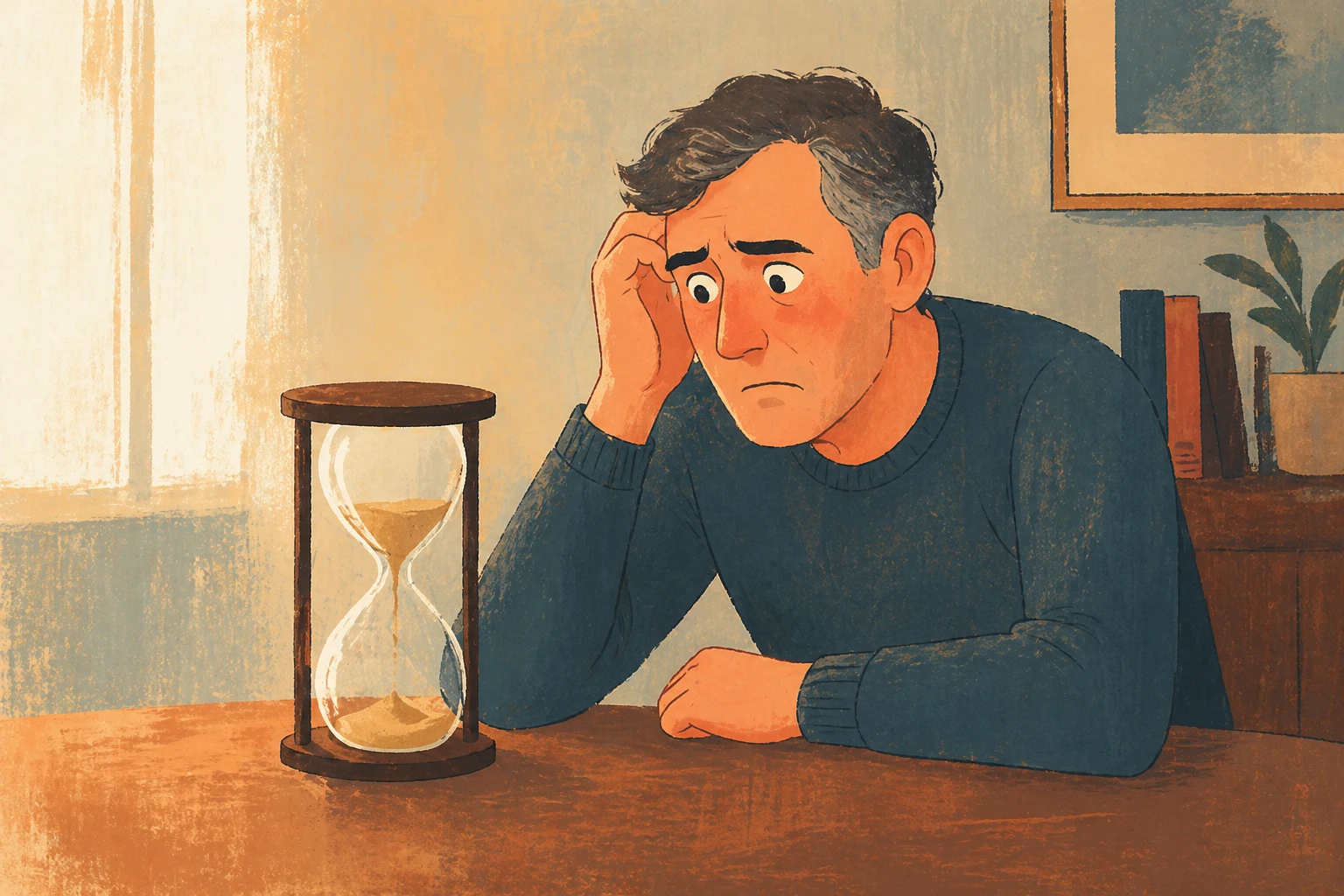
There’s a particular kind of anxiety that shows up in your 40s or 50s.
It doesn’t announce itself loudly. It doesn’t panic like a market crash or scream like a margin call. It just sits there quietly, in the background, doing the math.
You should have more by now.
Not more in the abstract. More in a very specific, uncomfortable way. More saved. More invested. More time behind you doing the work that compounds.
And once that thought takes hold, something subtle but dangerous begins to happen.
You stop thinking long term.
The Math vs. The Feeling
On paper, retirement is a math problem.
Save consistently. Invest reasonably. Let time do the heavy lifting.
But in real life, it’s rarely experienced that way.
It’s experienced as comparison. As regret. As a quiet realization that the years you thought you had are fewer than you expected.
And when time shrinks, patience shrinks with it.
A 25 year old can afford to be boring. A 50 year old who feels behind starts looking for something else.
Not necessarily because they’re greedy.
Because they’re scared.
The Appeal of Catching Up
Get rich quick schemes rarely advertise themselves as such.
They come dressed as opportunities.
A friend who “knows a guy.”
A new investment that’s “different this time.”
A strategy that promises to compress decades of growth into a few years.
What they’re really offering isn’t just returns.
They’re offering relief.
Relief from the feeling that you’re behind. Relief from regret. Relief from the slow, grinding nature of compounding that no longer feels fast enough.
And that’s what makes them so powerful.
Because they’re solving an emotional problem, not a financial one.
When Time Becomes the Enemy
The irony is that the moment you feel most pressure to take risk is often the moment you can least afford to.
When you’re young, volatility is a feature. You have time to recover.
When you’re older and feel behind, volatility becomes a threat. There’s less margin for error.
But emotions don’t care about that distinction.
They see a gap between where you are and where you think you should be and they want it closed now.
So you reach.
You take on risk you don’t fully understand.
You invest in things you wouldn’t have touched ten years earlier.
You convince yourself that this is the move that fixes everything.
And sometimes, it works.
Just often enough to keep the idea alive.
The Stories We Don’t Tell
For every story of someone who made a late life financial comeback, there are many more that quietly disappear.
The person who doubled down and lost.
The retirement that was delayed, then downsized, then quietly redefined.
The plans that became compromises.
These stories don’t get headlines.
They don’t get podcasts or book deals.
But they’re far more common.
The Real Risk
The biggest risk in trying to catch up quickly isn’t that you fail.
It’s that you permanently damage what you already have.
A portfolio that’s behind but stable can still grow.
A portfolio that’s blown up chasing a shortcut has no second act.
And that’s the part that’s easy to overlook when you’re focused on the gap.
You’re not starting from zero.
But risky decisions can take you there.
A Different Way to Think About It
There’s a quiet shift that happens when people make peace with being behind.
Not giving up. Not ignoring reality.
Just accepting that the path forward may look different than the one they imagined.
It often means:
Lowering expectations of what retirement looks like.
Working a few years longer.
Saving more aggressively, but investing more conservatively.
Focusing on what’s still within control instead of what’s already passed.
None of that is exciting.
None of it makes for a good story.
But it works.
Time Isn’t Just Years
When people think about being behind, they usually think in terms of years.
“I’m ten years late.”
“I should have started earlier.”
But time in investing isn’t just about the calendar.
It’s about behavior.
A person who makes steady, rational decisions for the next 10 years is often better off than someone who tries to make up for the last 20 in the next two.
Not because they found a secret.
Because they avoided a mistake.
The Temptation That Never Goes Away
Even people who know all of this still feel the pull.
That’s the uncomfortable part.
You can understand the math. You can understand the risks. And still, when you feel behind, a small voice says:
Maybe this is the one that changes everything.
That voice doesn’t go away.
You just get better at not listening to it.
The Long Game, Even When It’s Shorter
There’s no perfect solution for feeling behind on retirement.
There’s only trade offs.
But one of the most reliable patterns in finance is that the desire to get rich quickly is often what prevents people from getting rich at all.
Not because they didn’t try hard enough.
Because they tried to skip the part that requires time.
And time, even when there’s less of it than you hoped, is still doing more of the work than anything else.
The goal isn’t to erase the past.
It’s to avoid making it worse.