
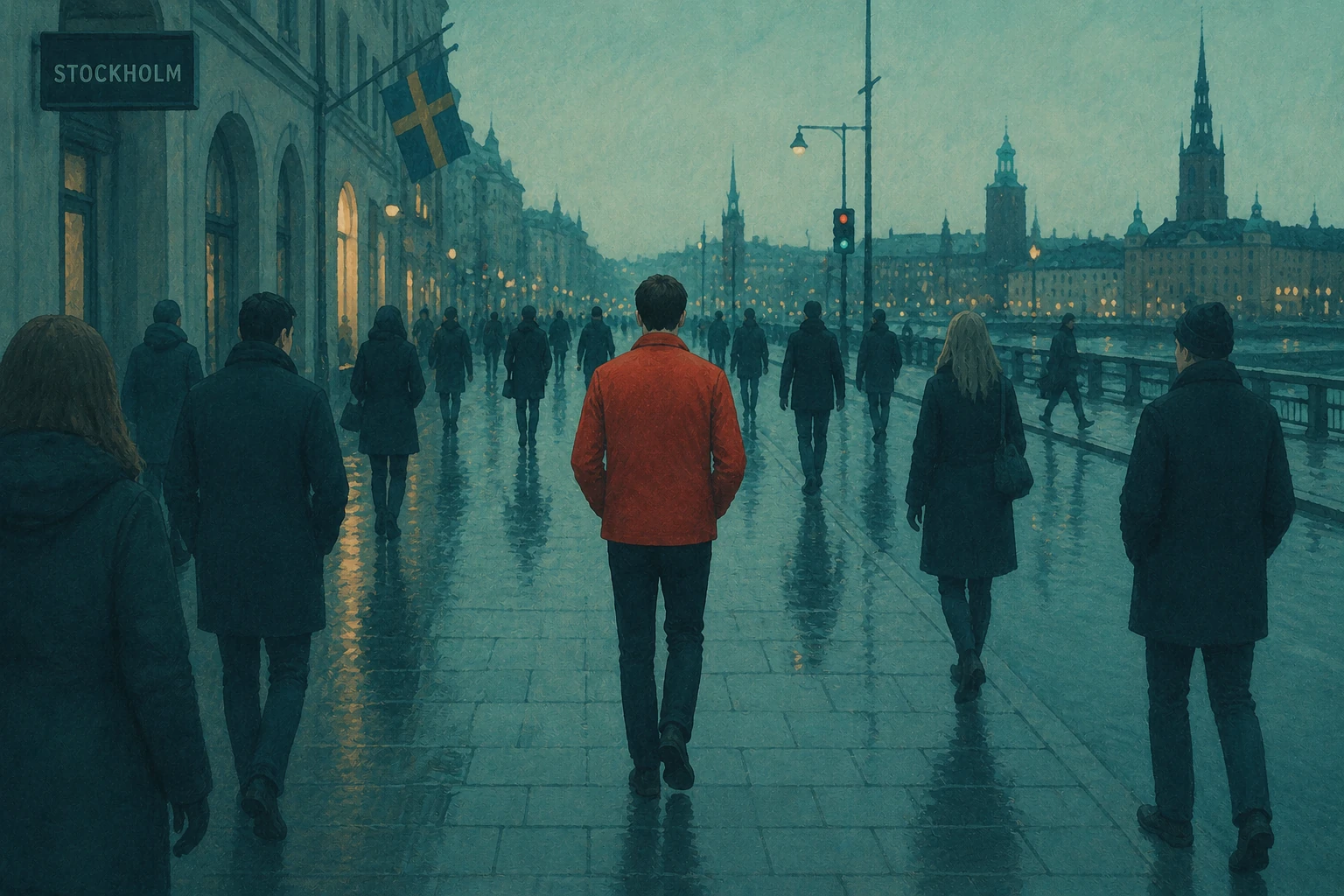
There’s something uniquely unsettling about realizing a place can give you almost everything you thought you wanted while somehow making you feel less alive over time.
That’s the feeling I couldn’t shake after living in Sweden for years.
On paper, it looked perfect. Clean cities. Beautiful nature. Public transportation. Universal healthcare. Stability. The kind of country people speak about like it’s the final evolved form of civilization.
When I first moved there, I remember feeling almost proud of myself. Like I had figured something out other people hadn’t.
For the first few months, it even felt magical.
Everything worked.
The trains were clean. The streets were quiet. People were polite. The air felt different somehow. There was this calmness to everything that initially felt sophisticated and mature compared to the louder, messier countries I had known before.
But slowly, over time, something started to feel… off.
Not dramatically off.
Not “this place is horrible.”
Just emotionally sterile.
Like living inside a beautifully designed apartment where nobody actually laughs.
The hardest thing to explain to people is that the coldness wasn’t obvious. Nobody was screaming at me. Nobody was openly hostile. In fact, people were often very polite. But after years there, I realized politeness and warmth are completely different things.
You can go days surrounded by people who are technically kind while still feeling profoundly alone.
That became one of the defining feelings of my life there: loneliness in crowded places.
I tried hard to integrate. I learned the language. I worked there. I built a life there. But after a while I started realizing most of my close friendships were with other immigrants. And eventually many of them left too.
Some moved back home. Others relocated to different countries entirely. Every time that happened, it felt like rebuilding my social life from scratch.
The strange thing is even many locals admitted this wasn’t unusual.
Several people openly told me that most Swedes form their friend groups early in life and don’t really expand them much afterward. Even native-born adults described making new friends there as difficult. That honesty almost made it sadder somehow because it meant I wasn’t imagining things.
Social interactions often felt sealed behind invisible glass.
You could have pleasant conversations with people for months and still never truly feel invited into their lives.
And then there was the subtle hierarchy you begin noticing as an outsider.
The assumptions.
The small pauses.
The slight change in tone when people hear your accent.
The way people sometimes spoke to me differently when I was alone versus when I was with someone Swedish.
Once, I was accused at a restaurant of not paying my bill. The situation immediately changed when a Swedish friend showed up. Nobody apologized. The suspicion just quietly evaporated.
Experiences like that are difficult because they’re almost impossible to prove. Nothing dramatic happens. But after enough moments like that, they accumulate psychologically.
You begin carrying this low-grade awareness that you are never fully seen as belonging.
And if you’re not white, from what many people shared with me, the experience can be much worse.
One thing that really surprised me was healthcare.
From the outside, Scandinavian healthcare is often described like some flawless system. The reality felt far more complicated. I arrived with existing diagnoses and prescriptions and still ended up trapped in endless waiting loops, referrals, delays, and bureaucratic dead ends.
Months would pass just trying to access basic continuity of care.
Again and again, I was told some variation of:
“You should just go private.”
Which becomes frustrating when you’re already paying extremely high taxes while being told the real solution is to spend even more money outside the system.
That contradiction wore me down over time.
The same thing happened with the social safety net. People constantly describe Scandinavian countries as places where society catches you if you fall. But watching people struggle through long sick leave processing times, delayed applications, reduced benefits, and endless bureaucracy made me lose confidence in the idea that the system would actually protect me if my life truly fell apart.
I started realizing my real safety net was still just my own savings account.
That realization changes your relationship to the entire society around you.
But honestly, the hardest part wasn’t the bureaucracy or even the healthcare issues.
It was the emotional atmosphere.
The conflict avoidance.
The feeling that nobody ever says what they really think.
People were often extremely politically correct in public while quietly judgmental in private. Conversations rarely felt fully honest. There was this constant pressure to remain agreeable, restrained, emotionally contained. Everything felt smoothed over.
At some point I realized I missed emotional messiness.
I missed spontaneous conversations.
I missed warmth.
I missed people who showed enthusiasm openly instead of acting like emotions should be kept on a leash at all times.
And the strangest part is that the country really is beautiful.
That’s what makes all of this emotionally confusing.
The nature is stunning. The cities are safe. The infrastructure works. Parents receive support. Public spaces are clean. Many things genuinely are better than in other countries.
But eventually I realized something uncomfortable:
A society can function extremely well while still feeling emotionally difficult to live inside.
That was the hardest thing for me to explain to people back home. They wanted the story to be simple. Either Sweden was paradise or I was exaggerating.
The truth was more complicated.
It’s entirely possible for a country to be stable, advanced, organized, and objectively successful while still making certain people feel deeply isolated.
And after years there, that isolation slowly started outweighing everything else.
By the time I finally admitted to myself that I wanted to leave, the feeling wasn’t anger anymore.
It was grief.
Grief for the version of my future I thought I was building there.
Grief for the fantasy I had attached to the country before I moved.
Because sometimes the hardest experiences in life aren’t disasters.
Sometimes they’re places that are almost what you wanted.