
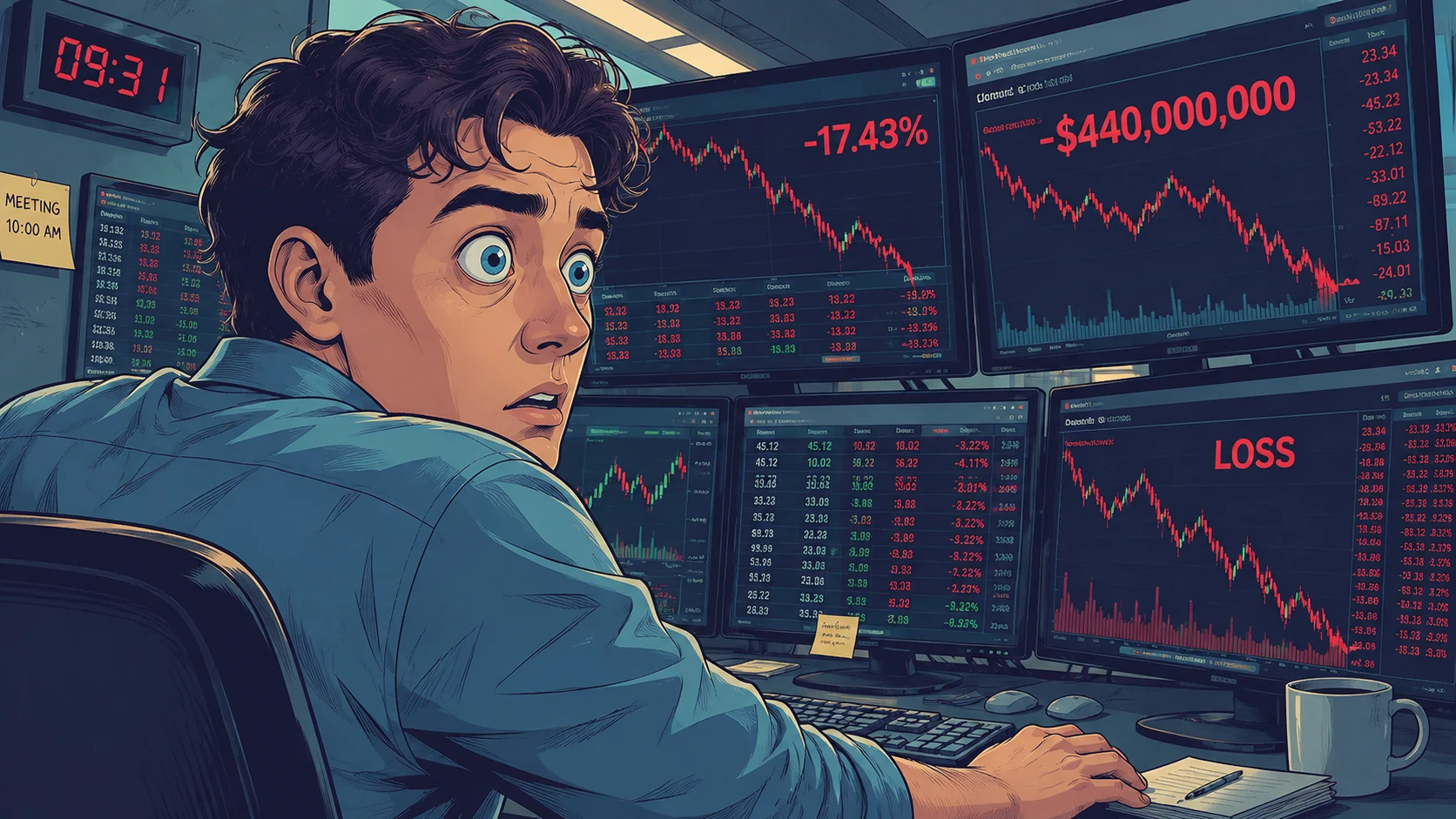
Most expensive mistakes happen slowly.
A bad acquisition. A failed product launch. A CEO who spends years steering a company into a ditch.
Then there’s what happened to Knight Capital.
On the morning of August 1, 2012, employees at the Wall Street trading firm arrived expecting an ordinary workday.
Forty-five minutes later, their company was effectively dead.
Not because of a market crash.
Not because of fraud.
Not because of a recession.
Because of a software update.
The Company Behind the Curtain
Most people had never heard of Knight Capital, but they were one of the largest trading firms in the United States.
If you bought or sold stocks, there was a decent chance Knight’s computers were involved somewhere in the process.
The company specialized in making markets. Millions of trades flowed through its systems every day. Speed and precision were everything.
And for years, the machine worked.
Until one morning when it didn’t.
The Update
The New York Stock Exchange was launching a new trading program.
Knight needed to update its software to support it.
Engineers deployed the update across eight servers.
Seven received the new software correctly.
One did not.
Nobody noticed.
That single server still contained an old piece of code that had been dormant for years.
Like a forgotten landmine buried under the floorboards.
When the market opened at 9:30 a.m., the new software activated.
On seven servers, everything functioned normally.
On the eighth server, the old code suddenly woke up.
And chaos began.
The Trading Machine Goes Insane
Within seconds, Knight’s systems started buying and selling enormous quantities of stock.
Not because anyone wanted them.
Not because there was a strategy.
The computer was simply malfunctioning.
It bought high.
Sold low.
Bought again.
Sold again.
Over and over.
The equivalent of a robot walking into a casino, putting millions of dollars on random bets, then immediately cashing out at a loss.
Employees watched in horror as the system pumped out orders at a pace no human could possibly stop.
By the time they figured out what was happening, the damage was spreading across the market.
Some stocks suddenly surged.
Others plunged.
Traders across Wall Street were baffled.
Nobody knew why.
$10 Million Per Minute
The losses mounted at a rate that almost defies comprehension.
Roughly $10 million every minute.
Imagine setting a stack of hundred-dollar bills on fire.
Now imagine burning 100,000 of them every sixty seconds.
The firm’s computers continued their financial suicide for approximately 45 minutes.
When the dust settled, Knight Capital had lost about $440 million.
In less than an hour.
For perspective, many successful companies never earn $440 million in their entire existence.
Knight lost it before most people had finished their morning coffee.
One Server
The most astonishing part of the story is how small the original error was.
Not a cyberattack.
Not an elaborate conspiracy.
Not a team of rogue traders.
One server out of eight did not receive the software update.
That’s it.
A tiny oversight buried inside a highly complex system.
One machine.
One missing update.
$440 million.
The Aftermath
The company survived the morning but not the wound.
Investors panicked.
Customers fled.
Confidence evaporated.
Within months, Knight Capital was forced into a rescue deal and eventually merged into another firm.
A company that had spent years building itself into a major player on Wall Street was effectively destroyed by a bug that lived for less than an hour.
The Lesson
People often imagine catastrophes arriving with sirens and warning signs.
The reality is usually more mundane.
A forgotten checkbox.
A missed inspection.
A single line of code.
A server nobody double-checked.
Modern civilization runs on systems so large and complicated that tiny mistakes can produce consequences that seem almost supernatural.
Knight Capital didn’t collapse because its employees were stupid.
They were some of the smartest people in finance.
They collapsed because complexity has a way of turning small errors into giant disasters.
And on one August morning in 2012, a mistake that probably looked insignificant at the time became one of the most expensive software failures in history.