
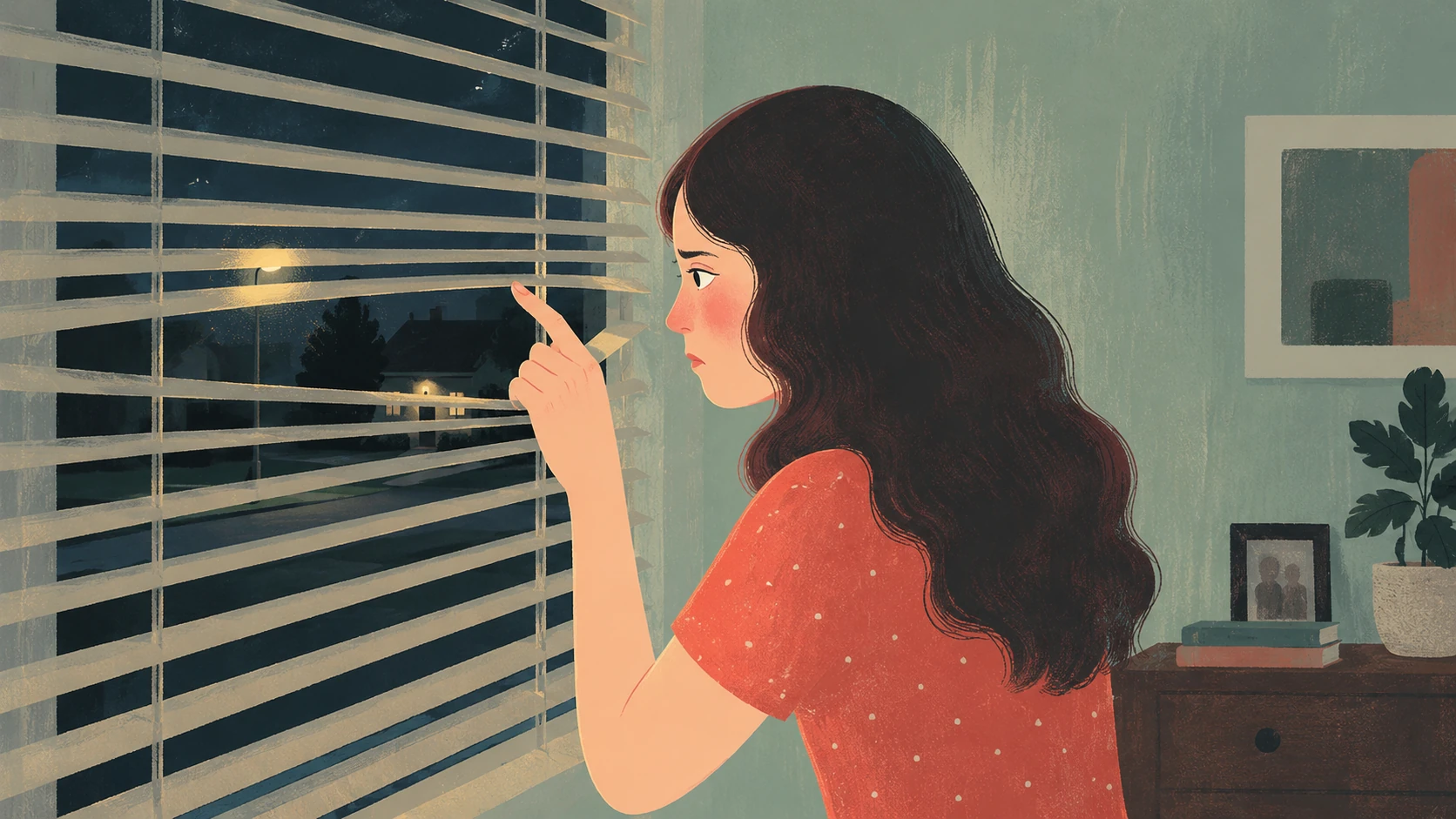
For two years, there was a stranger living at the edges of my life.
He wasn’t someone I knew. I never dated him. I never had a friendship with him. To this day, I don’t even know for certain where he first saw me. The police believed he probably followed me home from somewhere—a work event, a social gathering, a night out—but nobody was ever able to determine exactly when I first entered his orbit.
What I do know is that once I did, he never seemed willing to let me leave it.
The experience didn’t begin with anything dramatic. There was no threatening letter, no frightening confrontation, no obvious sign that I was in danger. Instead, there was simply a growing sense that the same person kept appearing wherever I happened to be.
At first I questioned my own judgment. Most people would. We cross paths with strangers all the time. You see someone at a coffee shop, then again at a grocery store, and your brain notices the coincidence.
But eventually the coincidences became too numerous to ignore.
I began noticing him with unsettling regularity. Sometimes he would be standing nearby, watching. Sometimes our eyes would meet and he would smile pleasantly. There was nothing overtly threatening about his behavior. In fact, that was part of what made it so difficult to explain to other people.
If someone had looked at a single interaction in isolation, they probably would have seen nothing unusual at all. What they didn’t see was the accumulation of those encounters: the same face, the same presence, the same feeling that someone was quietly inserting himself into the background of my life.
Then the gifts started appearing.
Flowers. Chocolates. Small offerings left where I would find them.
I remember how confusing that stage was because gifts are supposed to be kind gestures. They’re supposed to make people feel appreciated. Yet there was something deeply unsettling about receiving them from a person I didn’t know and had never invited into my life.
Every gift carried the same unspoken message: I know where you are.
As time passed, the behavior escalated.
What had once been occasional sightings became regular appearances. What had once felt like coincidence began to feel deliberate. He started spending time around my house. He lingered nearby. Sometimes I would catch glimpses of him outside.
The realization that someone knows where you live changes something fundamental inside you.
Home is supposed to be the place where the rest of the world stays outside. It’s where you close the door and stop performing for strangers. It’s where you relax.
When somebody starts appearing around your home, that separation disappears.
I began looking out windows differently. Every unfamiliar car attracted my attention. Every movement outside caught my eye. I found myself becoming hyperaware of things I had never noticed before.
Then came the moments that still make my skin crawl when I think about them.
I caught him looking through my windows.
Not once. Not twice. Many times.
There is something uniquely violating about realizing a stranger has been watching you inside your own home. It isn’t just fear. It’s embarrassment, anger, vulnerability, and helplessness all mixed together.
You suddenly start wondering how much they’ve seen. How long they’ve been there. Whether they’re watching right now.
Eventually I discovered he had been recording me.
He would use a phone attached to a telescopic pole to film through my bedroom window.
Even writing those words feels surreal.
For a long time after that, I couldn’t fully relax at home. I still struggle with it. To this day, I dislike having curtains or blinds open after dark. Rationally, I know the danger is gone. Emotionally, part of me still remembers what it felt like to realize somebody had been standing outside, watching me in moments when I believed I was alone.
The stalking wasn’t constant, which in some ways made it harder.
People often imagine a stalker as someone who appears every day, relentlessly and predictably. My experience was different. He would disappear for stretches of time. Just long enough for me to start believing that maybe it was finally over.
Then he would reappear.
That cycle became its own kind of torture.
You begin to heal. You start to relax. You reclaim some sense of normality. Then suddenly there he is again, reminding you that he never really left.
The uncertainty was exhausting.
I spent a lot of time asking myself the same question.
Why me?
It sounds simple, but anyone who has been targeted like this understands how consuming that question becomes. What made me interesting enough to obsess over? Was there something I had done? Something I could have avoided?
The frustrating truth is that there was never a satisfying answer.
I read extensively about stalking psychology during those years. Some stalkers are motivated by rejection. Others by power. Some by sexual obsession. Some by mental illness. Some by fantasies that spiral into something dangerous.
Knowing the theories didn’t make it any easier to understand why I had become the focus of one person’s fixation.
Eventually I turned to the legal system.
The police were supportive and helpful. They gave me advice on personal safety, home security, and documenting incidents. After enough evidence had accumulated, I was able to obtain a restraining order.
I remember feeling hopeful.
For the first time, it felt like there was a formal acknowledgment that what I had been experiencing was real and unacceptable. A court had reviewed the evidence and ordered him to stay away.
The optimism lasted less than twenty-four hours.
The day after the restraining order took effect, he showed up in my garden.
Looking back, that moment captures the helplessness that stalking victims often experience. You do everything you’re supposed to do. You report the incidents. You document the behavior. You follow the legal process. Then the person you’re trying to escape simply ignores it.
My boyfriend at the time had been watching all of this unfold.
He had listened to the stories. He had seen the fear. He had watched someone slowly chip away at my sense of security.
Before the restraining order came through, he had told me that if the legal route failed, he would handle it himself.
I didn’t entirely believe him.
As it turned out, I should have.
When the stalker appeared in our garden, my boyfriend confronted him.
The details of what happened next became the stuff of dark jokes among friends, but at the time it was anything but funny. The following morning, I found several of the man’s teeth scattered across the patio, along with blood that had dried overnight.
I remember standing there with a pressure washer, cleaning blood from my own property, thinking about how absurd my life had become.
For two years, I had worried about what this man might do.
For two years, I had altered my routines, watched my surroundings, and carried the weight of someone else’s obsession.
And now I was washing away the physical evidence of the final confrontation.
Oddly enough, I remember feeling sorry for him.
Not because I thought he was innocent. Not because I believed what he did was excusable. But because healthy people don’t spend years hiding outside strangers’ homes. Healthy people don’t record women through bedroom windows. Healthy people don’t dedicate years of their lives to pursuing someone who wants nothing to do with them.
Whatever was broken inside him had led him to this moment.
That realization didn’t erase my anger, but it complicated it.
After that, the physical stalking stopped.
There were a few attempts to contact me online using fake social media accounts, but the man who had spent years hovering at the edges of my life was suddenly gone.
People sometimes ask whether the experience traumatized me.
I suppose it depends on how you define trauma.
I don’t spend my days living in fear. I don’t think about him very often anymore. But I also don’t sit in a brightly lit room with uncovered windows after dark.
I notice unfamiliar cars more than I once did. I pay attention to who is standing nearby. I lock doors that I once might have left unlocked.
Those habits are small, but they remain.
The stalking ended years ago. My life moved on. Relationships began and ended. New experiences replaced old fears.
Yet every now and then, usually when I’m closing the curtains for the night, I’ll remember what it felt like to discover someone watching from the darkness outside.
And in those moments, I’m reminded that the most lasting effect of stalking isn’t necessarily fear.
It’s the loss of certainty.
The loss of that unquestioned belief that when you’re alone, you’re actually alone.