
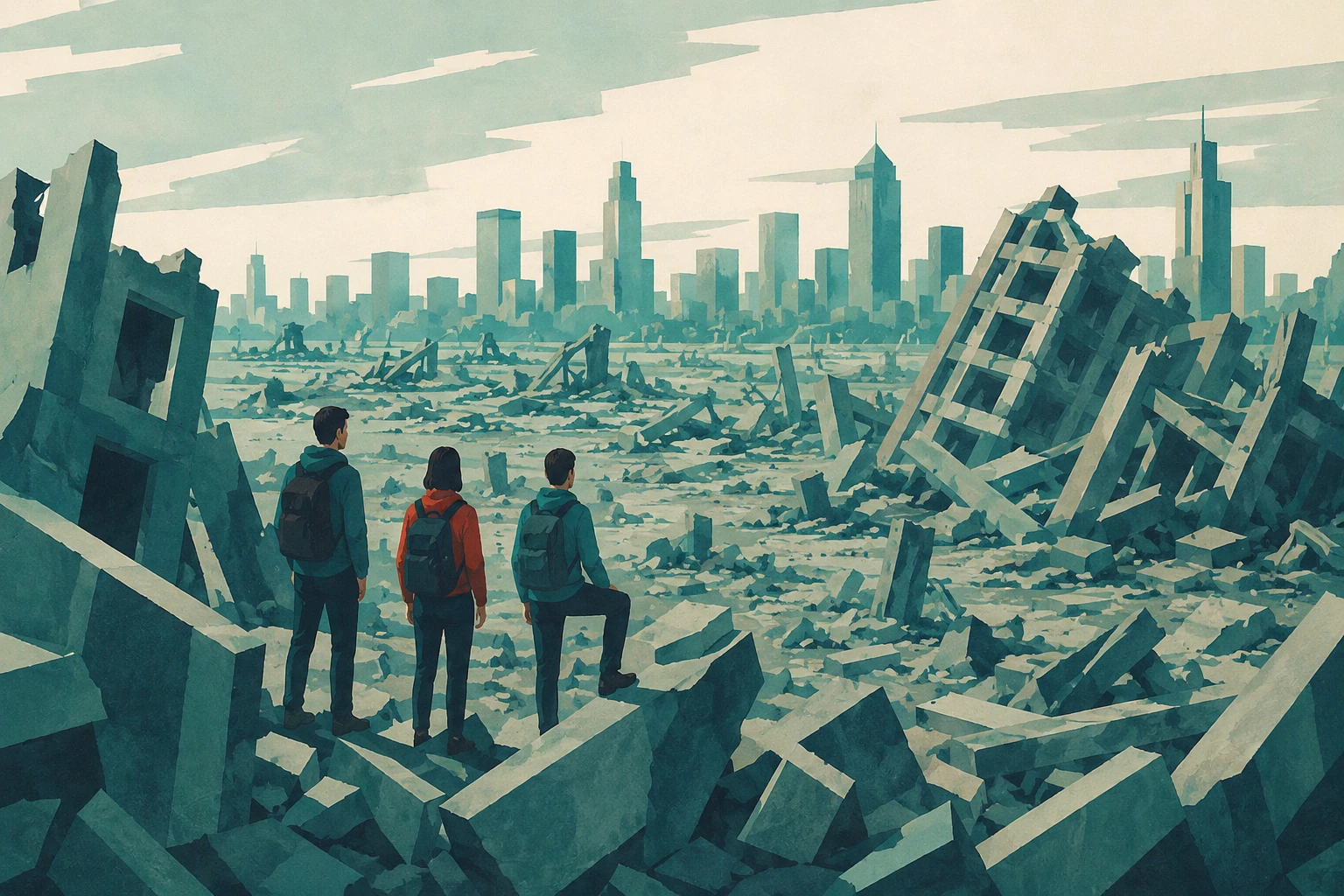
Imagine waking up tomorrow and civilization is gone.
Not humanity. Not life itself.
Just civilization.
The power grid is dead. The internet is gone. Fuel pumps don’t work. Supply chains have collapsed. The grocery store shelves are empty. Nobody is coming to fix anything.
How long would it take us to get back to where we are today?
The answer is both reassuring and terrifying.
The good news is that humanity wouldn’t disappear.
The bad news is that rebuilding civilization might take centuries.
The First Problem: Survival
Most people think rebuilding civilization starts with technology.
It doesn’t.
It starts with food.
Modern agriculture is one of the greatest achievements in human history. A handful of farmers using tractors, fertilizer, GPS-guided equipment, and global supply chains feed billions of people.
Take away those systems and everything changes.
Modern cities contain only a few days’ worth of food. Water treatment plants require electricity. Fertilizer factories require industrial infrastructure. Farm equipment requires fuel and replacement parts.
In the immediate aftermath of a collapse, the priority wouldn’t be rebuilding smartphones.
It would be figuring out how to avoid starvation.
The survivors would spend years simply trying to stabilize food production.
We Wouldn’t Start From Scratch
Here’s the important distinction.
Humanity wouldn’t be returning to the Stone Age.
The survivors would inherit the largest collection of tools, machines, books, factories, and technical knowledge ever assembled.
Every library would still exist.
Every engineering textbook would still be sitting on a shelf somewhere.
Millions of machines would still be scattered across the landscape.
Even if nobody could manufacture a new tractor, old tractors could be repaired and cannibalized for parts.
Civilizations that collapsed in the past had to rediscover everything.
We wouldn’t.
We would know exactly what we were trying to rebuild.
That’s a massive advantage.
Electricity Comes Back Surprisingly Fast
People often assume electricity would be gone for generations.
Not necessarily.
Small communities could restore power relatively quickly.
Hydroelectric dams would still exist.
Solar panels would still work.
Wind turbines would still stand.
Engineers and electricians wouldn’t suddenly forget how power systems function.
Local power generation could return within years in some regions.
The challenge would be scaling it.
Generating electricity for a town is one thing.
Rebuilding a continent-wide electrical grid is something else entirely.
That could take decades.
The Real Bottleneck Is Industry
Here’s where things get difficult.
Modern civilization rests on layers upon layers of industrial complexity.
To build a smartphone, you need semiconductors.
To build semiconductors, you need precision manufacturing.
To build precision manufacturing equipment, you need advanced metallurgy.
To produce advanced metallurgy, you need mining operations.
To run mining operations, you need fuel, transportation networks, machine tools, and industrial chemistry.
It’s like a giant pyramid.
Most people only see the tip.
But beneath every modern object lies an astonishing amount of hidden infrastructure.
Take something as simple as a ballpoint pen.
Making one from scratch requires mining metals, refining petroleum, manufacturing plastics, transporting materials, building factories, and maintaining quality control systems.
Now imagine trying to rebuild an MRI machine.
Or a jet engine.
Or a microchip.
Civilization is a lot more fragile than it looks.
The Semiconductor Problem
If there is one technology that might take the longest to restore, it’s computer chips.
Modern semiconductor fabrication plants are among the most complex facilities ever created by human beings.
The clean rooms are cleaner than operating rooms.
The manufacturing tolerances are measured in nanometers.
The supply chains span dozens of countries.
A single advanced chip may require thousands of manufacturing steps.
After a civilization-wide collapse, survivors could probably build radios, steam engines, and simple electrical devices relatively quickly.
But recreating modern computer processors?
That might take generations.
Not because the knowledge would be lost.
Because rebuilding the industrial ecosystem required to make them is extraordinarily difficult.
Transportation Takes Longer Than You Think
Roads don’t disappear overnight.
Railroads don’t vanish.
Ports remain.
But maintenance does.
Bridges eventually fail.
Tracks deteriorate.
Pavement cracks.
Vehicles break down.
Without a functioning industrial base, transportation networks slowly degrade.
Communities would likely become more localized for a long time.
Trade would continue, but at a much smaller scale.
Think less Amazon Prime and more nineteenth-century merchant networks.
Medicine Suffers the Most
One of the most sobering realities is healthcare.
Modern medicine depends on industrial civilization.
Antibiotics require manufacturing facilities.
Vaccines require sophisticated laboratories.
Medical imaging depends on advanced electronics.
A surgeon with training but no equipment can only do so much.
Human life expectancy would almost certainly fall dramatically during the rebuilding phase.
Many diseases that are minor inconveniences today would become major threats again.
So How Long Would It Actually Take?
The answer depends on what you mean by “civilization.”
If you mean organized communities, agriculture, basic industry, and electricity?
Perhaps 10 to 30 years.
If you mean railroads, large-scale manufacturing, and reliable national infrastructure?
Maybe 50 to 100 years.
If you mean a world with commercial aviation, advanced medicine, satellites, smartphones, artificial intelligence, and global trade?
Potentially several centuries.
Not because people would be incapable.
Because every generation would first need to rebuild the foundation beneath it.
Civilization isn’t a single invention.
It’s millions of inventions stacked on top of one another.
The Most Important Resource Isn’t Oil
It’s knowledge.
The greatest advantage survivors would possess is knowing what is possible.
Ancient civilizations didn’t know electricity existed.
They didn’t know germs caused disease.
They didn’t know steam engines could power factories.
We do.
That knowledge would survive.
Books would survive.
Universities could be rebuilt.
The scientific method would survive.
Humanity wouldn’t be wandering in the dark trying to rediscover the secrets of nature.
It would be climbing back up a ladder that had already been built once before.
And that’s why the answer is ultimately optimistic.
A collapse would be catastrophic.
Millions might die.
Entire industries could vanish.
Decades of progress could be erased.
But humanity has something no previous civilization possessed:
A complete instruction manual.
The question wouldn’t be whether civilization could be rebuilt.
The question would be how quickly we could rebuild everything we’ve become accustomed to taking for granted.