
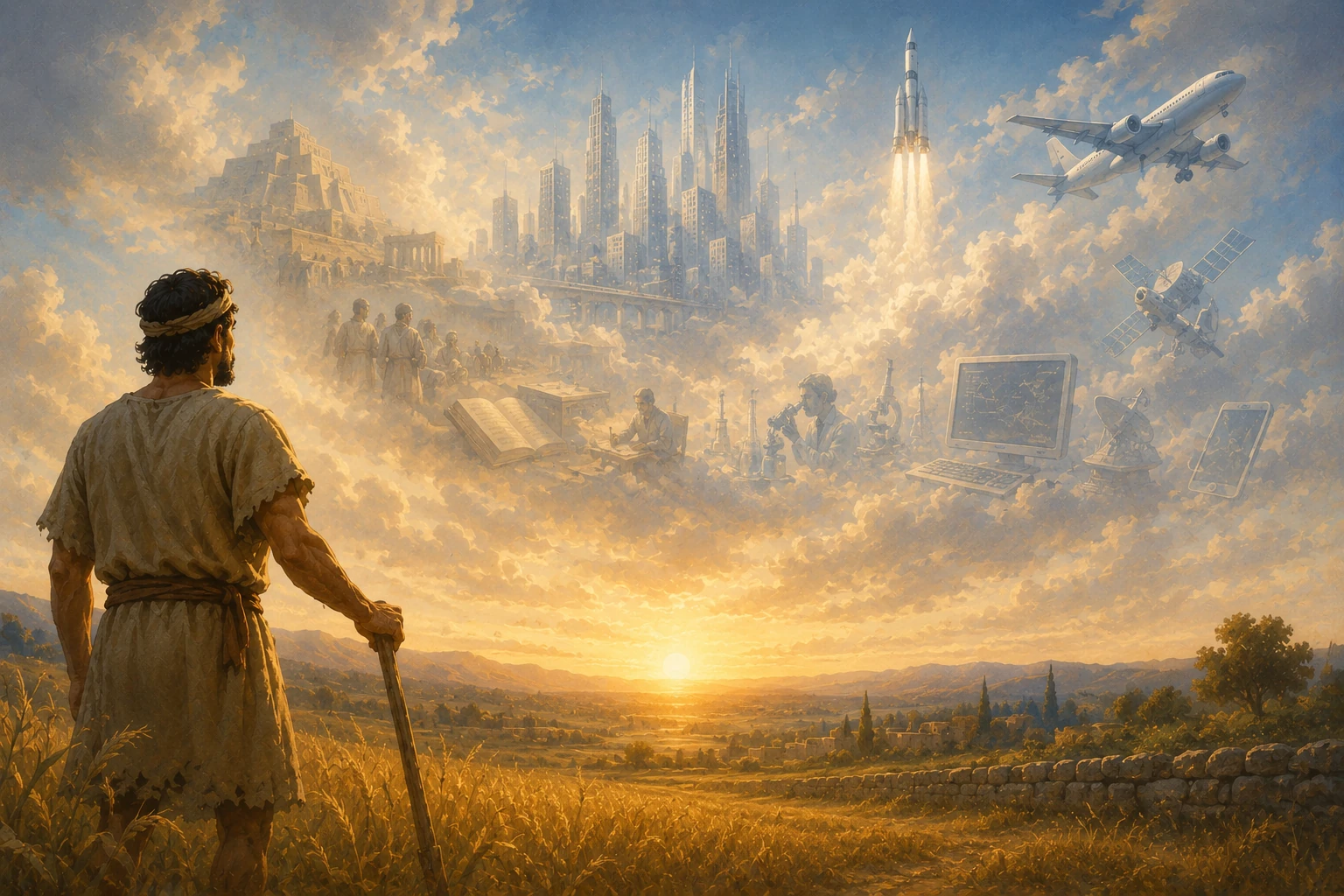
When people think about humanity’s greatest achievement, they often point to the Moon landing, the Internet, modern medicine, or the construction of the pyramids. These accomplishments are undeniably impressive. Yet all of them depended on a far older breakthrough that transformed the human story more than any other: agriculture.
For most of human history, people lived as hunter-gatherers. Small bands moved across landscapes in search of food, following migrating animals and seasonal plants. It was a way of life that sustained humanity for hundreds of thousands of years. But around 12,000 years ago, something remarkable happened. In several parts of the world, humans began cultivating crops and domesticating animals.
At first, farming may not have seemed like an improvement. Early farmers often worked harder than hunter-gatherers. Their diets became less varied, and living in permanent settlements exposed them to new diseases. Yet agriculture provided one thing that no previous way of life could: a reliable surplus of food.
That surplus changed everything.
When a community could produce more food than it immediately needed, not everyone had to spend every day searching for the next meal. Some people became builders. Others became merchants, priests, soldiers, artists, engineers, and scholars. Villages grew into towns. Towns became cities. Cities became civilizations.
Agriculture made possible the rise of writing, which allowed knowledge to be preserved across generations. It enabled governments to organize large populations and coordinate ambitious projects. It fueled trade networks that connected distant cultures. It laid the foundation for scientific discovery, technological innovation, and economic growth.
Virtually every major achievement in human history can trace its roots back to agriculture. The scientific method required settled societies with educational institutions. Modern medicine depended on generations of accumulated knowledge. The Industrial Revolution was possible because agricultural advances freed millions of people from farm labor. Even the Apollo missions, which placed humans on the Moon, relied on the complex industrial society that agriculture made possible.
Agriculture also allowed the human population to grow dramatically. Before farming, the Earth could support only a relatively small number of people. Today, billions of lives depend on agricultural systems that produce food on an unprecedented scale. While modern agriculture brings its own challenges, from environmental concerns to questions of sustainability, it remains one of the most important reasons humanity has flourished.
Of course, agriculture was not a perfect development. It contributed to social inequality, warfare over resources, and environmental changes that still affect the planet today. Yet every major transformation carries costs alongside benefits. The question is not whether agriculture created problems—it did—but whether humanity would have achieved everything it has without it.
The answer is almost certainly no.
Without agriculture, there would be no cities, universities, hospitals, libraries, nations, or spacecraft. There would be no symphonies, skyscrapers, computers, or scientific revolutions. Humanity would still exist, but the world would be almost unrecognizable.
Agriculture was more than a new way to obtain food. It was the invention that made civilization possible. It turned survival into progress and transformed scattered groups of humans into a species capable of reshaping the planet and reaching for the stars.
If humanity’s greatest achievement is the one that made all other achievements possible, then agriculture stands above them all.