
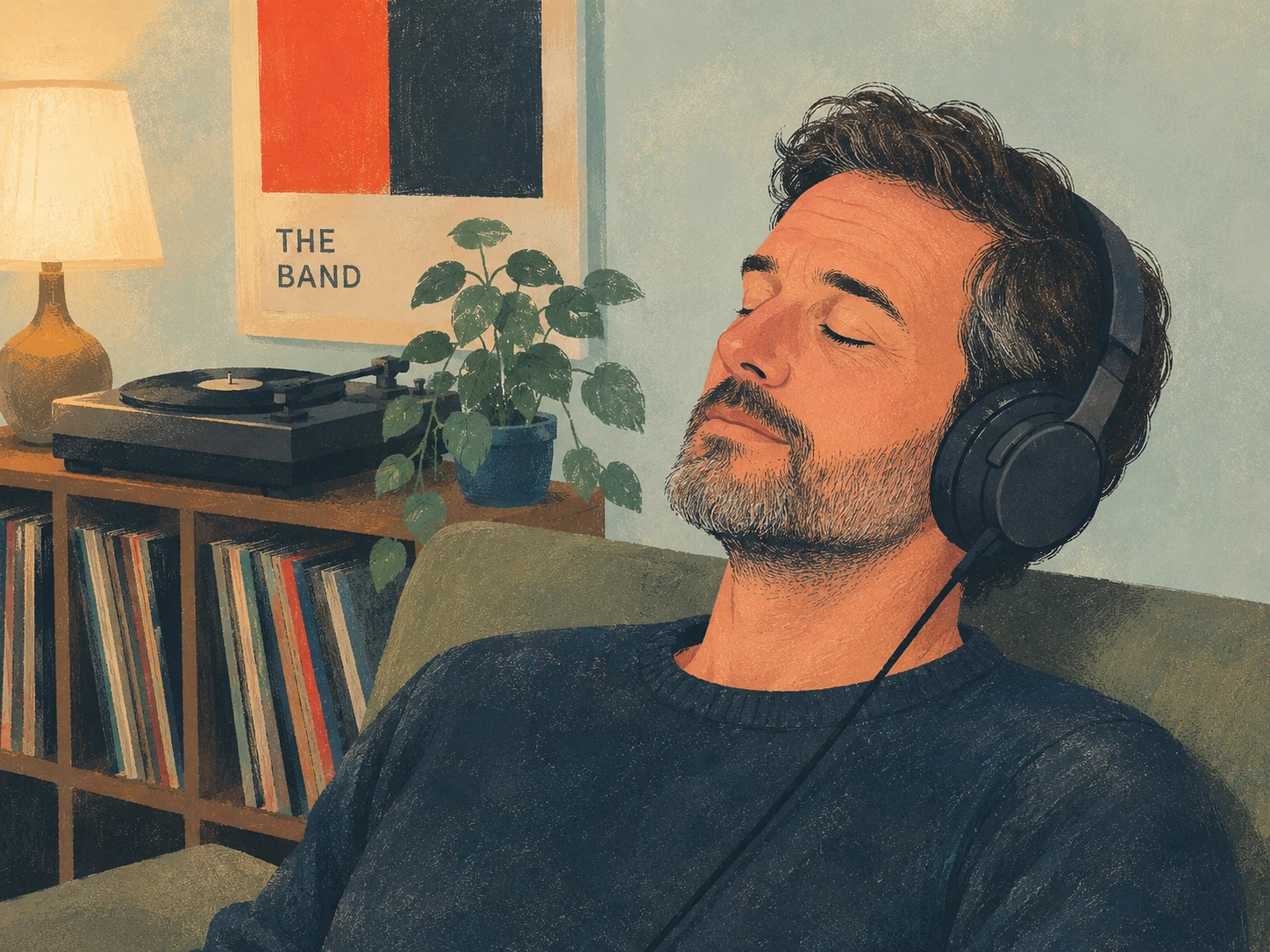
You probably can’t name a single song from the last two years that you’d voluntarily put on. Not because nothing good came out. Statistically, plenty did. It’s because somewhere along the way your brain filed “finding new music” under the same category as “learning a second language” and “doing your own taxes.” Technically possible. Realistically not happening.
And it’s not just music. It’s the five movies you re-watch on a loop. It’s the fact that you’ve seen The Departed enough times to recite Mark Wahlberg’s dialogue but somehow never got around to a single thing that won an award in the last decade. It’s the restaurant you order from because you already know the menu. Somewhere in your 30s, the part of you that used to chase the new stuff just clocked out. Quietly. Without a memo.
Here’s the thing: this isn’t laziness, and it isn’t a personal failing. It’s measurable, it’s neurological, and it happens to almost everybody on roughly the same timeline.
The numbers are weirdly specific
Researchers have actually pinned this down, and the dates are uncomfortably precise. A study of Spotify listening data found that people effectively stop seeking out new music around age 33. A separate survey from the streaming service Deezer put “musical paralysis” (their term for the point where you give up and just rerun the same playlists) at 30 years and six months on average.
The peak, the high-water mark of your curiosity, hits at 24. That’s when most people report listening to ten or more new tracks a week and actively hunting for new artists every month. After that it’s a slow leak. By your early 30s, the tap is basically off.
For what it’s worth, men hold on slightly longer than women. Guys hit their discovery peak around 25, women closer to 23. But nobody’s escaping the cliff. We’re all headed for the same playlist of stuff we loved in high school.
Why your teenage music feels like scripture
Here’s where it gets interesting, and a little tragic. The reason the songs from when you were 15 hit harder than anything you’ll hear at 45 isn’t nostalgia in the soft, greeting-card sense. It’s hardware.
Between roughly ages 12 and 22, your brain is going through rapid development at the exact same time it’s getting flooded with hormones that essentially scream “THIS IS IMPORTANT” at everything happening to you. Your first heartbreak, your first car, the song playing when both of those things happened. Your brain welds them together and files them as core memory. Brain imaging shows that the music you love lights up the reward circuit and dumps out dopamine, serotonin, and oxytocin. Same neurochemical machinery that drugs hijack. And in a teenager, that response isn’t a spark, it’s a fireworks show.
So that song you’ve heard 4,000 times isn’t just familiar. It’s chemically bonded to a version of you that felt everything at maximum volume. A new song from this year can’t compete because it has no memory attached to it yet. It’s just sound. Good sound, maybe. But it’s not load-bearing.
The cruel joke is that today’s disposable songs would feel exactly the same way if you’d heard them at 16. There’s nothing wrong with the new music. There’s something different about your brain.
But also, let’s be honest about your calendar
The neuroscience is real, but it’s got a co-conspirator, and it’s a lot more boring: you don’t have time anymore.
When people get asked why they stopped exploring, the answers aren’t romantic. They’re logistical. Roughly a fifth say they’re overwhelmed by how much choice there is. A chunk blame demanding jobs. And a meaningful slice point directly at the thing chewing up every spare minute: young kids. Discovering new music is a hobby that requires bandwidth, and somewhere around 30 most of us ran out.
This is the part the dopamine story conveniently leaves out. It’s easy to believe your brain “locked in” because that absolves you. Biology did it, not you. But a lot of “musical paralysis” is just the predictable result of having a mortgage, a commute, and a toddler who wakes up at 5 a.m. You’re not incapable of finding new things. You’re just exhausted, and the path of least resistance is the album you already know every word to.
So is it worth fighting?
Honest answer: it depends on what you’re actually losing.
The case for not fighting it is stronger than people admit. Re-watching the same films and replaying the same albums genuinely makes you feel good. That’s not you being a coward, that’s the dopamine doing its job. Comfort viewing and comfort listening lower stress and steady your mood. There’s nothing pathetic about a 45-year-old who’d rather rewatch Heat than gamble two hours on a movie that might suck. You’ve earned the right to a sure thing.
But here’s the case for fighting it, and it’s the one that should bug you a little. The research suggests that staying open to new stuff (what academics charmingly call “open-earedness”) does something the comfort loop can’t: it creates new memory bonds. Every new song or film you actually let in is a fresh anchor point, a new flag planted in your timeline. The reason your teenage years feel so vivid in memory is partly because they were stuffed with first experiences. Stop having new experiences and the years start to blur into one long rerun.
That’s the real cost of calcified taste. It’s not that you have bad taste. It’s that a life made entirely of familiar things compresses in the rearview mirror. The decades start to feel short because nothing in them was new enough to leave a mark.
The low-effort version of staying alive
You don’t have to become the guy who’s annoyingly into obscure stuff. You don’t need to spend two hours a night combing through releases like you did at 22. You don’t have two hours, and you’re not 22.
The trick is to lower the bar until it’s nearly free. One new album a month. One movie you’ve never seen for every three reruns. Steal taste from people younger than you: your nieces, your coworkers, the teenager in your life who thinks your music is hilarious. That’s how discovery worked when you were young anyway. You didn’t find it yourself, your friends handed it to you. That part never changes. You just stopped having friends who hand you stuff.
And give the new stuff time before you write it off. There’s a decent chance the throwaway song you half-tolerate this year becomes, fifteen years from now, the one that ambushes you in a hardware store and drops you straight into 2026, back when the kid was small and you were tired all the time and somehow it was all kind of great.
Your brain wants to coast. It’s allowed to, mostly. Just don’t let it convince you that the soundtrack of your life had to end at 33.