
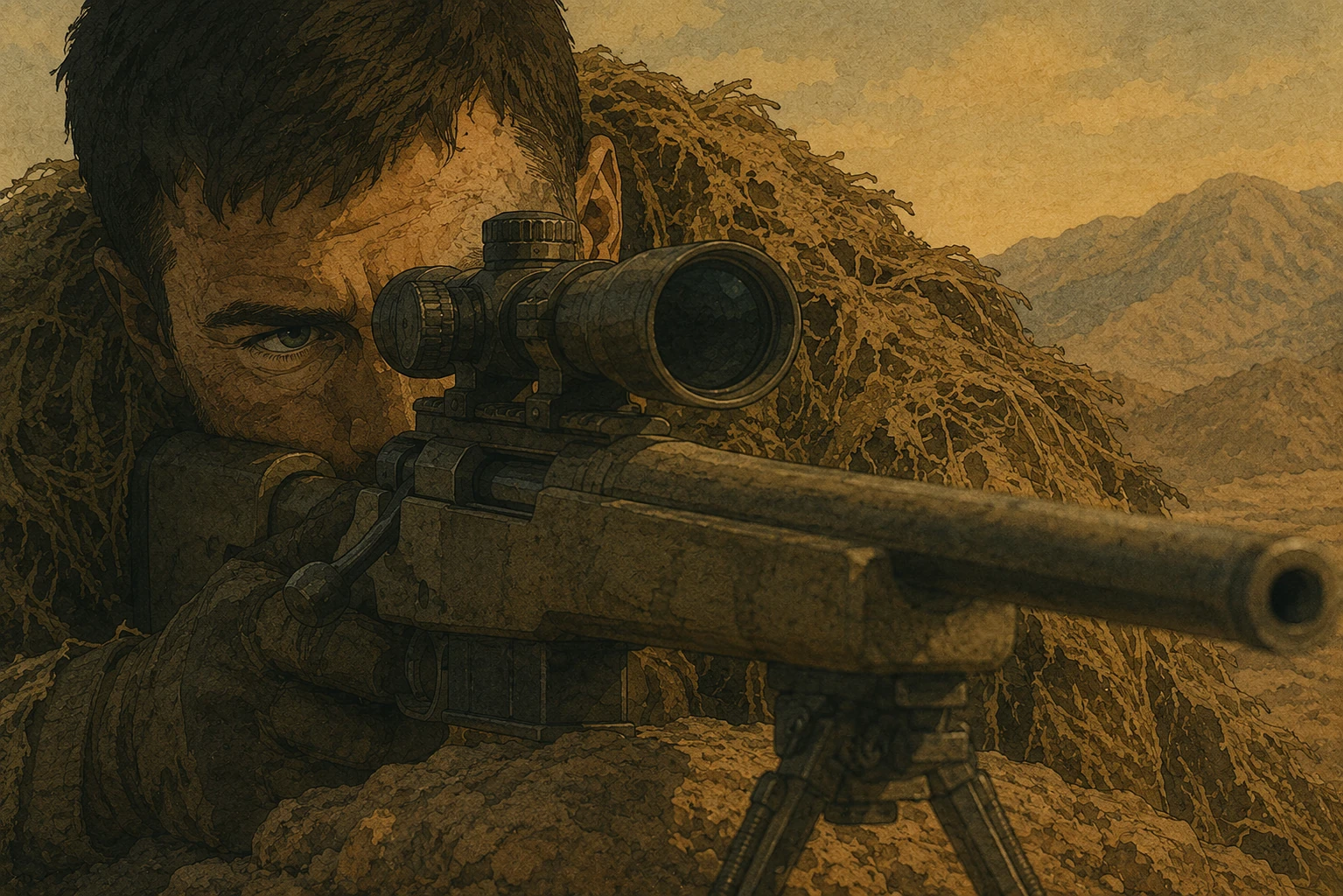
How did you end up becoming an Army sniper?
Honestly, it came down to being in the right place at the right time with the right scores.
I had just finished the Warrior Leader Course and graduated at the top of my class—550 soldiers, and yes, I still stand by that. My company ended up getting three sniper school slots. The First Sergeant basically went down a list of disqualifying traits, and by the time he finished there were only three of us left standing.
While everyone else was back in the barracks drinking beer, I was taking another PT test and going through more evaluations with the Recon platoon. Before long, I was headed to sniper school.
What would disqualify someone?
Some of it is pretty straightforward. Bad eyesight, PT scores that aren’t high enough, ASVAB scores that don’t meet the requirement, disciplinary flags, failing the psychological screening, or simply not volunteering willingly.
The Army doesn’t want someone who has to be convinced to do that job.
What was sniper school like?
Extremely tough.
The stalking exercises were probably the hardest part. I was the tallest guy in the class at 6-foot-4, so I didn’t exactly have the easiest time hiding. I had to make up for my size by becoming very good at camouflage and using terrain to hide my movement.
I got busted on my first graded stalk because another student behind me melted to the ground during a freeze when he wasn’t supposed to. I passed the second one by firing through a stand of trees from about 125 meters away. On the third, after I’d already passed, I decided to see how close I could actually get to the target. I crawled to within about ten meters before they spotted the tip of my boot while I was leaving.
Sometimes that’s all it takes.
Most people picture snipers constantly taking shots. Is that accurate?
Not even close.
I’d say 99.9 percent of the job falls under the sniper’s secondary mission, which is gathering battlefield intelligence for higher headquarters. You’re observing, reporting, identifying movement, and helping commanders understand what’s happening.
People imagine we’re constantly out hunting people, but that’s simply not what most of the job looks like.
In fact, I only went out on what I’d call a true sniper mission once. Even then, I wasn’t the one pulling the trigger. I was providing security with my machine gun while my partner handled the engagement.
People always focus on the shooter. How important is the spotter?
The spotter is probably the most valuable person on the team.
When I became a sniper, I actually started as the spotter. I was already a Sergeant, so they put me in charge of a company’s sniper section. We were so unprepared they didn’t even have a radio operator assigned to us.
The shooter gets all the attention, but the spotter is reading conditions, making calculations, communicating with headquarters, finding targets, and directing the engagement. The shooter still has to execute perfectly, but the spotter is often driving the entire operation.
How far were you comfortable shooting?
I’m comfortable shooting any rifle out to its maximum effective range if I’m familiar with it.
Generally speaking, though, the ideal engagement isn’t about some magical distance. It’s about being within the effective range of your rifle while remaining outside the effective range of whoever is trying to shoot back.
If someone wanted to learn long-range shooting today, what advice would you give them?
Mindset comes first. You have to eliminate distractions and be willing to constantly learn because there are things that simply won’t make sense until you experience them.
Training is far more important than buying expensive equipment. Spend money on instruction before you spend it on gear.
I’d also tell people to start with inexpensive equipment so they can learn what actually matters before investing thousands of dollars. One thing that does deserve your money is quality optics. Your scope is often more important than the rifle itself, and learning how to read your reticle is one of the most valuable skills you can develop.
What was the scariest place you served?
The Korengal Valley.
Our team was inserted covertly and stayed hidden for about ten days before the enemy realized we were there. They didn’t know exactly where we were, but they knew we were somewhere on the mountain.
They spent more than a day observing us before finally attacking.
Fortunately, we were listening to their radio traffic through an interpreter, so we knew where most of their positions were before the fight even started. Artillery was already on the way when they opened fire.
The battle lasted around six hours.
Oddly enough, the extraction scared me even more than the firefight. The helicopter nearly crashed during the pickup in complete darkness, not far from where helicopters had gone down during Operation Red Wings.
That was one of those moments where you genuinely think you might not make it home.
You mentioned your PTSD isn’t what most people imagine. What did you mean?
PTSD affects everyone differently.
I actually loved my job. Being an infantryman suited me. I was good at it, and I enjoyed the work.
What stayed with me wasn’t necessarily fear. It was survivor’s guilt.
The first unit I served with in Afghanistan was built from old Long Range Surveillance Companies, Rangers, and volunteers from line infantry units. We had some incredible leaders, but we also had leadership that almost got us all killed more than once.
Trying to process why you survived when other people didn’t—that’s something that follows you.
How did PTSD affect your life after leaving the Army?
When I first got out, I didn’t deal with it very well.
It dragged me down for a long time.
Eventually I reached a point where I accepted who I had become instead of fighting it. I stopped trying to run from my experiences and started learning from them.
I also quit drinking. I’ve been sober for several years now.
The triggers are still there. I still have emotional reactions, but now they might set me back for a few minutes instead of several days. That’s a huge difference.
You’ve mentioned psychedelic research. Did that play a role?
It helped me personally, but I don’t recommend it casually.
If you don’t know your own mind, I wouldn’t touch it.
People sometimes hear about psychedelics helping veterans and assume they’re some miracle cure. They’re not. You have to understand yourself before you go exploring your own mind.
What did serving teach you about leadership?
One lesson has stayed with me ever since.
If you demand respect, your soldiers might follow you on a run.
If you command respect, they’ll follow you into hell.
I never wanted to ask a soldier to do something I wasn’t willing to do myself. We worked hard before missions so things would run smoothly when it mattered.
When it came time to leave on patrol, my squad was already assembled, our vehicle was spotless, and everyone knew exactly what they were doing. That only happens when leaders set the example instead of simply giving orders.
Why did you eventually leave the Army?
I realized it wasn’t the career I wanted anymore.
The higher you go, the less time you spend actually doing your job and the more politics become involved.
Some people shouldn’t be leaders, but they stay anyway because the system rewards moving up. I knew I probably wouldn’t have enjoyed that path, so I decided to leave while I still loved the parts of the Army that mattered to me.
Looking back, what are you proudest of?
Earning my Combat Infantryman’s Badge when I was eighteen.
I was the youngest member of my battalion to earn it during that deployment.
It’s still something I’m proud of.
At the same time, combat isn’t something I romanticize. It was terrifying. It was exhausting. It changed everyone who experienced it.
I don’t hold anything against anybody for what I went through. It was simply the life I lived, and now I’m trying to make sense of it by telling the story.