
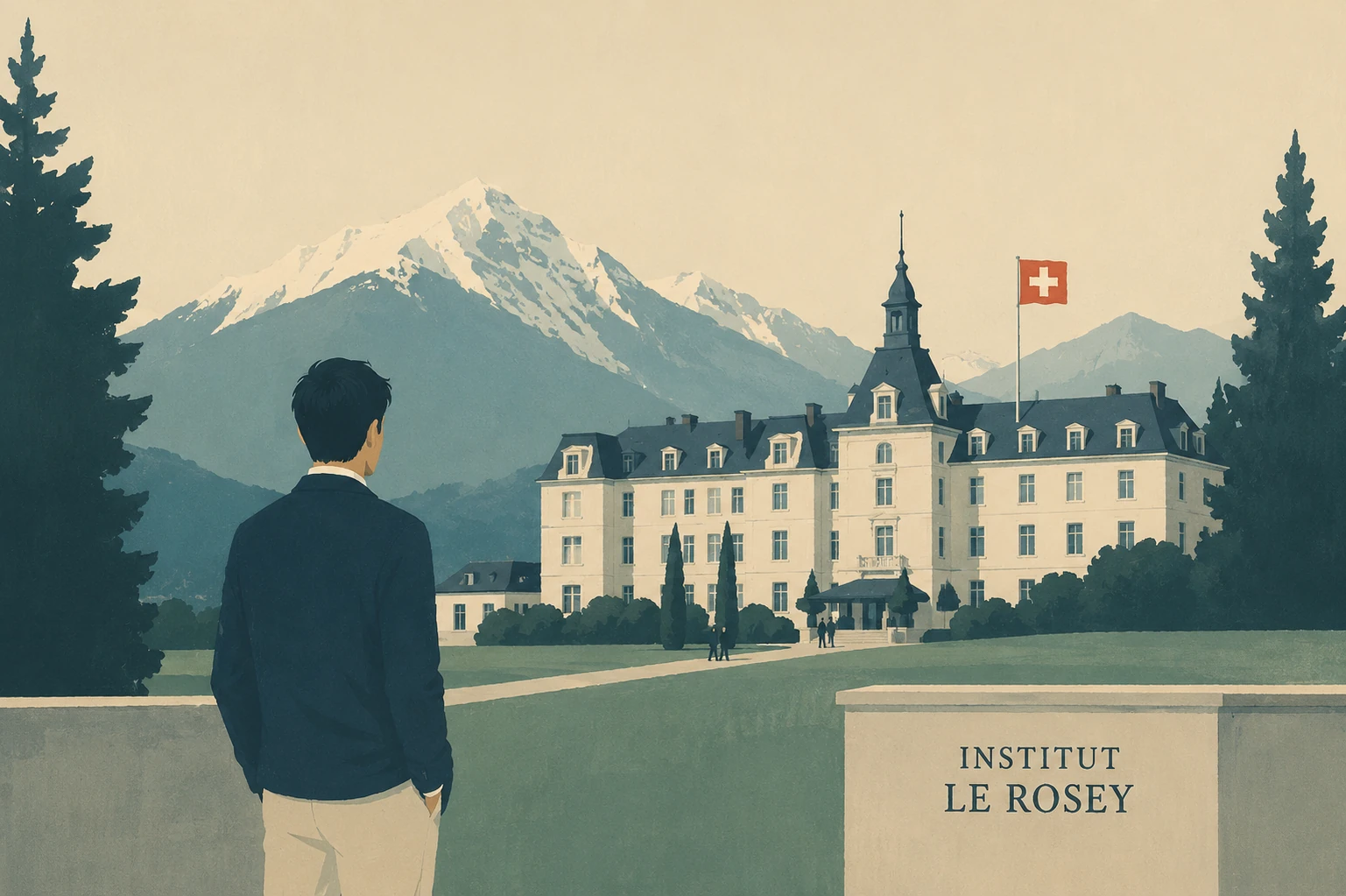
Whenever people find out I attended Institut Le Rosey, the conversation almost always begins the same way. They want to know about the billionaires, the royalty, the celebrities, and the eye-watering tuition.
They ask whether private jets really landed nearby, whether everyone wore designer clothes, whether the stories they’ve heard online are actually true.
The answer to most of those questions is yes.
What surprises people is that those are the parts of my experience I think about the least.
Looking back, the defining lesson of attending Le Rosey wasn’t learning how rich people spend their money. It was discovering how quickly the human mind adjusts to almost anything.
We tend to believe that extraordinary circumstances will always feel extraordinary, but they don’t. Given enough time, they simply become ordinary.
I remember arriving on campus and feeling as though I had wandered into a world that wasn’t entirely real. Luxury cars lined the entrances. Every so often someone would arrive by helicopter.
For the first few weeks, I noticed everything.
Then, almost without realizing it, I stopped noticing any of it.
The helicopters became part of the background. The Bentleys and Rolls-Royces blended into the scenery.
Eventually, even learning that someone’s father was a head of state or that another student’s mother was an internationally famous celebrity barely interrupted the conversation.
It taught me something I hadn’t expected to learn: normal is an incredibly flexible concept.
Before attending Le Rosey, I thought wealth was mostly about buying expensive things. I assumed luxury meant larger houses, faster cars, or more exclusive vacations.
Living among families who had access to almost unlimited resources gradually convinced me that money itself wasn’t what separated these circles from everyone else. The real difference was culture.
There is a language that exists within extremely wealthy communities, and almost none of it has anything to do with showing off.
Nobody sits you down and teaches it. You absorb it by listening.
You learn that certain places don’t need to be explained because everyone in the conversation already knows them. Someone doesn’t say they’re spending the summer in Martha’s Vineyard. They simply say they’re “going to the Vineyard.”
The same pattern appears everywhere.
Most people think luxury is recognizing a Rolex or carrying a Birkin bag. At Le Rosey, those things barely attracted attention because they were common enough to become invisible.
I remember girls carrying their art supplies inside Birkins worth more than many people’s cars. Nobody stopped to admire them because there was nothing unusual about it.
The truly interesting status symbols were often things most outsiders had never heard of.
Conversations revolved around obscure watchmakers instead of famous brands, tiny artisan workshops instead of global fashion houses, handmade products whose value came not from their logos but from the craftsmanship behind them.
It slowly became clear that, at the highest levels of wealth, knowledge itself often becomes the luxury. Knowing who made something matters more than knowing what company produced it.
That was probably the greatest education Le Rosey offered, and it wasn’t listed anywhere in the curriculum.
Academically, the school was excellent, but not because it possessed some secret formula unavailable anywhere else. The teachers were simply exceptional.
Most of them were ordinary Swiss educators who genuinely loved what they taught. Small class sizes meant they actually knew every student, challenged us individually, and encouraged discussion instead of memorization.
If the school’s academic reputation rested on anything, it rested on people rather than facilities.
The same could be said about the friendships.
Many people assume schools like Le Rosey exist primarily as networking machines, and there is certainly truth to that.
Parents don’t spend enormous sums of money without understanding that their children will spend years alongside future business leaders, politicians, royalty, entrepreneurs, and heirs to family companies spread across the globe.
Networking is undeniably part of the value.
But reducing every friendship to networking misses what boarding school actually does.
When you live together, study together, travel together, celebrate birthdays together, and endure exams together for years, genuine friendships inevitably form.
Some of the people I met there became far more than professional contacts. They became the kind of friends who feel like family.
Of course, not everything matched the glamorous image people imagine.
The food was surprisingly mediocre, which remains one of the running jokes among alumni.
It still amazes me that a school capable of charging tuition that exceeded the cost of many homes somehow struggled to produce memorable cafeteria meals.
If there’s one myth I can confidently dispel, it’s that extraordinary tuition guarantees extraordinary lunches.
There were also reminders that wealth has limits.
One pattern I noticed was how many students spent more time with chauffeurs, nannies, or household staff than with their own parents.
Many of our families ran international businesses or traveled constantly. Some parents appeared only during school performances or occasional weekends because work kept them on different continents for much of the year.
Money had solved almost every practical problem in their lives.
It had not solved the problem of time.
Living among extraordinary privilege made it impossible to believe that financial success automatically creates happy families. It doesn’t.
Wealth can purchase comfort, security, education, and opportunities beyond imagination, but it cannot guarantee closeness, affection, or peace.
People also ask whether wealthy students looked down on everyone else.
Some certainly did.
I occasionally overheard classmates gossiping about families whose annual incomes would place them comfortably among the wealthiest people in almost any city on earth.
Hearing someone describe a family earning half a million dollars a year as “poor” was surreal the first time it happened.
Eventually, though, I realized those conversations weren’t really about money.
People who enjoy judging others rarely stop at one category. If they aren’t criticizing someone’s finances, they’ll criticize their nationality, their accent, their appearance, or their education.
Wealth simply becomes another excuse rather than the real issue.
Perhaps the greatest irony of attending the world’s most expensive school is that it ultimately made me more grateful, not less.
Before boarding school, I was probably more spoiled than I realized. Like many teenagers, I accepted my circumstances without questioning them.
Living among people whose privilege often exceeded even my own forced me to think more carefully about what I had been given and how fortunate I already was.
People often assume a place like Le Rosey teaches students how to become wealthy.
Maybe it does.
But I think its more enduring lesson is something quieter.
It teaches you that money opens doors, connections create opportunities, and culture shapes belonging, but none of those things are capable of replacing character, friendship, or family.
Years later, I barely remember which classmates owned private jets or which families appeared on magazine covers.
What I remember are the conversations, the friendships, the teachers who loved their subjects, and the realization that no amount of wealth can change the things that ultimately matter most.
That, more than anything else, is what I carried with me after leaving Le Rosey.