
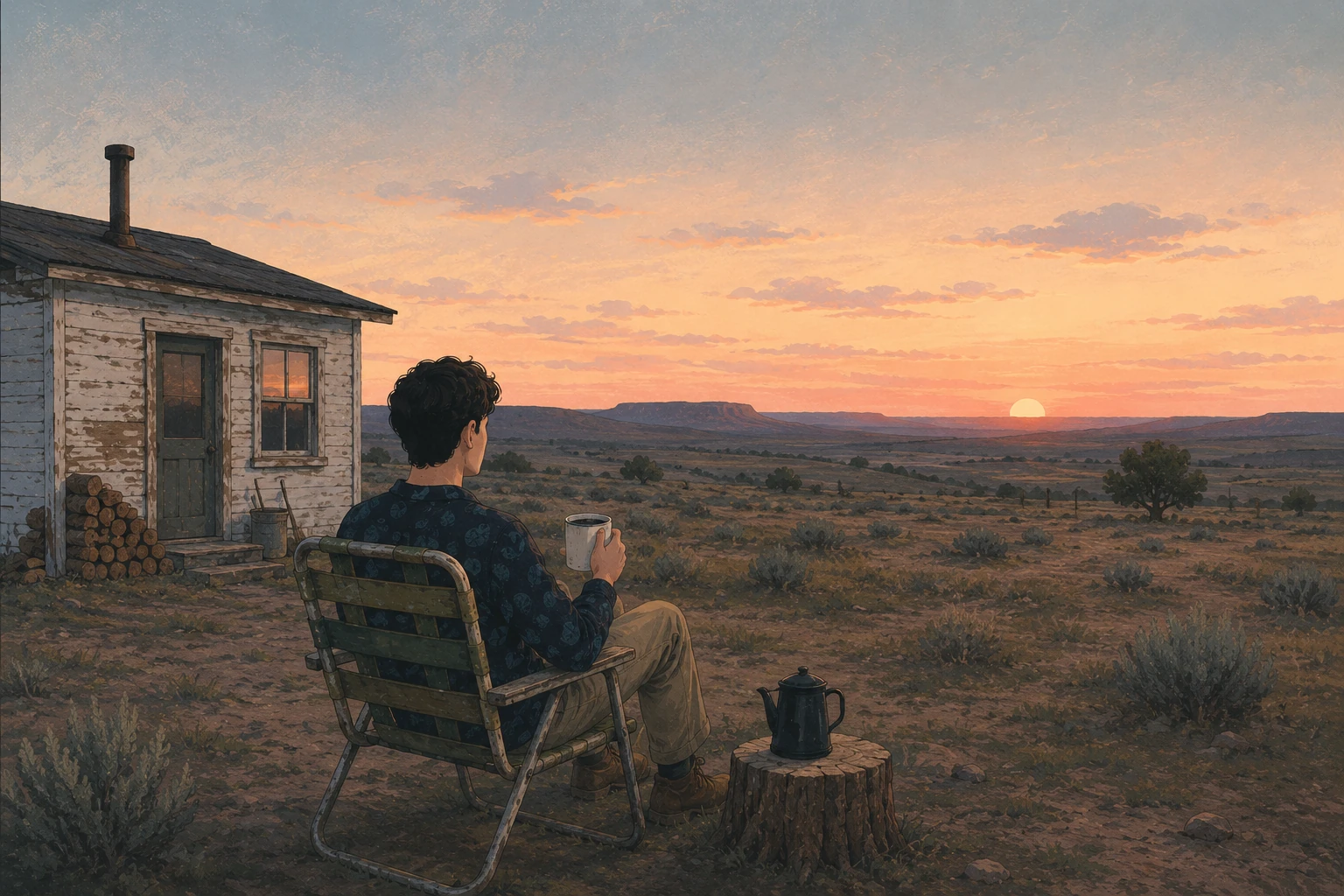
The first thing people ask is usually, “Don’t you get bored?”
The second is, “What happens if you have an emergency?”
Nobody ever asks the question that actually matters.
“Why would you leave all that convenience in the first place?”
Because that’s what everyone assumes I’d miss.
The grocery store ten minutes away.
Amazon packages on my porch the next morning.
Restaurants.
Traffic.
Coffee shops.
Neighbors.
The funny thing is, those are exactly the things I was trying to get away from.
When people hear that I live over an hour from the nearest grocery store, they look at me like I’ve admitted I churn my own butter.
It’s true, though.
If we run out of milk, that’s my fault.
There isn’t a convenience store around the corner.
There isn’t Uber Eats.
There isn’t, “I’ll just run back because I forgot something.”
If I forget an ingredient for dinner, dinner changes.
That’s just life now.
At first it felt inconvenient.
Now it feels normal.
You adapt surprisingly fast.
I keep lists for everything.
The second I notice we’re low on batteries, coffee filters, or dog food, it goes on the list.
Because forgetting doesn’t cost me fifteen minutes anymore.
It costs me half a day.
You become organized because the alternative is annoying yourself.
People think that’s the biggest adjustment.
It isn’t.
The biggest adjustment is realizing how much unnecessary movement filled your old life.
I’d spend entire Saturdays driving.
Target.
Costco.
Home Depot.
Lunch somewhere.
Back home.
I always felt busy.
Looking back, I wasn’t actually accomplishing much.
Out here, if I drive somewhere, there’s a reason.
Otherwise I’m home.
And home is where my life actually happens now.
One Saturday I spent four hours fixing a fence.
Not because it’s fun.
Because elk don’t care about property lines.
Neither do cattle.
Something is always broken.
If it isn’t the fence, it’s a gate.
If it isn’t a gate, it’s the water system.
If it isn’t the water system, it’s something the wind decided to throw across the driveway.
You stop thinking of home as something you own.
It becomes something you constantly maintain.
Oddly enough, I enjoy it.
Every project feels like it belongs to me.
I don’t fix things because someone else told me to.
I fix them because tomorrow I’ll walk past them again.
People ask if I get lonely.
Sometimes.
But probably less than I did living in the suburbs.
That sounds backwards until you’ve lived both lives.
In the suburbs I was surrounded by people I barely knew.
Thousands of them.
I could go months without having a meaningful conversation with anyone outside my family.
Out here I’ve gone an entire week without seeing another human being.
Not one.
And it was one of the most peaceful weeks I can remember.
That probably sounds insane if you’re an extrovert.
For me it felt like someone finally turned the volume down.
Night is different here.
The first night scared me.
Not because of bears.
Or coyotes.
Or mountain lions.
Darkness.
Real darkness.
The kind where you walk outside at two in the morning and realize cities have completely ruined your understanding of night.
There aren’t streetlights.
There isn’t the orange glow reflecting off clouds.
There’s just black.
And silence.
Not “it’s quiet.”
Silence so complete that you notice your own breathing.
You can hear your heartbeat.
It took me a while to stop feeling like something was wrong.
Nothing was wrong.
That’s just what the world sounds like when humans aren’t constantly making noise.
The funny thing is that I’ve become less impatient.
You have to.
You can’t live out here expecting instant anything.
Amazon struggles to find my address.
Mail only comes a couple times a week.
If weather gets bad enough, the roads close.
Sometimes you simply aren’t going anywhere.
Instead of fighting that, you start planning around it.
You stock extra food.
You keep spare parts.
You learn that buying one bolt is stupid.
Buy ten.
Future you will thank you.
There’s a saying out here that one missing part can turn a one-hour repair into a three-week project.
It’s true.
You stop assuming the world is standing by waiting to solve your problems.
You become your own hardware store.
Wildlife doesn’t care that this is your property.
Our first compost bin lasted two days before a bear demolished it.
Lesson learned.
Now every project starts with, “What animal is going to destroy this?”
You carry radios if you’re wandering the property.
You pay attention.
Nature isn’t hostile.
It just isn’t interested in your plans.
One thing I didn’t expect was how much my definition of entertainment changed.
People ask, “So what do you do all day?”
I don’t know.
Life.
After work maybe I fix a fence.
Maybe I split wood.
Maybe I sit on the porch with coffee for an hour watching absolutely nothing happen.
That sentence would have terrified the old me.
Now I think nothing happening is one of life’s underrated luxuries.
Here’s what surprised me the most.
I don’t miss convenience nearly as much as I thought I would.
I miss good restaurants.
Sure.
I miss being able to grab sushi on a random Tuesday.
But I don’t miss traffic.
I don’t miss errands becoming an entire afternoon.
I don’t miss hearing leaf blowers every Saturday morning.
I don’t miss looking out my window and seeing another house fifteen feet away.
Mostly, I don’t miss feeling like I was always in a hurry.
Living out here forces you onto nature’s schedule instead of everyone else’s.
If it snows, your plans change.
If it rains enough, maybe you stay home.
If the power goes out, you deal with it.
Some people would call that inconvenient.
I call it honest.
The world reminds you that you aren’t actually in control.
You were just paying enough money to pretend you were.
Whenever people visit, they always say the same thing.
“This is beautiful.”
And then they add, “But I could never live here.”
Maybe they’re right.
It isn’t for everyone.
It took the previous owners years to find someone willing to buy this place because most people love the fantasy of isolation more than the reality of it.
You have to enjoy solving your own problems.
You have to be okay with quiet.
You have to stop expecting the world to operate on your timetable.
But if you’re wired that way, you eventually realize something strange.
The middle of nowhere isn’t empty.
It’s the first place I’ve lived that actually feels full.
Not full of people.
Full of time.