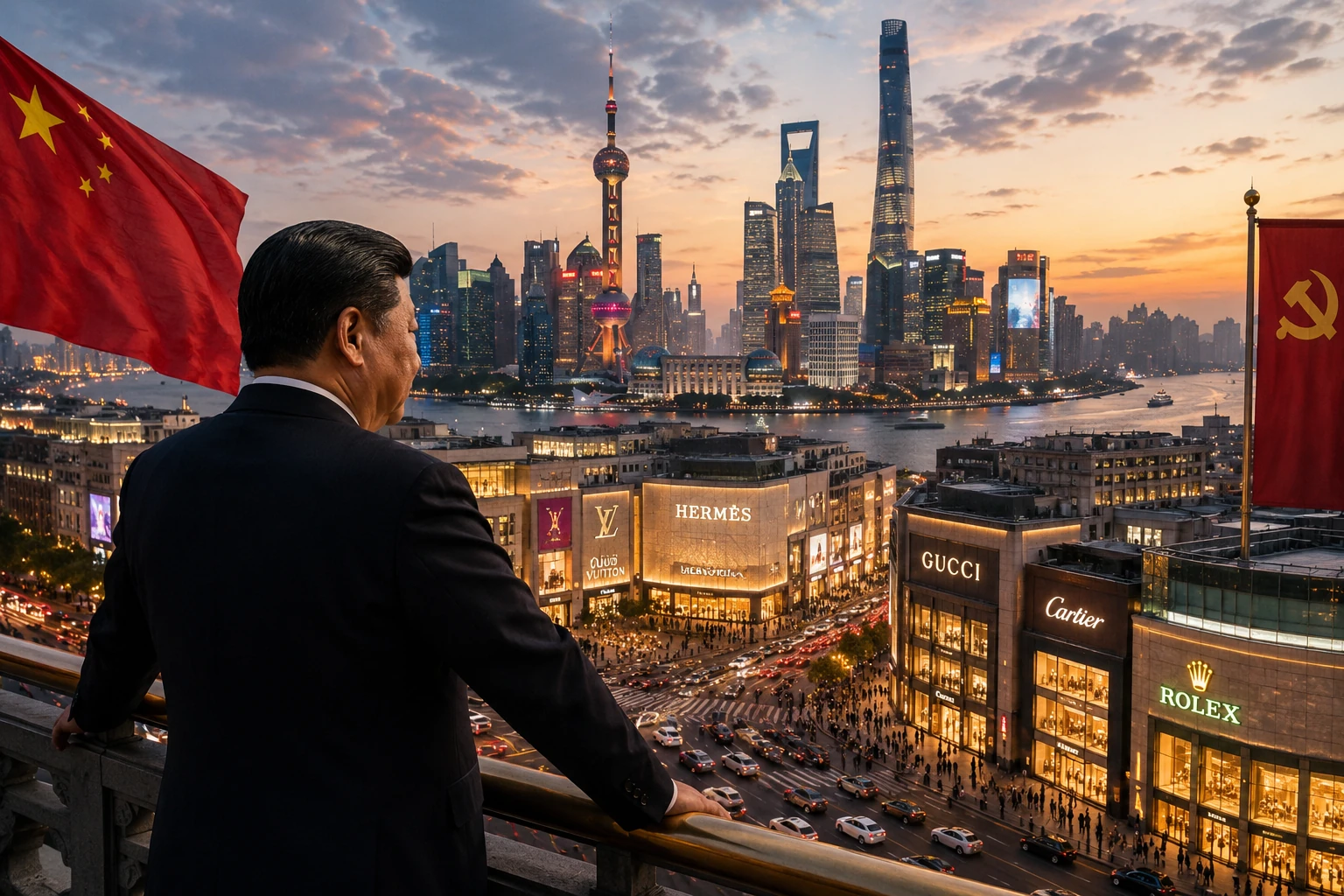
Walk through the financial district of Shanghai and you will see gleaming skyscrapers, luxury boutiques, Teslas, Ferraris, Starbucks on nearly every corner, and a stock exchange handling billions of dollars in trades.
China is also home to some of the world’s richest entrepreneurs, global technology companies, and more billionaires than almost any other country.
None of that sounds particularly communist.
So why is the country still governed by the Chinese Communist Party?
The answer is that modern China is not easily described by a single label. It is no longer the centrally planned communist economy that existed under Mao Zedong, but it is not a free market capitalist system either. Instead, China has spent the past four decades building something unique: a market driven economy operating under the political control of a one party communist state.
To understand why China still calls itself communist, you have to separate two ideas that people often lump together: communism as an economic system and communism as a political system.
Mao’s China Looked Much More Like Classical Communism
When the Chinese Communist Party came to power in 1949, its goal was to reshape the country according to Marxist Leninist principles.
Private businesses were nationalized.
Farmland was collectivized.
Factories became state owned.
The government decided what would be produced, how much workers would earn, and where resources would go.
Competition largely disappeared because the state controlled nearly every major aspect of the economy.
This was much closer to what most people picture when they think of a communist economy.
But the results were mixed at best and, in some cases, catastrophic.
The Great Leap Forward, Mao’s campaign to rapidly industrialize and collectivize agriculture, contributed to one of the deadliest famines in human history. Later, the Cultural Revolution threw much of the country into political and economic chaos.
By the time Mao died in 1976, China remained poor despite decades of centralized planning.
Deng Xiaoping Changed the Rules
China’s next great leader, Deng Xiaoping, reached a simple conclusion: ideology was not enough to make a country prosperous.
“It does not matter whether a cat is black or white, as long as it catches mice.”
That sentence became the unofficial philosophy behind China’s economic transformation.
Beginning in 1978, China started allowing things that would have been unthinkable under Mao.
Farmers could sell surplus crops for profit.
Private businesses were allowed to open.
Foreign companies were invited to invest.
Special Economic Zones experimented with market capitalism.
Prices became increasingly determined by supply and demand rather than government planners.
These reforms unleashed one of the most remarkable periods of economic growth in history. Hundreds of millions of people rose out of poverty, cities expanded at breathtaking speed, and China became the world’s manufacturing powerhouse.
Yet the Communist Party never gave up political control.
So Is China Capitalist?
Yes and no.
Today, much of China’s economy functions through markets.
Private companies compete with one another.
Consumers decide what to buy.
Entrepreneurs build businesses.
Investors trade stocks.
Foreign corporations operate factories throughout the country.
Those are all characteristics associated with capitalism.
But unlike in most capitalist countries, the Chinese government retains enormous influence over the economy.
The state owns many of the country’s largest banks, energy companies, railroads, telecommunications firms, and defense manufacturers.
Even private businesses often have Communist Party committees inside them.
The government can intervene aggressively when it believes a company has become too powerful or is acting against national priorities.
In recent years, major technology companies have faced antitrust investigations, new regulations, and leadership changes after falling out of step with government objectives.
Markets exist, but they operate within boundaries set by the Communist Party.
Why Keep Calling It Communist?
This is where many outsiders get confused.
The Communist Party does not argue that China has abandoned socialism.
Instead, it says the country is in the “primary stage of socialism.”
According to official ideology, market mechanisms are tools, not the end goal.
The party maintains that allowing private enterprise and competition has helped China develop its economy, strengthen the country, and improve living standards. Once the nation becomes wealthier and more technologically advanced, it argues, socialism can continue to evolve.
Whether critics find that explanation convincing is another matter.
Some economists argue China is best described as state capitalist, where markets exist but the government maintains decisive control over key industries.
Others prefer mixed economy or authoritarian capitalism, emphasizing that private enterprise flourishes without political liberalization.
China itself uses the phrase “socialist market economy.”
Each label captures part of the picture, but none tells the whole story.
The Party Never Left
One thing has remained remarkably consistent since 1949.
The Communist Party has never surrendered its monopoly on political power.
There are no competitive national elections.
No opposition parties can challenge the government’s authority.
The military answers to the Communist Party rather than the state.
Major institutions, including universities, state owned enterprises, and many private firms, operate under the party’s supervision.
This is why China’s political system is often easier to classify than its economic system.
Politically, it remains a one party communist state.
Economically, it incorporates many market based features that would have been considered capitalist only a generation earlier.
So Is China Actually Communist?
The answer depends on what you mean by “communist.”
If you mean an economy where the state owns nearly everything, private enterprise barely exists, and central planners make almost every economic decision, then no. Modern China looks very different from Mao’s China or from the Soviet Union at its peak.
If you mean a country ruled exclusively by a Communist Party that maintains ultimate authority over politics, the military, and many aspects of economic life, then yes.
China has not abandoned communism so much as redefined it.
It adopted markets without adopting liberal democracy.
It embraced entrepreneurship without allowing political competition.
It created billionaires without surrendering the Communist Party’s dominance.
The Bottom Line
Perhaps the biggest mistake is assuming China must fit neatly into one category.
It does not.
Modern China is neither a textbook communist economy nor a conventional capitalist one.
Instead, it has built a hybrid system unlike any other: a dynamic market economy overseen by a Communist Party that remains determined to stay in power.
That contradiction is not a flaw. It is the defining feature of modern China.