
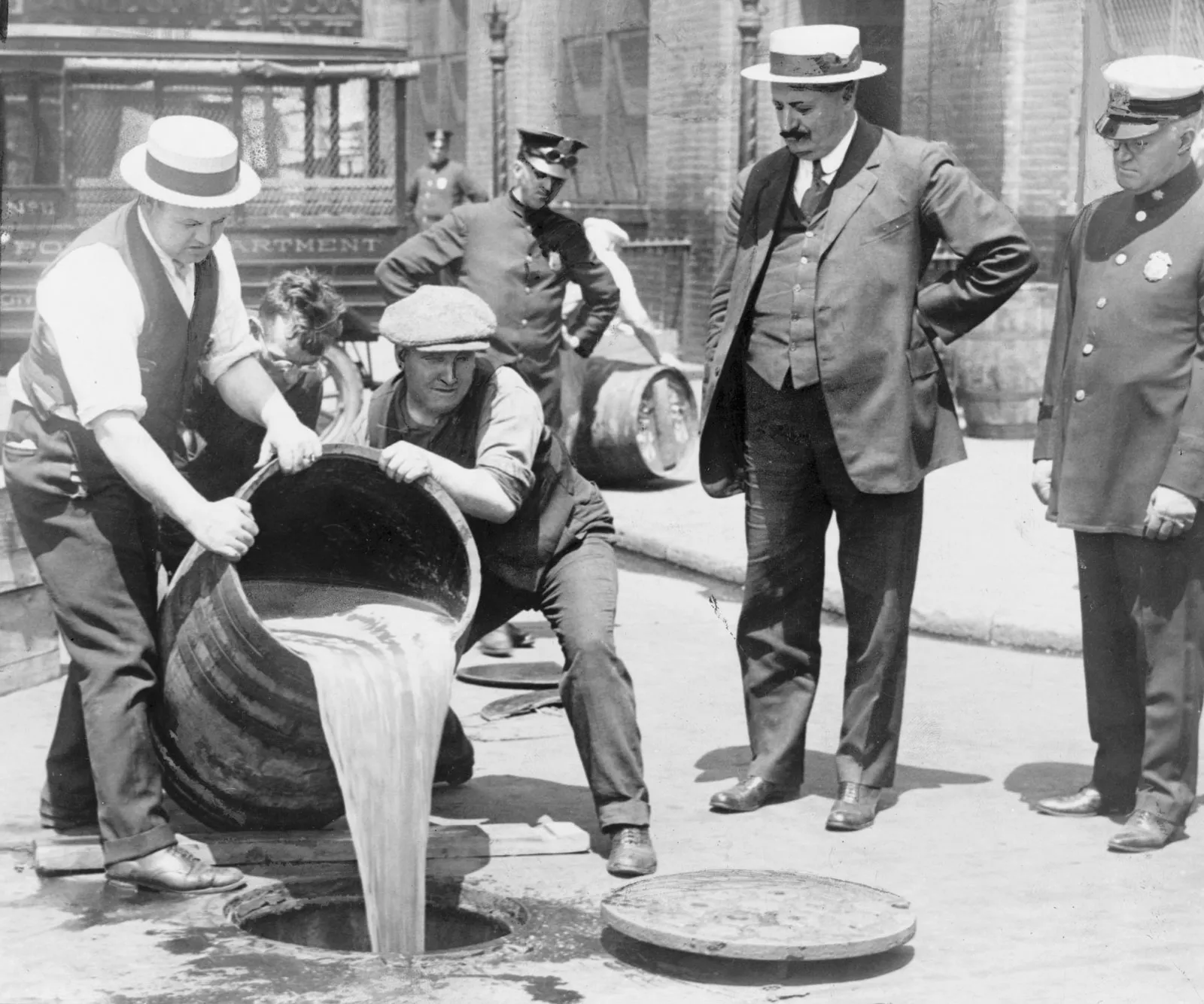
Looking back, Prohibition seems almost absurd.
In 1920, the United States essentially outlawed the commercial production and sale of alcoholic beverages. Breweries closed. Saloons disappeared. Ordinary Americans could no longer legally walk into a bar and order a beer.
The result is now remembered as one of America’s great policy failures: speakeasies, bootlegging, organized crime, corruption, and eventually an embarrassing constitutional reversal just thirteen years later.
So how did something like that ever get enough support to become a constitutional amendment?
The answer is that Americans in 1919 were not voting on the Prohibition we remember.
They were voting on the world that came before it.
And that world had a serious drinking problem.
America Drank a Lot
Alcohol consumption in the early United States could be astonishing by modern standards.
In the 1830s, historians estimate that the average American over age 15 consumed roughly seven gallons of pure alcohol per year. That is not seven gallons of beer or wine. That is seven gallons of alcohol itself.
Whiskey was cheap, plentiful, and deeply embedded in everyday life.
Workers sometimes drank on the job. Political campaigns handed out liquor. Taverns were centers of social and political life. Alcohol could appear at breakfast, lunch, and dinner.
Consumption declined substantially later in the 19th century, but industrialization created another highly visible drinking culture: the urban saloon.
And the saloon was not simply the neighborhood equivalent of a modern sports bar.
It could be a rough place.
Saloons were overwhelmingly male spaces, and many were associated, fairly or unfairly, with gambling, prostitution, political machines, violence, and chronic drunkenness.
For millions of women, alcohol was not an abstract question of personal liberty.
It was something their husbands spent the grocery money on.
The People Hurt by Drinking Often Could Not Vote
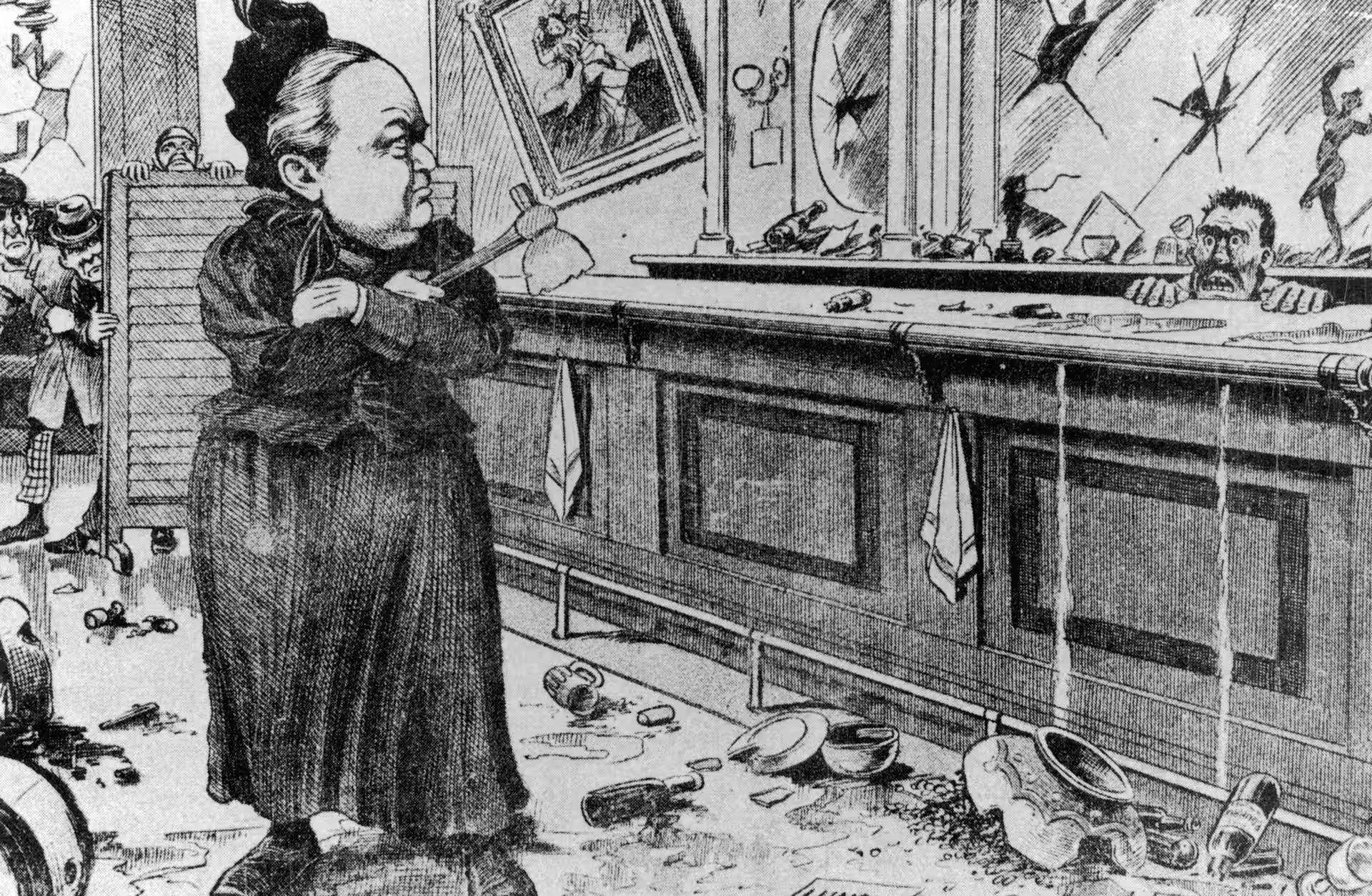
This is one of the most important parts of the story.
For much of the temperance movement’s rise, American women could not vote in national elections.
Yet women frequently suffered the consequences of male alcoholism.
A husband might come home drunk, lose his wages gambling or drinking, abuse his family, or simply leave his wife and children without enough money to survive.
Divorce was difficult. Employment opportunities for women were limited. Social welfare programs barely existed.
A woman’s economic survival could depend almost entirely on her husband’s behavior.
That helps explain why women became some of the most passionate organizers against alcohol.
The Woman’s Christian Temperance Union became one of the largest women’s organizations in the country. Activists portrayed alcohol not simply as a vice but as a threat to the home.
From their perspective, shutting down the saloon could mean protecting women and children from men who drank away their paychecks.
Prohibition was not originally sold as:
“The government should control what you drink.”
It was sold more like:
“Why should the liquor industry be allowed to destroy families for profit?”
That was a much more powerful argument.
Then the Movement Became a Political Machine
The organization that transformed temperance from a moral crusade into an extraordinarily effective political operation was the Anti Saloon League.
Founded in 1893, the League understood something important: it did not need politicians to personally hate alcohol.
It just needed them to fear the political consequences of opposing Prohibition.
The League organized voters, distributed enormous amounts of propaganda, pressured candidates, tracked legislators’ voting records, and supported politicians willing to vote dry.
And unlike some earlier temperance groups, it was remarkably focused.
It was not trying to solve poverty, reform prisons, improve labor conditions, and ban alcohol simultaneously.
It wanted one thing.
Prohibition.
A politician could disagree with the League on almost everything else and still receive its support if he voted correctly on alcohol.
That made the movement unusually powerful.
Prohibition Also Became a Rural Versus Urban Fight
By the early 20th century, America was changing rapidly.
Cities were exploding in population. Millions of immigrants had arrived from Germany, Ireland, Italy, Eastern Europe, and elsewhere.
Many brought drinking cultures with them.
German Americans had beer gardens.
Irish neighborhoods had saloons.
Italian families drank wine.
To many rural, Protestant Americans, these rapidly growing cities seemed culturally alien, and alcohol became wrapped up in those anxieties.
Temperance therefore overlapped with nativism.
Not everyone supporting Prohibition was motivated by anti immigrant sentiment. Many genuinely believed alcohol caused poverty, violence, and family destruction.
But prejudice unquestionably strengthened the coalition.
The stereotypical saloon keeper was increasingly portrayed as a corrupt urban immigrant undermining traditional American values.
So the fight over alcohol became partly a fight over what kind of country America was becoming.
Businesses Had Their Own Reasons to Support It
Some industrialists also liked temperance.
Factories filled with complicated machinery were dangerous enough without workers arriving drunk or hungover.
A sober workforce was seen as more punctual, productive, and reliable.
Industrialization increasingly demanded workers who could show up at a specific time and operate machinery for long shifts.
The old tradition of drinking during the workday did not fit particularly well with the modern factory.
Temperance could therefore be framed not only as moral reform but as economic modernization.
Then World War I Gave Prohibitionists the Perfect Enemy
This may have been the final political accelerant.
America entered World War I in 1917.
Suddenly Germany was the enemy.
And some of America’s largest breweries had German names.
Anheuser Busch.
Pabst.
Schlitz.
German American brewing culture, which had once been a normal part of American life, became politically vulnerable almost overnight.
Prohibitionists cleverly connected beer with Germany.
Why, they asked, should American grain be used to make beer when it could feed soldiers and civilians?
Why should Americans enrich brewers associated with the country they were fighting?
Anti German hysteria did not create Prohibition, but it weakened one of the most powerful industries standing in its way at exactly the right moment.
And By Then, Much of America Was Already Dry
Another reason national Prohibition was not as radical as it sounds today is that millions of Americans were already living under alcohol restrictions.
Counties and states had been passing local prohibition laws for decades.
By the time the constitutional amendment arrived, national Prohibition looked less like a completely new social experiment and more like the final stage of a movement that had been winning elections across the country for years.
The political momentum was enormous.
In December 1917, Congress proposed the 18th Amendment.
To become part of the Constitution, it needed ratification from three fourths of the states.
It got there remarkably quickly.
Nebraska became the 36th state to ratify it on January 16, 1919.
One year later, national Prohibition took effect.
But Here Is the Crucial Misunderstanding
The 18th Amendment did not actually make drinking alcohol illegal.
It prohibited the manufacture, sale, or transportation of intoxicating liquors for beverage purposes.
That distinction mattered.
Prohibition supporters imagined that if you eliminated the commercial alcohol industry, Americans would gradually stop drinking, or at least drink far less.
They were not necessarily picturing federal agents smashing down doors because Grandpa had a bottle of whiskey hidden in the cabinet.
They imagined empty saloons.
Fewer drunken husbands.
Safer workplaces.
Less domestic violence.
Less poverty.
Less crime.
More money going home to families instead of into the cash register at the neighborhood bar.
Put that way, the idea does not sound quite as insane as it does in retrospect.
The Problem Was That Americans Did Not Stop Wanting Alcohol
The law could close the legal market.
It could not eliminate demand.
So another market appeared.
Bootleggers supplied liquor.
Speakeasies replaced saloons.
Smugglers brought alcohol across borders and coastlines.
People made their own.
Doctors prescribed medicinal whiskey.
Corrupt police officers and politicians took bribes.
And criminals discovered that supplying something millions of otherwise law abiding Americans wanted could be extraordinarily profitable.
Organized crime did not begin with Prohibition, but Prohibition handed criminal organizations an enormous new industry.
Figures like Al Capone became spectacularly wealthy supplying illegal alcohol.
The government had created a black market worth fortunes.
And enforcing the law across an enormous country proved extraordinarily difficult.
Prohibition Even Changed Drinking Culture in Unexpected Ways
There was another irony.
The old saloon had largely been a male institution.
Speakeasies were different.
Women increasingly drank alongside men. Cocktails became fashionable. Drinking acquired an aura of rebellion and sophistication.
Instead of eliminating drinking culture, Prohibition helped transform it.
There is also evidence that alcohol consumption initially fell significantly under Prohibition. So it was not true that the law accomplished absolutely nothing.
But over time, the social costs of enforcement became increasingly difficult to ignore.
Americans were watching police arrest people for something huge numbers of ordinary citizens did not consider particularly immoral.
That undermined respect for the law itself.
Then the Great Depression Changed the Argument
When the Great Depression began in 1929, another question became difficult to avoid:
Why was the government spending money fighting alcohol while simultaneously preventing a legal industry from creating jobs and paying taxes?
Legal breweries meant employment.
Legal liquor meant tax revenue.
Repeal could help governments desperate for money.
The moral equation had changed.
What had once been presented as a reform that would make America richer and more productive was increasingly viewed as an expensive enforcement nightmare.
In 1933, the 21st Amendment repealed the 18th.
It remains the only time in American history that one constitutional amendment has been passed specifically to repeal another.
Prohibition Was Not as Crazy as It Looks From the Future
It is easy to imagine Prohibition as a bunch of puritanical busybodies suddenly deciding that nobody should be allowed to have a beer.
That is part of the story.
But it is not enough to explain how the movement became powerful enough to amend the Constitution.
Prohibition succeeded because an enormous coalition of Americans believed alcohol was connected to some of the country’s most serious problems.
Women saw domestic abuse and financial ruin.
Religious reformers saw moral decay.
Factory owners saw unreliable workers.
Rural Protestants saw threatening urban saloon culture.
Nativists saw immigrant influence.
Progressive reformers saw a predatory industry profiting from addiction and poverty.
Politicians saw an extraordinarily organized voting bloc.
And World War I temporarily turned powerful German American brewers into politically convenient villains.
Those interests did not all agree with one another.
They did not have to.
For one brief moment, they agreed on alcohol.
And that was enough.
The larger lesson of Prohibition is not simply that banning popular things does not work.
It is that major political movements rarely become powerful because millions of people suddenly embrace an obviously ridiculous idea.
They become powerful because the idea is attached to real problems people already care about.
By the time the unintended consequences become obvious, the law is already on the books.
And sometimes, it is in the Constitution.