
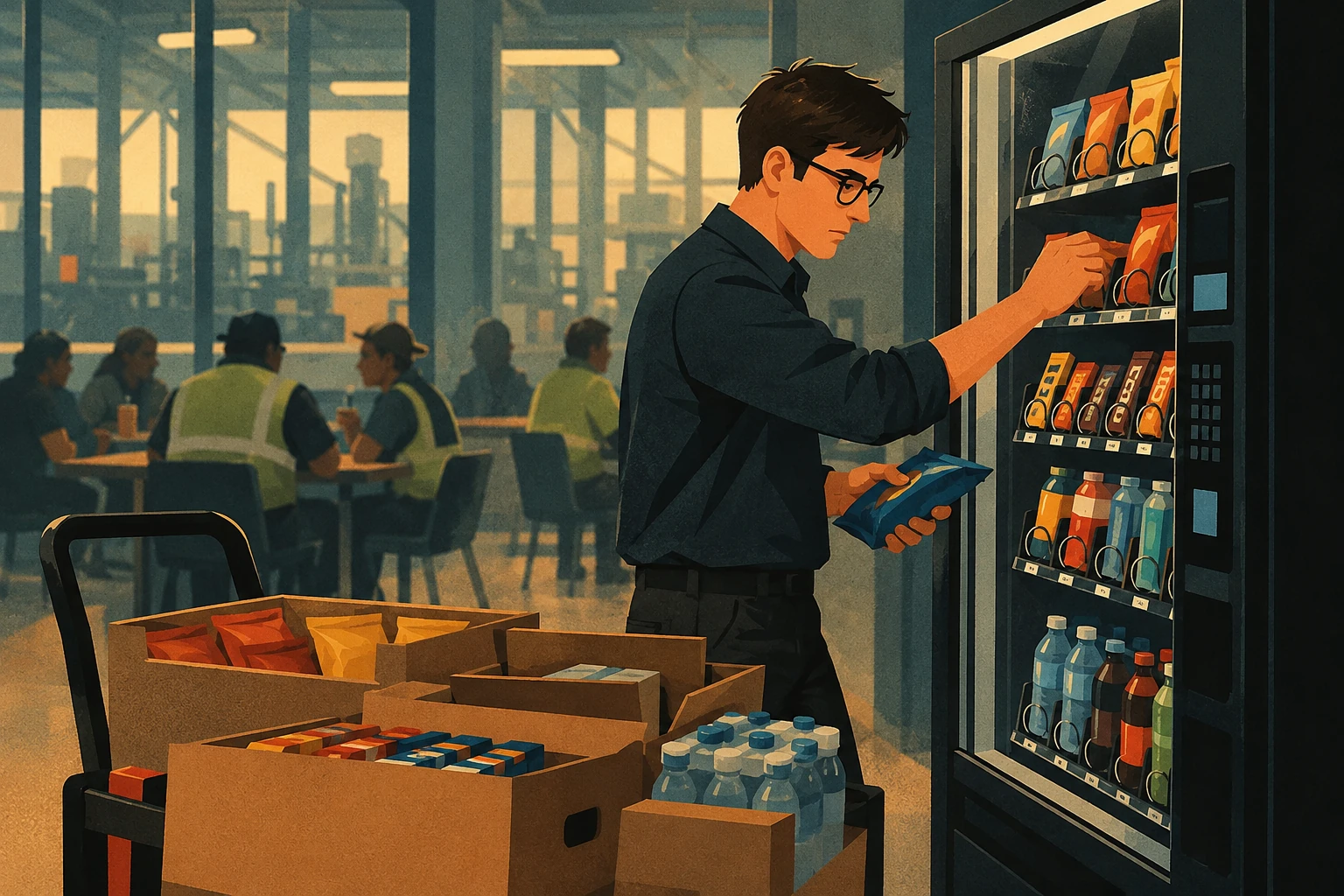
I run a six machine vending route, and the first thing I tell people when they ask me about getting into vending is that this is not passive income. That is probably the biggest misconception I see.
People picture buying a machine, filling it with chips and drinks, finding a place to put it, and coming back every once in a while to collect the money. It sounds simple, and compared with some businesses, it is pretty straightforward. But straightforward doesn’t mean passive.
I’ve been doing this for about five years. My six machines gross around $6,000 a month, and roughly half of that goes right back into buying product. I probably spend 10 to 12 hours a week shopping, receiving orders, sorting inventory, loading everything up, driving to locations and servicing the machines. I have two other businesses, so I look at the vending income as vacation money. It’s a nice additional source of income, but six machines aren’t going to replace a strong full time salary.
Could somebody build a full time business out of vending? Absolutely. There are operators with much bigger routes than mine. You just need to understand that the bigger the route gets, the more work and infrastructure you’re going to need.
Location is everything.
If there is one thing I’ve learned in five years, it’s that the location matters more than almost anything else.
Four of my machines gross around $1,500 a month each, while two gross less than $600. They’re being operated by the same person, stocked with similar products and managed basically the same way. The difference is where they’re sitting and how many people have a reason to use them.
The locations I like are factories with more than 100 employees, multiple shifts and ideally seven day operations. I also like places where employees have short lunch periods and don’t have a convenience store or fast food restaurant right around the corner.
The reason is pretty simple. I’m solving a problem for the company as much as I’m selling food to its employees.
If workers only have 30 minutes for lunch, management doesn’t necessarily want them getting into their cars, driving somewhere, waiting for food and hoping they make it back on time. My machines give those employees an option without leaving the property, and that has value to the company.
That’s also why I don’t currently pay rent or a percentage of sales to my locations. They get something out of having the machines there. I’ve had a location in the past that wanted a percentage, and there are plenty of vending operators who work under those arrangements, but I prefer locations where the business sees the machine as an employee benefit.
Other operators do very well in hotels, hospitals, car dealerships and all kinds of other places. I’m not saying factories are the only good locations. They’re simply what has worked for me.
I wouldn’t buy a machine and assume I could figure out the location later.
When people get interested in vending, they naturally start looking at machines. I think that’s backwards.
If somebody asked me what vending machine they should buy, one of my first questions would be where they plan to put it. A beautiful new machine with all the latest technology is still a bad investment if nobody uses it.
I’ve had to relocate two of my machines over the years, and moving them isn’t something you want to do regularly. These machines can weigh around 1,000 pounds. I hire people who specialize in moving vending equipment, and it costs me around $500 to relocate one.
You can recover from a bad location, but I’d much rather spend more time finding the right location in the first place.
You also have to be careful when people start talking about revenue.
My route grosses around $6,000 a month, but gross sales are not the same thing as profit.
Roughly $3,000 goes back into product. After that, I still have credit card processing fees, liability insurance, gas, vehicle expenses, maintenance, taxes and the occasional product that doesn’t sell before it expires. Credit card fees can be particularly noticeable in vending because you’re dealing with so many small transactions.
Then there is my time. That’s the part people tend to leave out when they’re doing the math on a vending business. If I’m spending 10 to 12 hours a week running the route, that time has value too.
So when somebody tells you their vending route does $6,000 a month, don’t immediately start calculating what you’re going to do with your $72,000 a year. You need to know what it costs to generate those sales and how much work goes into producing them.
The work itself isn’t complicated, but there is a lot of it.
My better machines need to be serviced two or three times a week. That’s actually a good problem because it means product is moving, but somebody still has to do the work.
I buy a lot of my inventory through Sam’s Club and have as much as possible shipped. I also use curbside pickup and buy from places like Costco, Walmart and Amazon when it makes sense.
Once I have the inventory, I still need to sort it, pack what each machine needs, load the vehicle and drive to the locations. Then I have to restock the machine, clean the glass and other surfaces, check for expired products and make sure everything is working correctly.
I usually allow about an hour per machine when I’m servicing them, in addition to the time spent shopping, preparing inventory and driving. I normally block out Tuesday morning, Friday afternoon and Sunday for the route.
Some of my locations also have security requirements, so I can’t necessarily walk in whenever I feel like it. If you’re thinking about running vending machines around a regular job, that’s something you need to ask about before accepting a location. A machine inside a secure factory may only be accessible during certain hours.
Eventually, something is going to break.
I wasn’t a vending machine technician when I started, but I’ve learned quite a bit over the years because I had to.
I’ve replaced power supplies, relays, cooling decks and trays, and I’ve dealt with software updates and other technical issues. The first time something breaks, it can be intimidating because you don’t really know what you’re looking at. After you’ve done it a few times, you become much more comfortable with the equipment.
There are technical videos and other resources available, and you learn as you go. You don’t have to become an expert repair technician before you buy your first machine, but you should be comfortable with the idea that owning equipment means maintaining equipment.
What people say they want and what they actually buy can be very different.
Everybody says they want healthy vending options. Then they stand in front of the machine and buy Doritos.
My machines were originally associated with a healthy vending concept, but they’re my machines, so I stock them based on what actually sells. At my locations, the mix is probably around 70 percent traditional vending products and 30 percent healthier products.
Drinks are especially strong for me. Soda, energy drinks, bottled water and coffee products all do well. Chips, danishes, donuts and things like Cheez Its also sell. Candy doesn’t move as much as people might expect, so I carry the things I know sell without dedicating too much of the machine to it.
I’ve also experimented with fresh food. People told me they wanted salads, so I tried salads. They didn’t buy them, and salads don’t give you much time to wait around for somebody to change their mind.
I’ve had better luck with products like burritos, Hot Pockets, packaged sandwiches, Lunchables and Uncrustables.
That’s one of the things I like about having machines that report sales and inventory. I don’t have to guess. I can see what people are buying. If something isn’t moving, I take it out. If something is constantly selling out, I give it more space.
Every location is a little different, and over time you learn what that particular group of customers wants.
Storage is another part of the business people don’t think about.
I’m fortunate because I own a hair salon and have a storage room in the back that’s roughly 10 feet by 15 feet. I can receive inventory there, organize everything and pull my vehicle up to the back entrance when it’s time to load the route.
If you’re starting a vending business, you need to think about where you’re going to put all of this stuff. Once you have several machines, you’re not talking about a few bags of chips sitting on a shelf. You’re buying cases of drinks, snacks and food products.
You also have to store food properly. Heat can ruin certain products, some things require refrigeration or freezing, and chocolate can be surprisingly annoying when it comes to temperature.
You also generate an unbelievable amount of cardboard. Nobody puts that in the vending business brochure, but trust me, you’re going to become very familiar with cardboard.
Technology has made running the route much easier.
Most of my sales are credit card transactions now, which is a big change from when I started. I still have machines that accept cash, but I don’t deal with nearly as much cash as I used to.
The machines also report inventory remotely, so I can check my phone before I leave and see what each machine needs. That makes a huge difference in how efficiently I can service the route.
Instead of driving to a location and opening the machine to figure out what sold, I can pack the products I need beforehand. The machines also give me reports that help with tracking sales and handling things like sales tax.
You pay for some of that convenience through processing fees and technology costs, but personally I wouldn’t want to run my route without it.
People also ask me whether they should start with one machine.
Personally, I wouldn’t, although that doesn’t mean it can’t be done.
An average machine might gross around $600 a month, while a strong location can produce more than $1,000. The problem with owning one machine is that if you happen to get a $400 or $500 location, that’s your entire vending business.
When you have several machines, you have some diversification. Some locations will be excellent, some will be average, and occasionally you’ll get one that just isn’t working and needs to be moved.
There are economies of scale too. If I’m already driving somewhere and servicing several machines, the trip makes sense. Driving across town to service one machine is a different calculation.
I started with six new machines and invested around $60,000. That included modern equipment and help finding locations.
That doesn’t mean everybody needs to spend $60,000 to get into vending. You can buy used equipment, find your own locations and start with much less money. There are people who have built routes that way.
I just think you need to understand the tradeoff. Starting smaller means risking less money, which can be a very smart thing, but it also means one weak location can have a much bigger effect on your results.
Finding good locations is probably the most valuable skill you can develop.
When I started, the vending company I worked with had locators who cold called businesses and identified companies that were interested in vending services. I still had to go in, meet with management, measure the space and actually close the location.
Today, I would be comfortable finding locations myself. I’d probably go into industrial parks and start knocking on doors.
I’d be looking for the same characteristics I’ve learned to value over the years: lots of employees, multiple shifts, short lunch periods, long operating hours, limited nearby food options and a management team that understands why having food and drinks on site benefits them.
Even then, nothing is guaranteed. You can find a location that looks perfect on paper and discover that sales aren’t what you expected. That’s part of the business. You watch the numbers, change the product mix, adjust pricing when necessary and give the location a chance.
If it still doesn’t work, you move the machine.
So is vending worth it?
For me, it has been.
I’ve owned the machines for about five years, they’re paid for now, and I’ve learned how to operate the route pretty efficiently. I know what sells, how often my machines need to be serviced, when prices need to change and when a location isn’t performing well enough.
The six machines give me a nice stream of extra income, and like I said, I think of it as vacation money.
If I wanted to turn vending into my full time business, though, I’d need a much bigger route. That would mean more machines, more inventory, more driving, more storage, more maintenance and eventually probably employees and warehouse space.
At that point, I’m not just scaling the income. I’m scaling the work too.
That’s why I wouldn’t tell someone to get into vending simply because they heard a machine can make $1,000 a month. I’d want them to think about where they’re going to put the machine, how many people will use it, what those people are likely to buy, how often it will need to be serviced, where the inventory will be stored and what happens when something breaks.
Most importantly, I’d want them to calculate what they’re actually making after product, card fees, maintenance, gas, insurance, taxes and their time.
If those numbers still look good to you, vending can absolutely be a good little business.
Just don’t go into it thinking you’re buying a machine that spits out passive income.
You’re buying a small business, and like every other small business, you’re going to have to run it.
“`