
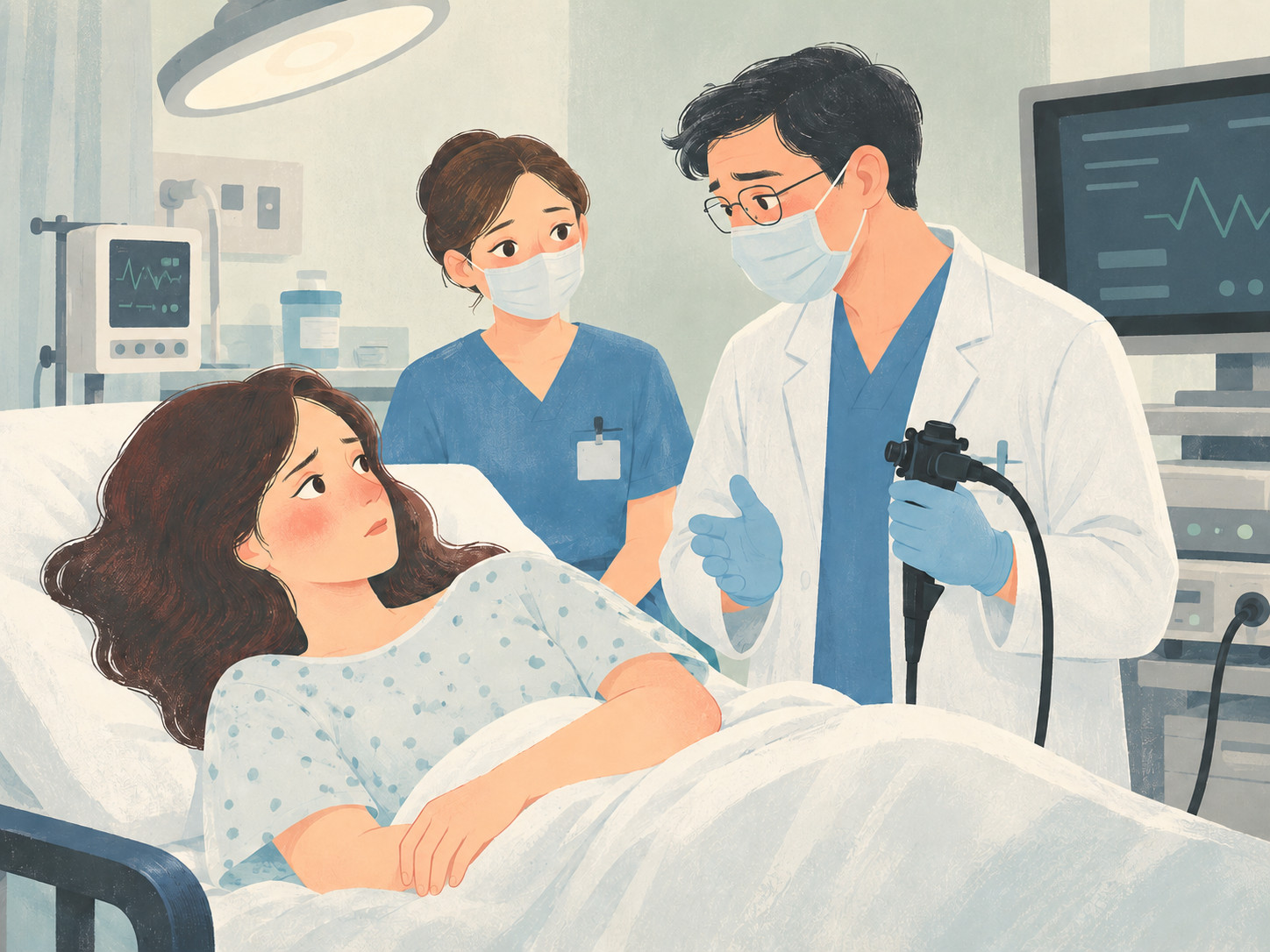
I’m 36 years old, and I recently had a colonoscopy without any sedation.
Yes, I was completely awake. No anesthesia, no painkillers, nothing to make me sleepy. Just me, a doctor, a camera, and a very strange afternoon.
When I tell people this, they look at me like I’ve voluntarily signed up to be tortured. My friends and family couldn’t believe it. The staff at the medical office didn’t seem to believe I was actually going to follow through with it either.
But here’s the surprising part: I’d absolutely do it again.
And considering what the doctors found, I’m incredibly glad I went through with it.
I was more afraid of sedation than the actual procedure.
The whole thing started when I noticed some pretty drastic changes in my bowel movements.
Without getting too graphic, what used to be normal and well-formed had become thin, almost like fettuccine noodles. I was having trouble going, and even when I did, I never really felt like I’d finished.
Obviously, that’s not something you want to ignore.
My doctor recommended a colonoscopy, which made sense. Except I had one major problem: I was terrified of being sedated.
I can’t even fully explain why. Maybe it’s the idea of losing consciousness or surrendering control of my body to someone else. Whatever it was, the thought bothered me enough that I kept putting off the appointment.
Weeks went by.
Eventually, I started looking through online colonoscopy communities, hoping to find some reassurance. That’s when I discovered something I hadn’t even realized was an option.
People were having colonoscopies while completely awake.
Apparently, this isn’t all that unusual in certain other countries. I found people sharing their experiences, saying that while it wasn’t exactly pleasant, it was manageable.
So I called the doctor’s office and asked if I could skip the sedation.
They told me it was allowed, but I got the distinct impression nobody believed I would actually do it.
My doctor, thankfully, was supportive.
The day of the procedure, I started questioning my own sanity.
They took my vital signs, put in an IV for hydration, and had me lie on my left side.
My doctor explained that she’d talk me through the uncomfortable parts. She also assured me that if I changed my mind, sedation was available.
That was reassuring, although I was determined to get through it awake.
The actual insertion wasn’t a problem.
What I hadn’t fully appreciated was that they needed to expand my colon with fluid or gas to get a clear view. And when the scope started navigating the bends in my intestines, that’s when things got interesting.
It wasn’t a sharp, stabbing pain. It was more like an intense, very strange pressure that would build for a few moments and then disappear.
Some parts were definitely uncomfortable.
There were moments when I had to concentrate on breathing slowly, the same way I’d learned to breathe through contractions during childbirth.
I kept repeating a little mantra to myself:
“My body is strong. My mind is strong. I can do hard things.”
I know that sounds like something you’d find printed on a decorative pillow at Target, but it actually helped.
At one point, about halfway through, I remember thinking, Oh my God. I cannot believe I’m actually doing this.
But then I reminded myself that the procedure would be happening to my body whether I was awake or unconscious. I just happened to be aware of it.
So I kept breathing.
The weirdest part was watching the inside of my own body on television.
There was a large monitor in the room, and I could see everything the doctor was seeing.
I have to admit, it was fascinating.
You spend your entire life walking around with all these organs inside you, and you never really think about what they look like.
Well, there they were, in high definition.
The doctor and I were actually chatting throughout the procedure. It was such a bizarre situation. I’m lying on my side, fully conscious, watching a camera travel through my intestines while having a perfectly normal conversation with the medical staff.
At certain points, I was so interested in what was happening on the screen that it helped take my mind off the discomfort.
And then they found the polyps.
I watched as the doctor removed them with a little snare.
That was probably my least favorite part to watch. Not because it hurt. Surprisingly, I didn’t feel the polyps being removed at all.
It was just strange knowing I was watching someone remove actual tissue from inside my body.
There are certain things you don’t necessarily expect to see in your lifetime. That’s one of them.
The whole procedure took about 20 minutes.
And just like that, it was over.
So how much did it actually hurt?
People keep asking me this, and I think it’s a fair question.
I’ve had a C-section where the medication didn’t work properly, and I could feel what was happening. That was a 10 out of 10 on my personal pain scale.
Compared with that, I’d give this colonoscopy a 3 out of 10.
There were brief moments of genuine discomfort, especially when the scope was making its way around the bends. But it was never so bad that I couldn’t breathe through it.
Most of the time, it was simply a very weird sensation.
I realize my experience isn’t going to be everyone’s experience. Some people have extremely painful colonoscopies without sedation. Anatomy, the difficulty of the procedure, and the doctor’s technique can all make a difference.
I’m certainly not suggesting everyone should do what I did.
But for me personally, it was much less frightening than I’d imagined.
And because I hadn’t received sedation, I didn’t have to spend the rest of the day recovering from the medication or dealing with the usual post-sedation restrictions.
I could get dressed and go about my day.
Here’s the part that really matters.
Remember those changes in my bowel movements that sent me to the doctor in the first place?
It turned out that minor hemorrhoids were responsible for most of those symptoms.
But the colonoscopy also revealed something I hadn’t expected.
Precancerous polyps.
The doctor removed them during the procedure.
I’m 36. I wasn’t going in for a routine age-based screening. I went because something about my body had changed, and I was fortunate enough to get it checked.
If I had kept postponing the colonoscopy because of my fear of sedation, those polyps would still be there.
That doesn’t mean they definitely would have become cancer. Not all precancerous polyps do. But removing them eliminates that particular risk, and that’s something I’m extremely grateful for.
It’s funny to think that the hemorrhoids that were making my life uncomfortable may have indirectly done me a very big favor.
They might have saved my ass. Literally.
Since sharing my experience, I’ve heard from people who had colonoscopies without sedation and barely felt a thing. I’ve also heard from people who said they’d never do it again because the pain was terrible.
And plenty of people absolutely love the sedation. Some describe it as the best nap of their lives.
Good for them. Seriously.
I’m not trying to convince anyone that staying awake is better, or that enduring discomfort earns you some sort of medal.
I’m sharing this because I almost let my fear of one part of a medical procedure stop me from having the procedure altogether.
Learning that another option existed made all the difference.
If you’re putting off a colonoscopy because you’re afraid of sedation, talk to your doctor. Ask what options are appropriate for you. There may be alternatives you haven’t considered.
And if sedation is the best choice for you, take it. The important thing is getting the examination when you need it.
As for me, when it’s time for my next colonoscopy, I’ll probably choose to stay awake again.
Although I wouldn’t complain if they let me pick what we watch on the monitor next time.
Was this worth your time?
What missed? (optional)