







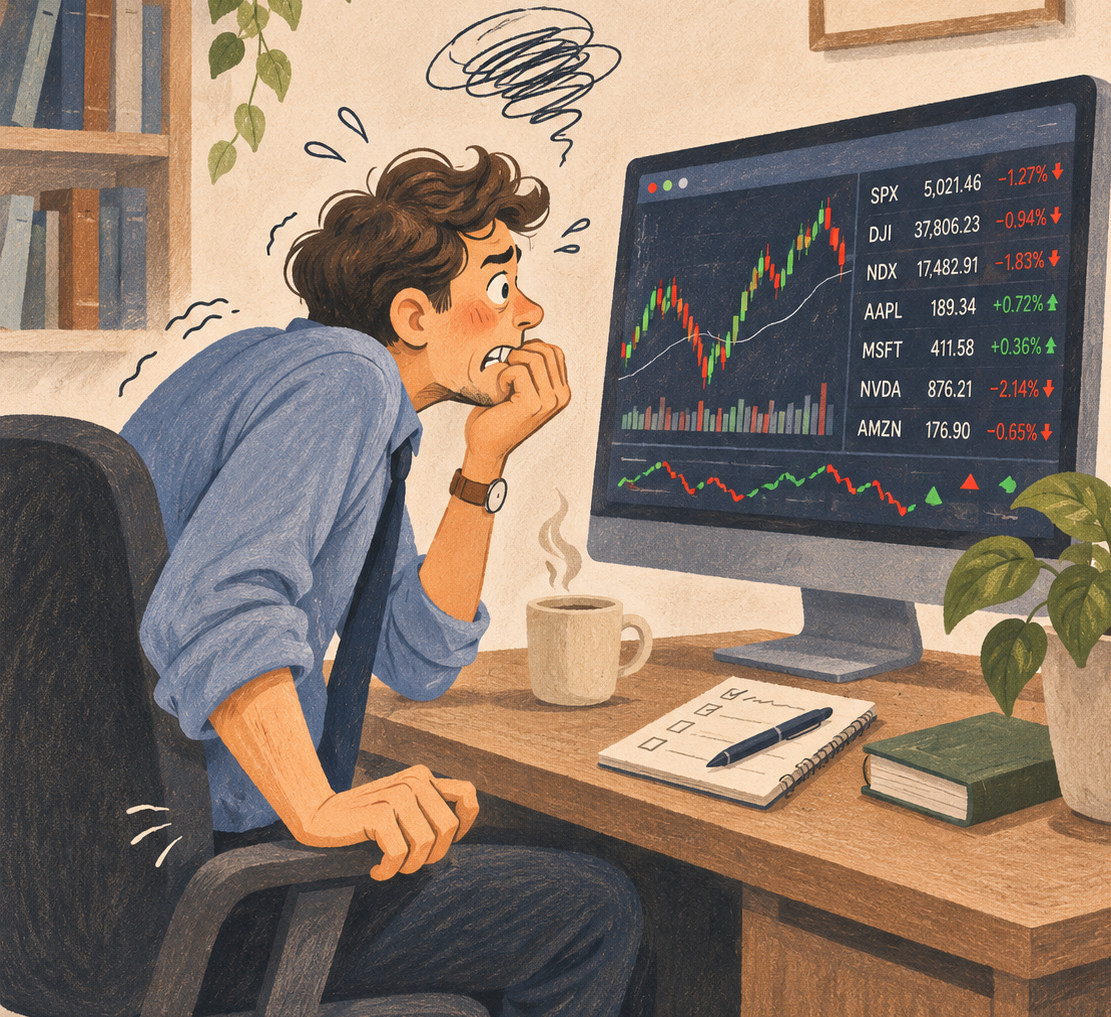
There’s something strangely addictive about checking your investment portfolio.
You open the app, see that you’re up $800, and feel pretty good about yourself. Maybe you check again after lunch. Now you’re only up $300. By the end of the day, you’re down $200, and somehow your mood has soured.
Nothing about your actual financial situation has meaningfully changed. You’re still invested in the same companies. Your retirement is still twenty years away. But you’ve managed to experience an emotional roller coaster over money you weren’t planning to touch for decades.
This is one of the strange contradictions of long-term investing. We tell ourselves we’re investing for the next twenty or thirty years, but we judge our progress every twenty or thirty minutes.
And the more frequently you check, the more likely you are to see losses.
Markets fluctuate constantly. On any given day, your portfolio might be worth more or less than it was yesterday. But over longer periods, the historical tendency of a diversified stock portfolio has been to grow, despite plenty of painful setbacks along the way.
There’s also a psychological cost to all this monitoring.
Psychologists have studied a phenomenon called myopic loss aversion. The basic idea is that people who evaluate their investments too frequently become more sensitive to short-term losses. Because losing money feels worse than gaining the same amount feels good, constantly watching those fluctuations can make investing feel much riskier than it actually is over your intended time horizon.
And that anxiety can lead to bad decisions: selling during downturns, chasing whatever is performing well, or abandoning a perfectly reasonable investment strategy because of a few ugly weeks.
Of course, you should review your investments periodically, especially when your circumstances or financial goals change.
But if you’re investing in broad-market index funds for retirement decades from now, there’s usually very little you need to do on a random Tuesday afternoon.
The point of long-term investing is to give your money time to work for you. Not to give yourself another thing to worry about every day.
Was this worth your time?
What missed? (optional)