
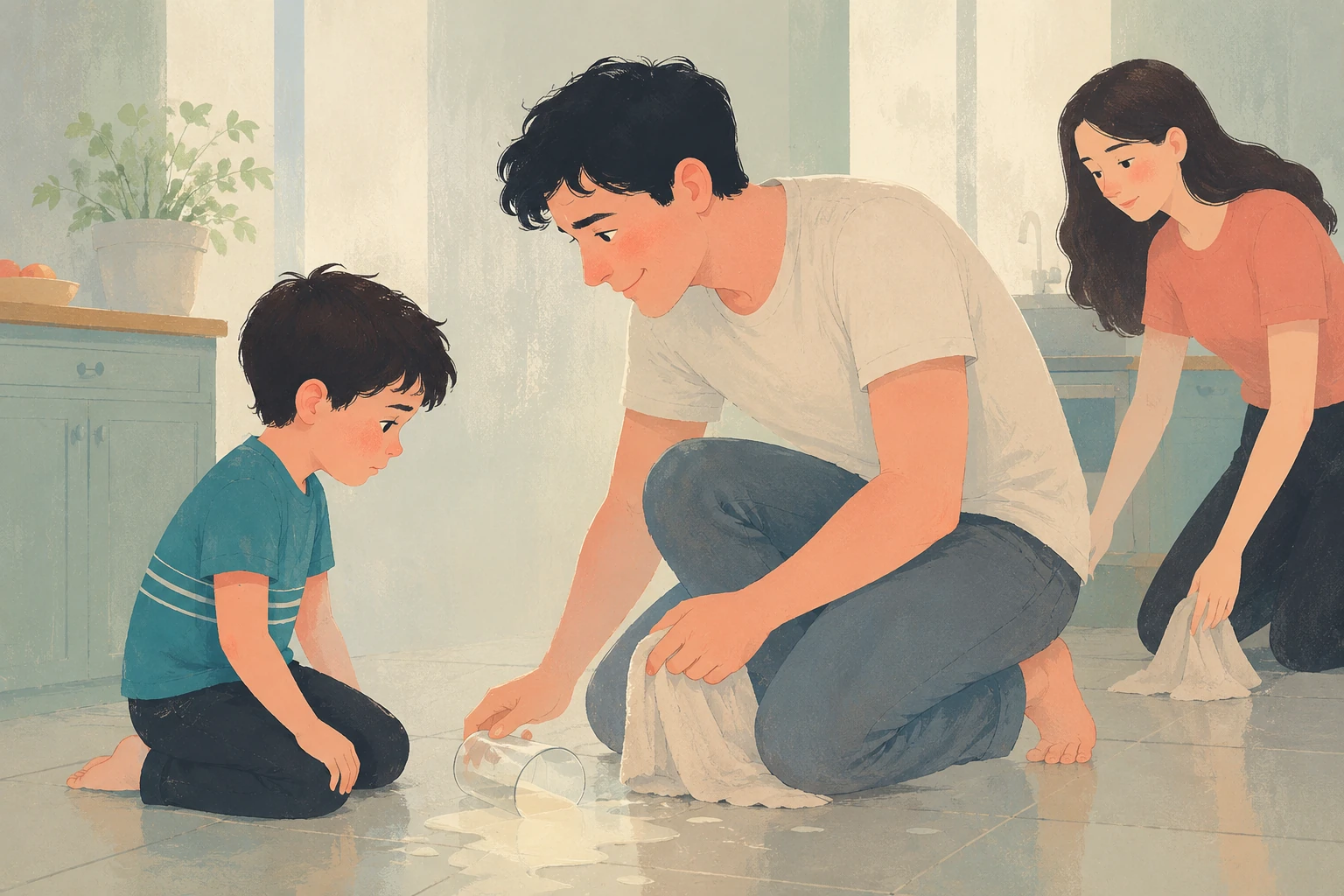
There are people who think yelling is just part of life.
To them, it’s weather. Storms roll in, voices rise, doors slam, someone says something they regret, and eventually the sun comes back out. That’s what families do, they tell themselves. Everybody loses their temper. Everybody has bad days.
And then there are people who grow up in homes where that almost never happened.
If you’re one of them, you probably don’t realize how unusual it is.
As a kid, you assume every family settles disagreements the same way yours does. You think every parent can be angry without becoming frightening. That every argument ends with conversation instead of silence. That people can disagree without trying to win, humiliate, or wound each other.
It isn’t until much later that you discover some children learned to identify a parent’s mood by the sound of footsteps in the hallway. Some became experts at reading facial expressions before they could even read books. Some instinctively knew when to disappear into their bedrooms because the volume in the kitchen had crossed a familiar threshold.
For them, yelling wasn’t an exception.
It was the atmosphere.
Growing up in a quiet home doesn’t mean there was no conflict. That’s the misconception. Healthy families argue. Parents get frustrated. Children push boundaries. People disappoint each other.
The difference isn’t the absence of anger.
It’s the absence of fear.
There’s something profoundly stabilizing about knowing that the people you love won’t become emotionally unrecognizable when they’re upset. That disappointment won’t suddenly transform into cruelty. That mistakes won’t be met with explosions.
As a child, this teaches you something without anyone ever saying it aloud.
You learn that conflict is survivable.
You learn that love can remain intact even when people are frustrated with each other.
Most importantly, you learn that raising your voice isn’t what gives your emotions legitimacy.
That lesson follows you into adulthood in ways you rarely notice.
You don’t instinctively brace yourself when your boss asks to talk. You don’t assume every disagreement with your spouse is the beginning of the end. You don’t interpret criticism as rejection or silence as punishment.
Because somewhere deep inside, your nervous system learned that conflict doesn’t automatically lead to catastrophe.
It’s difficult to overstate what a gift that is.
People often talk about childhood in terms of obvious milestones: birthdays, vacations, holidays, graduations. But the real architecture of childhood is built from repeated moments so ordinary they barely register while they’re happening.
A father calmly saying, “Let’s figure this out.”
A mother taking a walk before finishing an argument.
Parents apologizing to each other after tempers cool.
Voices that stay measured, even when emotions don’t.
These moments accumulate.
Not dramatically.
Quietly.
Like compound interest.
Children raised in this kind of environment begin to expect something remarkable from the world: that people can solve problems without destroying one another.
It sounds almost naive until you realize how many adults never learned that.
Some spend decades believing that love and volatility are inseparable. That passion requires shouting. That being understood means speaking louder. That winning an argument matters more than preserving the relationship.
Those beliefs rarely appear out of nowhere.
They’re inherited.
Not genetically.
Behaviorally.
Children become fluent in the emotional language spoken around them. If that language is sarcasm, they become sarcastic. If it’s contempt, they learn contempt. If it’s patience, they learn patience.
The remarkable thing about calm households isn’t that they produce perfect people.
They don’t.
Their children still become anxious. They still make mistakes. They still experience heartbreak, failure, and loss.
But they carry into those experiences an internal model of conflict that says, This doesn’t have to become chaos.
And that changes everything.
It changes friendships because they don’t confuse disagreement with rejection.
It changes marriages because they know arguments don’t have to become competitions.
It changes parenting because they’re more likely to pause before repeating the voices they never heard growing up.
Perhaps the greatest gift of a peaceful home is that it gives you emotional options.
When you’ve only seen one way to respond to frustration, that response begins to feel inevitable. But when you’ve watched adults regulate themselves—when you’ve seen anger expressed without intimidation—you grow up understanding that emotions aren’t commands.
They’re information.
You can feel them without surrendering to them.
Of course, no family gets this right all the time.
Every parent loses their patience. Every child remembers moments that could have gone differently.
Perfection isn’t the point.
Consistency is.
Children don’t need homes without conflict.
They need homes where conflict doesn’t make them question whether they’re safe.
Because one day they’ll leave that house.
They’ll build families of their own. They’ll disagree with spouses, comfort frightened children, navigate impossible days, and discover that every stressful moment presents a quiet choice.
To repeat what they experienced.
Or to offer something better.
And if they were fortunate enough to grow up in a house where people didn’t yell, they’ll often find themselves doing something that once felt completely ordinary.
Taking a breath.
Lowering their voice.
Choosing calm.
Not because someone taught them to.
Because someone showed them how.