
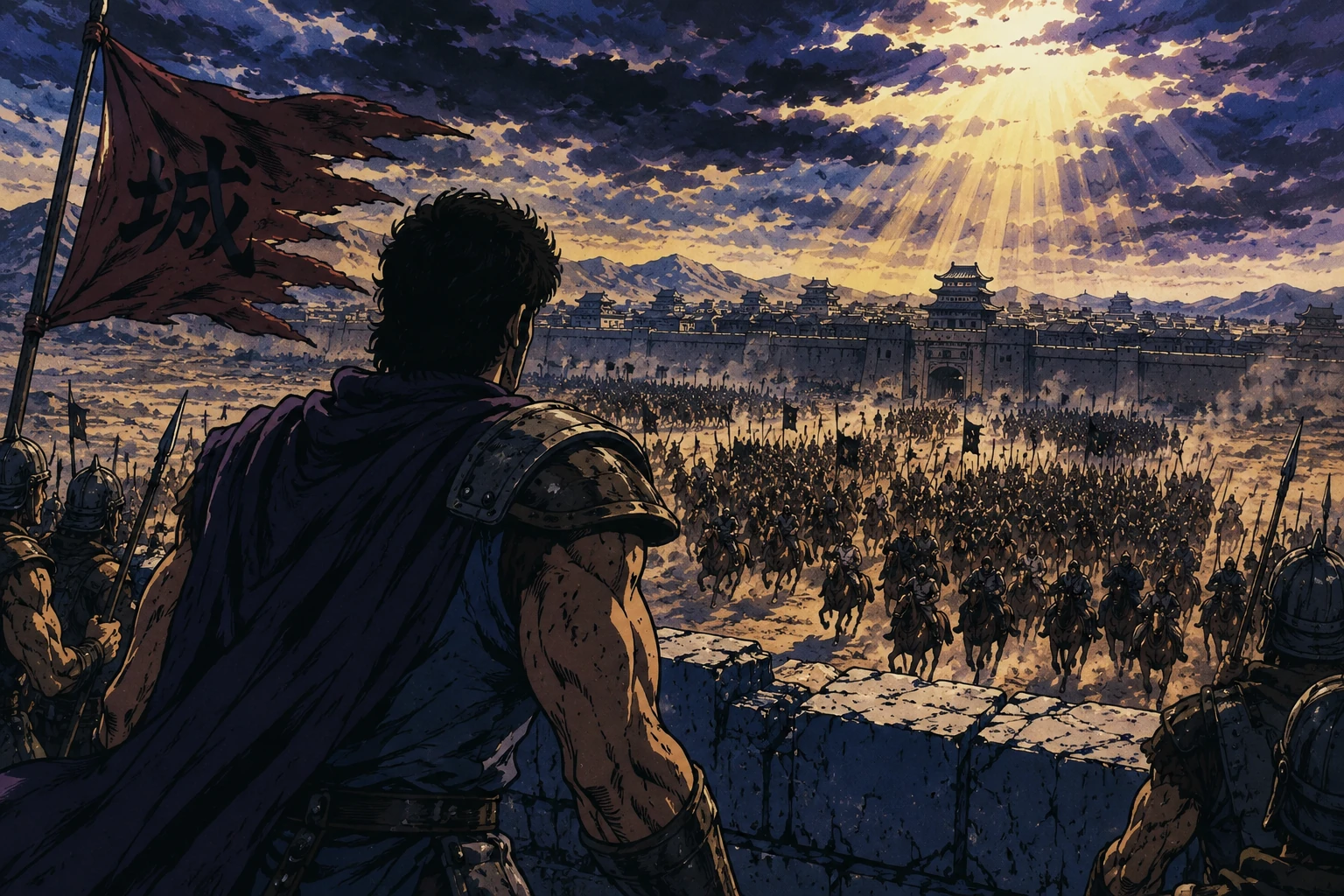
Imagine you’re standing on the walls of your city sometime around the year 1220.
You hear they’re coming long before you see them.
Merchants stop arriving. Refugees begin trickling through the gates. Then the stories start.
Entire cities erased.
Mountains of skulls.
Horsemen who appear from nowhere, surround armies twice their size, and vanish before anyone can catch them.
Some people insist the tales are exaggerated. They have to be.
No army can really conquer half the known world in a generation.
Right?
Then one morning you see dust stretching across the horizon.
They’re here.
First, Understand Who You’re Facing
If you’re picturing a disorganized horde charging wildly across the fields, forget it.
The Mongol army under Genghis Khan was arguably the most effective military machine of the medieval world.
Every soldier had spent a lifetime on horseback. They could ride for extraordinary distances, fire arrows accurately at full gallop, and operate as part of a disciplined unit rather than as individual warriors chasing glory.
European armies often relied on armored knights.
The Mongols relied on coordination.
That’s a terrifying difference.
An individual knight might win a duel.
The Mongols won campaigns.
They Probably Already Know Everything About Your City
Long before the first arrows fly, they’ve gathered intelligence.
They know where your wells are.
They know which roads lead to the gates.
They know which neighboring rulers hate each other.
They may even know which influential families inside the city resent the current leadership.
Spies, merchants, scouts, and captured prisoners all become sources of information.
By the time the Mongol army arrives, they’re often solving a problem they’ve already studied for weeks or months.
Meanwhile, your city may have only just learned they’re coming.
Then Comes the Offer
This is the part movies often leave out.
The Mongols didn’t necessarily want to destroy your city.
Destroying cities is expensive.
Dead craftsmen don’t pay taxes.
Burned granaries don’t feed armies.
Instead, a messenger usually rides forward with a simple proposal.
Surrender.
Open the gates.
Pay tribute.
Accept Mongol rule.
Do that, and there’s a good chance your city survives.
Many did.
The Mongols had little interest in fighting battles they didn’t have to fight.
But there’s a catch.
You only get this offer once.
If Your Leaders Refuse…
Now things become much darker.
The Mongols settle in for a siege.
They don’t simply surround the city.
They isolate it.
Nobody gets in.
Nobody gets out.
Fields are destroyed.
Livestock disappears.
Nearby villages are emptied.
Supply lines vanish.
Inside the walls, time becomes the enemy.
Food grows scarce.
Disease spreads.
Fear becomes almost as dangerous as hunger.
And every morning, the Mongols are still there.
Waiting.
Then the Psychological Warfare Begins
This may have been their greatest weapon.
If a nearby city resisted and was destroyed, survivors were often deliberately allowed to escape.
Not out of mercy.
Because terrified refugees tell stories.
Every gruesome detail becomes part of the next city’s calculations.
Sometimes prisoners were marched in front of city walls.
Sometimes captives were forced to help build siege engines.
Sometimes the defenders simply watched neighboring towns disappear one by one.
The message was always the same.
Look what happened to them.
Your turn is next.
By the time the Mongols reached many cities, fear had already done half the work.
The Walls Aren’t as Safe as You Think
Medieval defenders trusted walls.
For centuries, that had been enough.
The Mongols adapted.
They recruited Chinese engineers who specialized in siege warfare.
They employed massive trebuchets capable of smashing fortifications.
Mining tunnels weakened walls from below.
Siege towers closed the distance.
Flaming projectiles rained into crowded neighborhoods.
Some accounts even describe plague victims or animal carcasses being launched into cities to contaminate water supplies and damage morale.
Whether every story is literally true is debated by historians.
The important point isn’t any single tactic.
It’s that the Mongols learned constantly.
Every campaign made them better.
Suppose the Walls Finally Fall
This is where your personal odds change dramatically.
If your city surrendered before the assault, life might continue under new rulers.
Taxes increase.
Governors change.
You now answer to the Mongol Empire.
But you’re alive.
If your city resisted until it was taken by force, everything depends on who you are.
Skilled artisans might be spared because the empire needed talent.
Engineers, blacksmiths, physicians, scribes, and craftsmen were valuable.
Young people might be enslaved or relocated thousands of miles away.
Children could be absorbed into new communities.
Soldiers were rarely shown much mercy.
Political leaders almost never were.
Ordinary civilians faced outcomes that ranged from survival to massacre depending on the city, the campaign, and whether the Mongols wanted to make an example of the place.
History remembers places like Nishapur and Merv because the destruction was so immense that even medieval chroniclers struggled to describe it.
So… Should You Fight?
This is the impossible question.
If surrender means losing your independence forever, is resistance worth it?
Some cities believed it was.
Some hoped relief armies would arrive.
Others believed their walls would hold.
Occasionally they were right.
More often, they weren’t.
It’s easy to say, from eight hundred years away, that surrender was the logical choice.
It’s much harder when you’re the governor who has sworn to defend your people.
Or the soldier standing beside you.
Or the citizen wondering whether the stories are even true.
What Were Your Chances?
If you’re just an average defender on the walls, the odds are not encouraging.
The Mongols conquered territory stretching from Korea to Eastern Europe.
They defeated kingdoms, caliphates, empires, and armies that believed themselves unconquerable.
No military force wins every battle.
The Mongols lost campaigns and suffered setbacks.
But during the height of their expansion, betting against them was one of the worst wagers in history.
Your best chance of survival probably isn’t fighting heroically on the battlements.
It’s hoping your city’s leaders recognize what they’re facing before pride turns a difficult decision into a fatal one.
Because once the Mongols commit to taking your city by force, the battle is no longer just about who controls the walls.
It’s about whether there’s a city left when they’re done.