
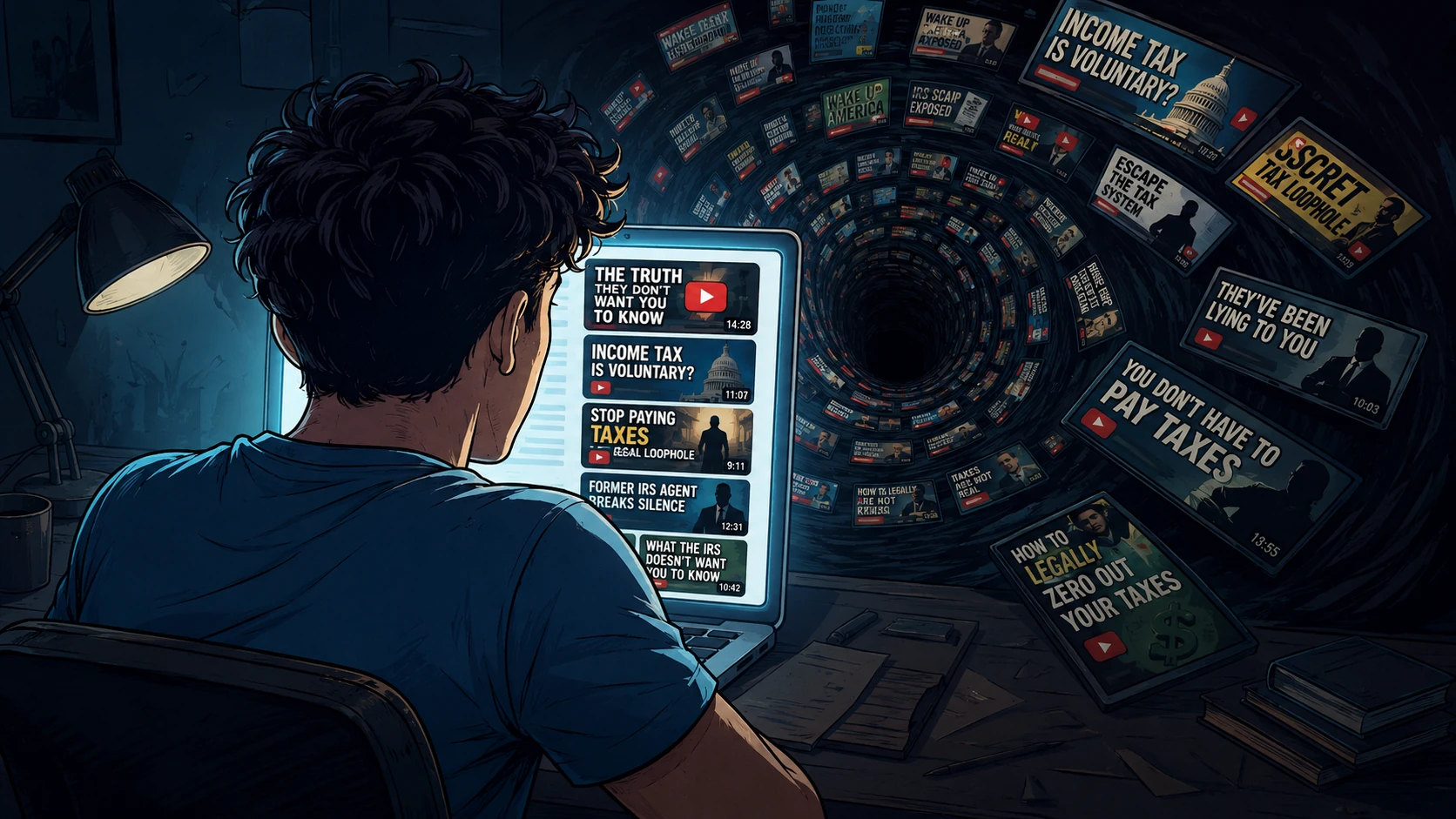
Every few months, another video starts making the rounds online.
The title is always irresistible.
“Former IRS Employee Reveals the Truth.”
“The Income Tax Is Voluntary.”
“Everything You’ve Been Told About Taxes Is a Lie.”
“The Government Doesn’t Want You to Know This.”
Millions of people click because they want it to be true.
Who wouldn’t?
The average American pays thousands of dollars a year in federal income taxes. Add payroll taxes, state taxes, property taxes, sales taxes, gas taxes, and dozens of hidden fees, and it is easy to understand why people feel like they are working for the government before they ever work for themselves.
So when someone confidently claims that most Americans do not actually have to pay federal income tax, it feels less like a conspiracy theory and more like discovering a hidden escape hatch.
The problem is that reality does not work that way.
These Videos Sell Hope More Than Law
The appeal is not really about statutes or court cases.
It is about the emotional payoff.
Imagine discovering that everyone else has been duped while you possess secret knowledge.
It is an incredibly satisfying feeling.
Psychologists sometimes call this the appeal of hidden knowledge. If you can convince people that everyone, from the government to universities to the media to the legal profession, is keeping the truth from them, you have created a powerful narrative. Anyone who disagrees becomes part of the cover up.
That is why these videos often frame themselves as forbidden information rather than ordinary legal arguments.
If the IRS says you are wrong, that is presented as proof you are right.
If courts reject the argument, that is because the courts are corrupt.
If tax attorneys disagree, they are protecting the system.
Eventually, there is no evidence that can disprove the claim because every contradiction becomes part of the conspiracy.
Ask Yourself a Simple Question
Suppose there really were a legal loophole that allowed ordinary Americans to stop paying federal income taxes.
Would it remain a secret?
Think about who would know.
Every Fortune 500 company employs armies of tax lawyers.
Every billionaire hires elite accountants.
Every major accounting firm studies tax law for a living.
Thousands of tax attorneys spend their careers looking for perfectly legal ways to reduce their clients’ tax bills.
If there truly were a legitimate legal argument that most Americans simply did not owe federal income tax, it would not live on YouTube.
It would be the biggest legal development in modern American history.
The Courts Have Already Considered These Claims
One of the most important facts left out of these videos is that nearly all of the major “you do not have to pay taxes” arguments are decades old.
They have been argued.
Appealed.
Argued again.
Appealed again.
Federal judges across the country have consistently rejected claims that wages are not income, that filing taxes is voluntary for most workers, or that the federal income tax does not apply to ordinary citizens who meet the filing requirements.
That does not mean the tax system is perfect.
It does not mean the IRS never makes mistakes.
It does not mean tax laws cannot change.
It simply means the current legal system has already answered these questions.
There Is a Difference Between “Should” and “Is”
This is where many of these videos blur an important line.
Someone might argue that America should abolish the federal income tax.
That is a political opinion.
Someone might argue that tariffs, consumption taxes, or a flat tax would be better.
That is also a political opinion.
Those are legitimate policy debates.
But saying, “I think the tax system should change,” is completely different from saying, “The law already says you do not have to pay.”
One is about changing the rules.
The other is about claiming the current rules do not exist.
Those are not the same thing.
Survivorship Bias Is Powerful
The internet naturally amplifies success stories.
If someone claims they have not paid taxes for years, that story spreads.
What you do not see are the thousands of people who tried similar strategies and quietly ended up paying years of back taxes, interest, penalties, legal fees, or, in some cases, criminal fines or convictions.
Those stories do not go viral because they are not exciting.
They are just expensive.
This is survivorship bias at work.
You only hear from the people still telling the story.
You rarely hear from the people whose story ended with a payment plan and a tax lien.
The Internet Rewards Confidence
Notice something about these videos.
The speakers are rarely uncertain.
They do not say, “Here is one interpretation.”
They say, “This is the truth.”
Confidence is persuasive.
But confidence is not evidence.
History is full of people who were absolutely certain about things that turned out to be wrong.
When someone’s financial advice requires you to ignore decades of established law, confidence alone should not be enough.
If It Sounds Too Good to Be True
There is an old saying that applies here better than almost anywhere else:
If something sounds too good to be true, it probably is.
The idea that millions of Americans have been voluntarily paying taxes they never actually owed for generations is an extraordinary claim.
Extraordinary claims require extraordinary evidence.
Not a viral clip.
Not a persuasive speaker.
Not an hour long interview.
Evidence that can withstand scrutiny from courts, independent legal experts, and decades of challenges.
So far, these videos have not provided that.
Healthy Skepticism Goes Both Ways
It is perfectly reasonable to question government spending.
It is reasonable to criticize the complexity of the tax code.
It is reasonable to argue that taxes are too high or that the system should be reformed.
But skepticism should not stop once someone tells you exactly what you want to hear.
The same critical thinking you apply to politicians, the media, or government agencies should also apply to internet personalities promising a legal shortcut that could dramatically change your life.
Before making a decision that could affect your finances for years, ask one question:
Would I still believe this if it were not exactly what I wanted to hear?
That is often where real critical thinking begins.