
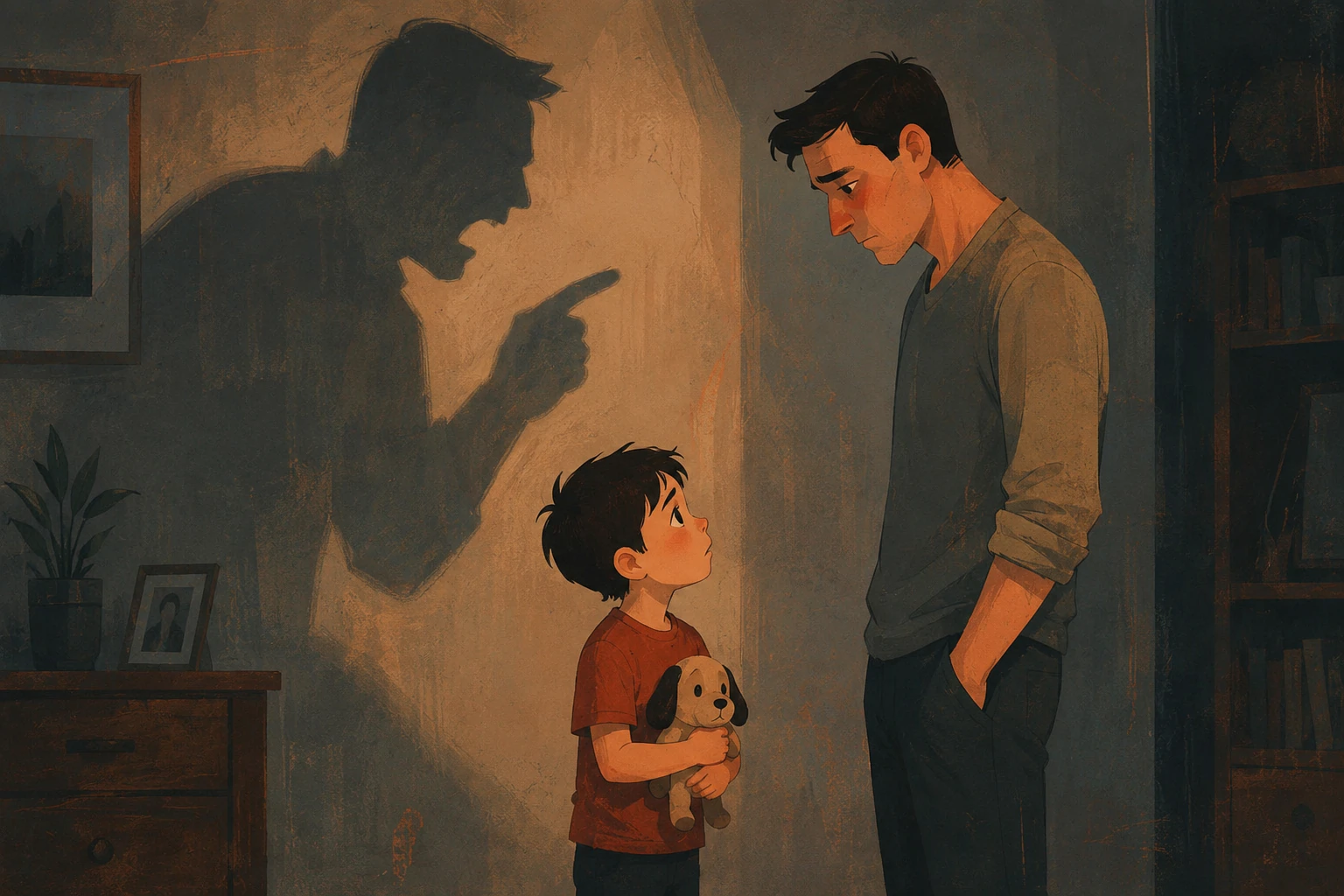
There is a quote that hits differently once you become a parent:
“You either face your demons, or they raise your children.”
It sounds dramatic. Maybe even a little too perfect for social media. But underneath the clever phrasing is an uncomfortable truth about parenting: the things you refuse to deal with don’t necessarily disappear.
Sometimes they become part of the way you raise your children.
Your anger. Your insecurity. Your fear of abandonment. Your need for control. Your inability to apologize. The way you handle conflict. The way you respond when you feel disrespected. The things your parents did to you that you promised yourself you would never do to your own kids.
Having children has a remarkable way of finding all of it.
Before becoming a parent, it’s relatively easy to construct a life around your weaknesses. If you’re impatient, you can walk away. If you’re overwhelmed, you can disappear into your phone for an hour. If you’re exhausted, you can sleep. If someone continually pushes your buttons, you can simply stop spending time with them.
A child removes many of those escape routes.
A baby doesn’t care that you’ve slept four hours. A toddler doesn’t understand that you’ve had a terrible day at work. A five-year-old will ask you the same question eleven times while you’re trying to get everyone out the door.
Eventually, the polished adult version of yourself gets tired.
And someone else comes out.
Sometimes it’s your father.
Sometimes it’s your mother.
You hear yourself saying something in exactly the tone you hated growing up.
Maybe it’s, “Stop crying.”
Maybe it’s, “Because I said so.”
Maybe it’s an explosion of anger wildly disproportionate to what your child actually did.
And for a moment you wonder:
Where did that come from?
The uncomfortable answer is that it may have been there all along.
We Learn How to Be Human From Other Humans
Children don’t learn relationships from lectures. They learn them by living inside relationships.
Long before a child understands concepts like emotional regulation, conflict resolution, boundaries, affection, or communication, they are watching adults demonstrate them.
They notice what happens when Dad gets angry.
They notice whether Mom apologizes.
They notice whether disagreement means conversation, silence, screaming, or someone leaving the room.
They learn whether mistakes are something you admit or something you hide.
They learn whether love feels safe or unpredictable.
And much of what parents demonstrate came from somewhere else.
Their own childhood.
This is one reason family patterns can survive for generations even when nobody consciously chooses them.
A man raised by an emotionally distant father may become uncomfortable when his own son cries. He doesn’t necessarily think, I want my son to feel ashamed of his emotions.
He may genuinely want the opposite.
But vulnerability makes him uncomfortable because vulnerability was never welcomed in his own home.
So when his son cries, he says:
“Come on. You’re fine.”
The words seem harmless.
But underneath them may be something inherited decades earlier.
His father taught him that uncomfortable emotions should be suppressed.
And without realizing it, he has begun teaching the same lesson.
Sometimes We Repeat Our Parents. Sometimes We Overcorrect.
Generational patterns aren’t always obvious copies.
Sometimes they appear as opposites.
A woman raised by controlling parents may promise herself that her children will have freedom. But because she’s terrified of becoming like her parents, she may struggle to establish boundaries at all.
Someone who grew up poor may shower their children with everything they never had, then discover that they have difficulty telling them no.
Someone whose parents constantly criticized them may avoid correcting their own children because criticism feels emotionally dangerous.
The behavior changed.
The wound is still making decisions.
That’s what makes unresolved baggage so difficult to recognize.
We often think breaking a cycle simply means doing the opposite of what our parents did.
It doesn’t.
Breaking a cycle means understanding why you’re reacting the way you are in the first place.
Your Child Will Find Your Weak Spots
There is something almost ruthless about parenting in this respect.
Children eventually discover every part of you that isn’t particularly well regulated.
Your patience.
Your ego.
Your anxiety.
Your relationship with control.
Your ability to tolerate noise, uncertainty, embarrassment, inconvenience, and frustration.
Not because they’re trying to expose you.
Because they’re children.
A toddler melting down in a grocery store isn’t conducting a psychological experiment on you. But your reaction to that meltdown may reveal things about yourself that years of comfortable adult life never required you to confront.
Maybe what bothers you isn’t actually the screaming.
Maybe it’s the feeling that strangers are judging you.
Maybe disobedience feels strangely personal.
Maybe losing control of the situation makes you panic.
Maybe crying triggers anger because crying wasn’t tolerated when you were young.
Suddenly the question isn’t simply:
“Why is my child behaving like this?”
Sometimes the more useful question is:
“Why is this affecting me so strongly?”
That question can change a family.
Facing Your Demons Doesn’t Mean Becoming Perfect
The quote can sound as though parents must completely heal themselves before raising children.
That’s impossible.
There are no perfectly regulated parents walking around peacefully responding to every tantrum with enlightened wisdom.
Parents get frustrated.
Parents lose their tempers.
Parents say things they regret.
Parents occasionally handle situations badly.
The goal isn’t perfection.
It’s awareness.
It’s recognizing when your reaction belongs more to your past than to the child standing in front of you.
It’s being able to stop afterward and say:
“I shouldn’t have yelled at you. I was frustrated, but that wasn’t the right way to handle it. I’m sorry.”
That sentence alone can represent enormous generational progress.
Because perhaps nobody ever said it to you.
Someone Has to Break the Pattern
Every family passes things down.
Some of them are beautiful: traditions, humor, resilience, recipes, stories, affection, values.
Others are heavier.
Anger.
Shame.
Silence.
Addiction.
Fear.
Control.
Emotional distance.
Eventually someone gets the opportunity to examine what they’ve inherited and decide what continues.
That doesn’t necessarily require blaming your parents. They inherited things too.
Your father may have learned his anger from his father.
Your mother may have learned her anxiety from her mother.
Go back far enough and you may find generations of people doing the best they could with emotional tools that were handed to them by equally imperfect people.
Understanding that can create compassion.
But compassion doesn’t require continuation.
At some point, someone has to say:
This came through my family, but it doesn’t have to go any further.
And that may be one of the quiet responsibilities of parenthood.
Your children will inherit plenty from you that you cannot control: your genes, your circumstances, the era they’re born into, and countless pieces of luck and chance.
But there are other inheritances you can influence.
How anger is handled.
Whether affection is freely given.
Whether mistakes can be admitted.
Whether emotions are safe to express.
Whether conflict ends in repair.
Whether love feels conditional.
Whether home feels safe.
You don’t have to defeat every demon before becoming a good parent.
But you should probably learn their names.
Because the parts of yourself you refuse to examine don’t simply disappear when you have children.
They come into the house with you.
And if you aren’t careful, they start parenting too.