
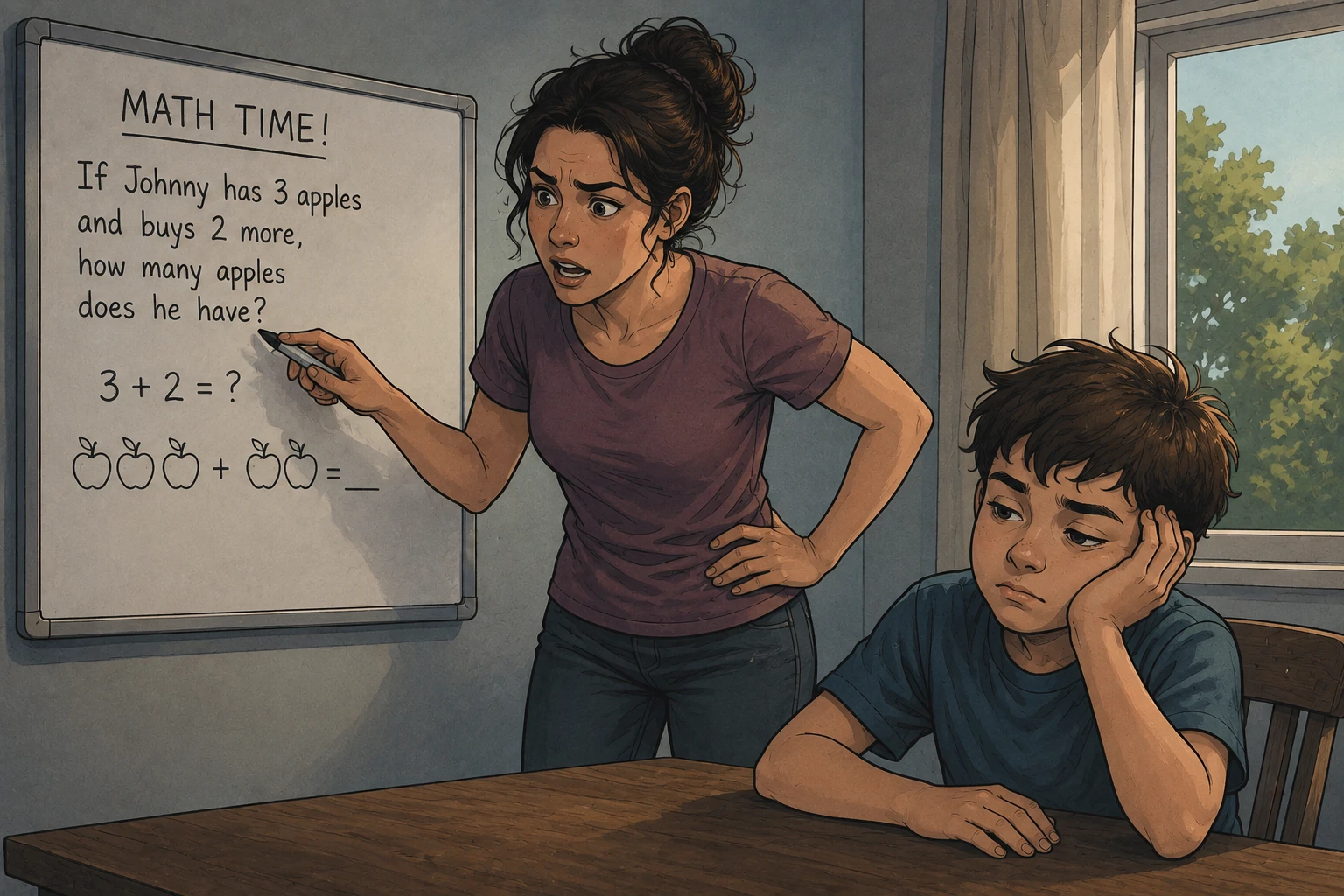
There is something slightly bizarre about homeschooling that we don’t talk about enough.
If you want to teach third grade at a public school, you’ll generally need a degree, teacher preparation, certification or licensure, background checks, and continuing professional development.
If you want to teach your own third grader?
In many states, the requirements are dramatically lower.
Congratulations. The student came out of your household, so apparently you’ve unlocked the education expansion pack.
To be fair, plenty of homeschooling parents do an excellent job. They buy rigorous curricula, join co-ops, hire tutors for subjects they can’t teach, use online courses, and obsessively track their children’s progress. Some homeschooled students receive educations that would make many traditional schools jealous.
But that’s not really the uncomfortable question.
The uncomfortable question is: What happens when the parent isn’t good at it?
Knowing Your Kid Isn’t the Same as Knowing How to Teach
One of the most common defenses of homeschooling is, “Nobody knows my child better than I do.”
Probably true.
But knowing your child and knowing how to educate your child are two completely different qualifications.
You also know your child’s teeth better than their dentist does. That doesn’t mean you’re grabbing a drill when they get a cavity.
Teaching isn’t simply knowing that 7 × 8 = 56 and communicating this information to a smaller person.
Good teachers learn how children acquire literacy, how mathematical concepts should build upon one another, how to assess comprehension, how to identify learning difficulties, how to modify instruction when something isn’t working, and how to distinguish “my child completed the worksheet” from “my child actually understands this.”
There’s an entire profession built around this.
“But Parents Can Learn Alongside Their Children”
Absolutely.
And that’s actually a wonderful attitude for a parent to have.
It’s slightly less reassuring when you’re talking about the person responsible for providing the education.
Imagine boarding a plane and hearing:
“Good morning, passengers. I’ve never actually flown a 737 before, but I’ve purchased an excellent curriculum and I’m really excited to learn alongside you.”
Suddenly credentials don’t seem like such elitist gatekeeping.
Obviously teaching your kid fractions isn’t flying an airplane. But the principle is worth considering: in almost every important profession, we recognize that enthusiasm is not a substitute for competence.
Homeschooling sometimes gets a strange exemption.
The Good Homeschoolers Understand Their Limitations
Ironically, the strongest homeschooling parents often behave less like all-knowing teachers and more like educational managers.
They recognize what they don’t know.
Can’t teach calculus?
Find someone who can.
Kid struggling to read?
Get a specialist involved.
Chemistry getting beyond your abilities?
Enroll them in a community-college course or reputable online program.
These parents aren’t necessarily claiming, “I’m qualified to teach every academic discipline from kindergarten through twelfth grade.”
They’re saying, “I’m taking responsibility for assembling the people and resources who are.”
That’s a much more defensible proposition.
The problem is that homeschooling systems don’t always guarantee that every parent will approach the job that way.
Who Checks Whether the Kid Is Actually Learning?
This is where the debate gets much more serious.
Homeschooling oversight varies considerably across the United States. Depending on where a family lives, requirements concerning notification, curriculum, assessments, instructional hours, and parental qualifications can differ substantially.
And that raises an awkward question:
If nobody outside the household meaningfully evaluates the child’s education, how do we know it’s working?
Parents are not neutral evaluators of their own parenting.
None of us are.
A parent can sincerely believe their 11-year-old is “learning at his own pace” when an independent reading assessment might reveal that he’s several years behind.
That’s precisely why outside assessment matters.
Not because every homeschooling parent is incompetent, but because competent people are usually willing to have their work measured.
“Public Schools Fail Kids Too”
They absolutely do.
There are terrible teachers. Dysfunctional districts. Kids graduate without being able to read proficiently. Bullying happens. Special-needs students can fall through cracks. Parents can spend years fighting bureaucracies that seem spectacularly uninterested in their child.
But “public schools sometimes fail children” isn’t an argument for removing accountability from homeschooling.
It’s an argument for demanding accountability from both.
If a school isn’t educating children, that’s a problem.
If a parent isn’t educating a homeschooled child, that’s also a problem.
The child doesn’t particularly benefit from knowing which ideology failed them.
Parental Rights Aren’t the Only Rights Involved
Much of the homeschooling debate is framed around parental rights.
Parents should decide how their children are raised.
That’s an important principle.
But there’s another person involved who tends to disappear from the conversation:
the child.
Children have an enormous stake in receiving an education that prepares them for adulthood.
A 9-year-old cannot realistically determine whether their science curriculum is adequate. A 12-year-old can’t compare their education with statewide academic standards and hire a geometry tutor because Dad isn’t particularly strong at proofs.
The adults are making decisions whose consequences the child may not fully discover until years later.
That deserves some scrutiny.
Homeschooling Doesn’t Need to Be Banned. It Needs Guardrails.
None of this means parents should need an education degree before they’re allowed to homeschool.
That would probably be excessive.
Teaching one or two children with a professionally designed curriculum is fundamentally different from managing 30 students in a classroom.
But there’s a vast distance between “parents need teaching degrees” and “parents should essentially be trusted to figure it out.”
A reasonable system could preserve homeschooling while requiring basic academic standards, periodic independent assessments, intervention when children fall substantially behind, and appropriate outside instruction when parents cannot provide it themselves.
Excellent homeschooling families would probably have little difficulty meeting those standards.
The standards exist for everyone else.
Because the question shouldn’t be whether parents have the right to homeschool.
It should be whether children have the right to actually be educated.
And “Trust me, I’m their parent” is a strangely low bar for something that can determine the entire trajectory of another person’s life.