
Nobody wants a colonoscopy.
There are no colonoscopy vision boards. Nobody turns 45 and thinks, Hell yes, this is finally my year.
You have to drink something that turns your bathroom into a place of worship. You can’t eat. You get sedated. And then a doctor puts a camera somewhere you generally prefer cameras not to go.
So naturally, people put it off.
And that’s unfortunate, because a colonoscopy is one of those rare medical procedures where a doctor can potentially find cancer before it’s cancer and remove it right then and there.
That’s kind of incredible.
The Problem With Feeling Fine
Here’s the shitty thing about colorectal cancer: early on, you may feel completely normal.
No dramatic pain. No flashing warning light. No moment where your body announces, Hey, you should probably get this checked out.
Precancerous growths called polyps can sit inside your colon quietly for years. Some of them eventually develop into cancer.
And while they’re doing that, you might be going to work, hitting the gym, raising your kids, planning vacations, and generally assuming everything is fine.
This is why “I’ll go to the doctor if something feels wrong” is such a terrible strategy for certain diseases.
By the time something feels wrong, the situation may already be considerably more complicated.
A Colonoscopy Isn’t Just Looking for Cancer
This is the part people sometimes miss.
A colonoscopy isn’t merely a cancer detection test.
It’s also cancer prevention.
During the procedure, a doctor examines the inside of your colon and can remove suspicious polyps before they have the opportunity to become cancerous.
Think about how unusual that is.
Imagine if a mechanic could look inside your engine, find the tiny component that’s going to destroy the transmission eight years from now, and just pull the damn thing out.
You’d probably let him do it.
Yet when the machinery happens to be our own body, we’re remarkably good at saying, “Eh, maybe next year.”
45 Is the New 50
For people at average risk, major U.S. guidelines now recommend beginning colorectal cancer screening at age 45, rather than waiting until 50.
And there’s a reason screening has moved earlier.
Colorectal cancer isn’t exclusively an old person’s disease. Rates among younger adults have been concerning enough that doctors and public health organizations have pushed screening earlier.
And 45 isn’t some magical force field.
If you have a strong family history of colorectal cancer or certain polyps, inflammatory bowel disease, particular hereditary cancer syndromes, or concerning symptoms, your doctor may recommend screening considerably earlier.
That’s why knowing your family history matters.
Your uncle’s colon cancer isn’t just an unfortunate family story. It may be useful medical information.
The Survival Difference Is Enormous
Cancer is one of those subjects where people understandably become obsessed with treatments.
Chemotherapy. Immunotherapy. Surgery. New drugs. Clinical trials.
All of that matters.
But one of the most powerful weapons against cancer is far less exciting:
Finding the damn thing early.
When colorectal cancer is localized, meaning it hasn’t spread beyond where it started, survival rates are dramatically better than when it’s discovered after spreading to distant parts of the body.
That’s the cruel mathematics of cancer.
A tumor discovered today and the same tumor discovered years from now aren’t necessarily the same problem.
Time matters.
“But I Don’t Have Any Symptoms”
Good.
That’s when screening is supposed to happen.
Screening isn’t something you do because you’re sick. It’s something you do because you’d prefer to stay alive and healthy long enough to become sick from something much stupider at age 93.
Waiting for symptoms defeats much of the point.
Blood in the stool, unexplained weight loss, persistent changes in bowel habits, iron-deficiency anemia, and abdominal discomfort can all warrant medical evaluation. But the goal of routine screening is to catch trouble before your body has to start sending increasingly angry emails about it.
Yes, the Prep Sucks
Let’s address the elephant sitting on the toilet.
For most people, the worst part of a colonoscopy isn’t the colonoscopy.
It’s the prep.
You drink the bowel-cleansing solution. You spend an intimate evening with your bathroom. You begin questioning every decision that led you to this moment.
It’s not fun.
But let’s maintain some perspective.
You’re trading roughly a day of inconvenience for a procedure that could potentially prevent one of the most common cancers.
Human beings will spend six hours researching which television has slightly better black levels, but somehow hesitate to spend a day checking whether something dangerous is growing inside their body.
Our priorities can be spectacularly stupid.
And Colonoscopy Isn’t the Only Screening Option
There’s another important point here: colorectal cancer screening doesn’t always mean getting a colonoscopy immediately.
Depending on your risk factors and medical situation, stool-based tests and other screening methods may be appropriate.
The important thing isn’t winning some imaginary award for choosing the toughest screening method.
It’s actually getting screened.
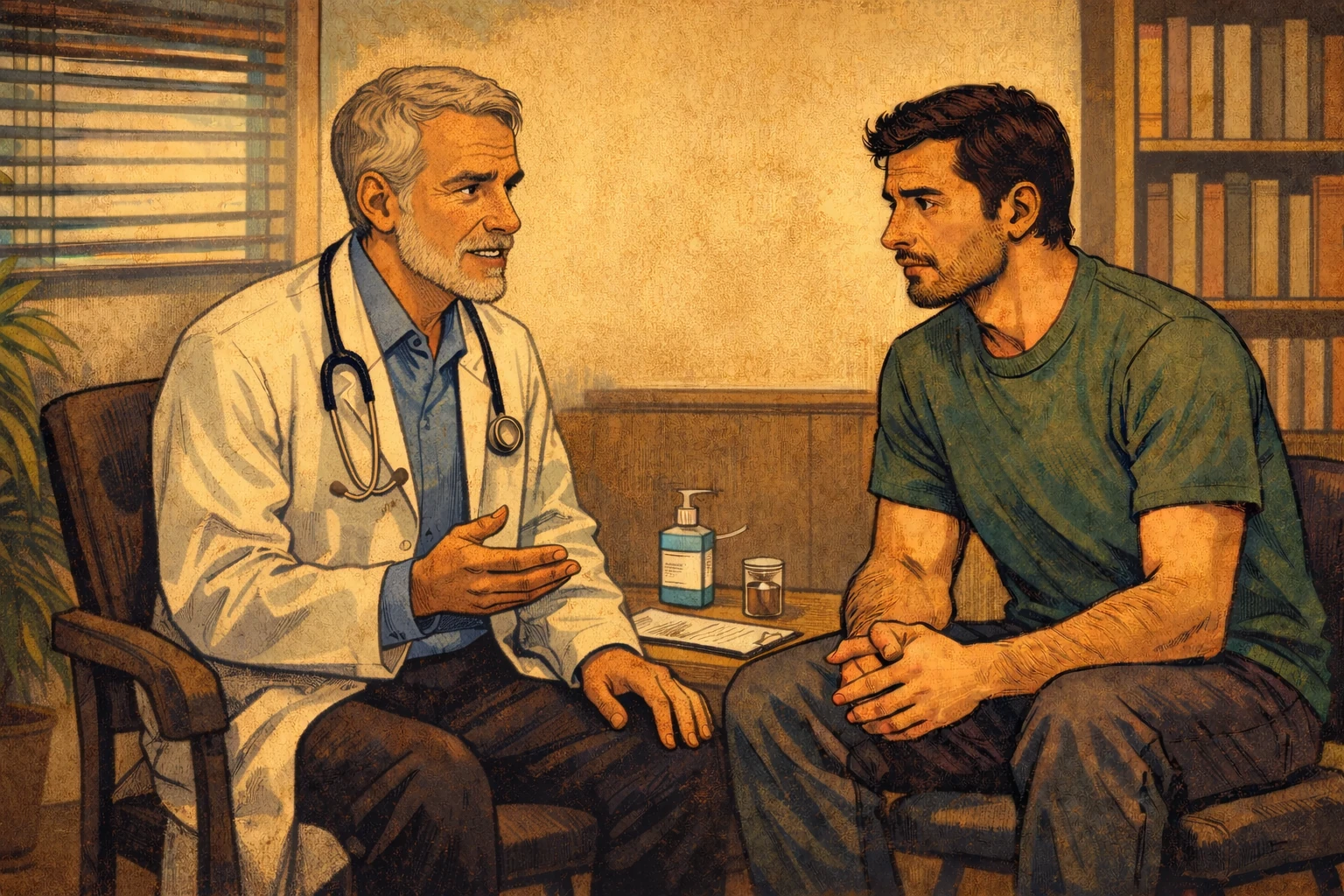
Talk to your doctor about your age, family history, symptoms, and risk factors, and figure out which screening strategy makes sense for you.
Then do it.
Not six months from now.
Not after work calms down.
Not when the kids are older.
Not when you’ve magically transformed into the kind of person who enjoys scheduling medical procedures.
This Is What Taking Care of Yourself Actually Looks Like
We tend to imagine health as something dramatic.
Running marathons. Eating organic vegetables. Buying expensive supplements. Taking ice baths while listening to a podcast about mitochondrial optimization.
But a lot of staying healthy is incredibly boring.
Wear sunscreen.
Check your blood pressure.
Get your vaccines.
Go to the dentist.
Get recommended cancer screenings.
Do the mundane shit that dramatically increases your odds of being around later.
Because taking care of yourself isn’t always about feeling better today.
Sometimes it’s about doing something mildly unpleasant today so that ten years from now, you still get to be here.
And if you’re due for colorectal cancer screening, that’s a pretty damn good trade.