
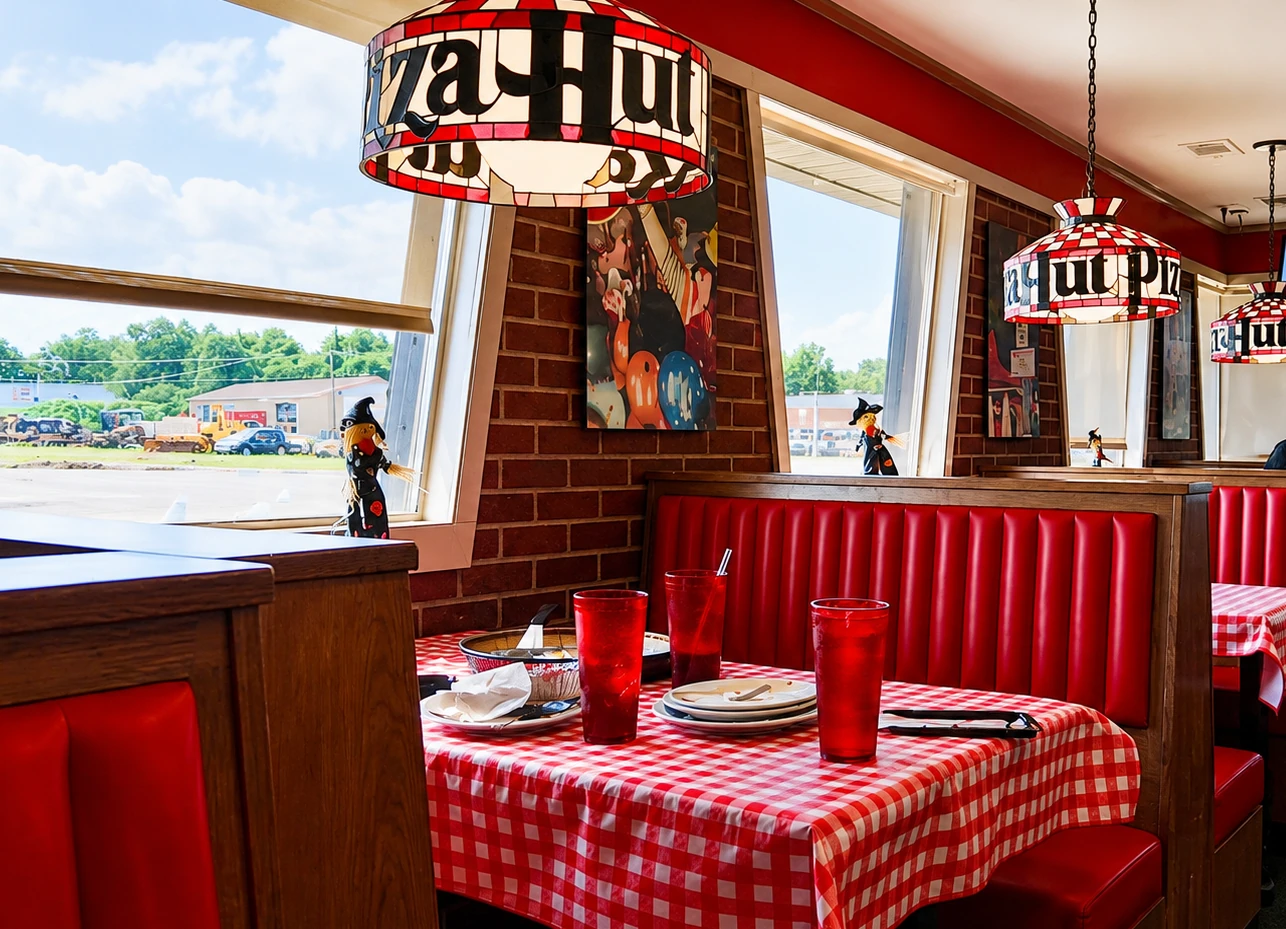
There was a time when going to Pizza Hut actually felt like going somewhere.
You piled into the family car and drove to that unmistakable building with the giant red roof. Inside, it was dark and cozy. There were stained-glass lamps, red plastic cups filled with Pepsi, a salad bar, arcade machines, and booths you could disappear into.
Then somebody brought out a Personal Pan Pizza in a black skillet hot enough to remove your fingerprints.
For millions of kids growing up in the 1980s and 1990s, Pizza Hut wasn’t merely somewhere you got pizza. It was where your Little League team went after a game. It was where you had birthday parties. It was where you cashed in your BOOK IT! certificate after reading enough books to earn a free pizza.
And the pizza was pretty damn good.
At least that’s how everyone remembers it.
Today, Pizza Hut still has thousands of restaurants around the world, but in America something clearly went wrong. The restaurants disappeared. The pizza became inconsistent. Domino’s passed it. Stores closed. Sales struggled.
And in 2026, after decades under the same corporate umbrella, Yum! Brands agreed to sell Pizza Hut.
So what the hell happened?
The easy explanation is nostalgia. Everything tasted better when you were nine years old.
There’s probably some truth to that.
But nostalgia doesn’t explain all of it.
Because Pizza Hut spent decades slowly getting rid of almost everything that made people love Pizza Hut.
Pizza Hut Used to Sell More Than Pizza
The old Pizza Hut was fundamentally different from Domino’s.
Pizza Hut was a restaurant.
You sat down. Someone took your order. You waited. Your pizza arrived sizzling at the table.
There were salad bars, pitchers of soda and beer, arcade games, booths and those bizarre lamps that somehow made every Pizza Hut feel exactly like every other Pizza Hut.
The red-roof building itself became one of the most recognizable pieces of restaurant architecture in America.
That entire experience was part of the product.
Then Americans changed how they bought pizza.
Delivery exploded. Carryout became more important. Then came online ordering, smartphones and apps.
And Domino’s understood this new world better than anyone.
Domino’s essentially decided it wasn’t really in the restaurant business.
It was in the pizza logistics business.
Small stores. Efficient kitchens. Delivery drivers. Great online ordering. No enormous dining room sitting half-empty on a Wednesday afternoon.
Pizza Hut had thousands of restaurants built for the exact opposite business model.
By 2019, roughly 90 percent of Pizza Hut’s business was happening outside the restaurant, even though nearly half of its traditional locations were still designed around dine-in customers.
So Pizza Hut began eliminating them.
Financially, it made sense.
But something strange happened.
Pizza Hut accidentally got rid of Pizza Hut.
It Tried to Become Domino’s
The red roofs disappeared.
The salad bars disappeared.
The arcade machines disappeared.
The waitresses disappeared.
The pitchers disappeared.
The stained-glass lamps disappeared.
And increasingly, Pizza Hut became a counter in a generic strip mall where you picked up a cardboard box.
The problem was that Domino’s was already really good at being Domino’s.
Pizza Hut removed much of what differentiated it without becoming better at convenience than its biggest competitor.
By 2018, Domino’s had overtaken Pizza Hut as the world’s largest pizza chain.
That was an incredible reversal.
Pizza Hut had spent decades being synonymous with pizza in America.
Now it was chasing Domino’s.
And Yes, They Actually Changed the Pizza
Here’s where everyone who says, “Pizza Hut doesn’t taste like it used to,” gets some vindication.
It doesn’t.
At least not exactly.
Pizza Hut reformulated its famous Original Pan Pizza in 2019 after several years of development. The company promoted a crispier crust along with changes to the cheese and sauce combination.
Maybe the new recipe technically performed better in taste tests.
But that’s a dangerous game with nostalgic food.
People don’t necessarily want the scientifically optimized version of Pizza Hut.
They want Pizza Hut.
When someone orders a Big Mac, Oreo or Coca-Cola, consistency is part of the appeal. You want the thing you remember.
Changing Pizza Hut’s signature pizza while simultaneously removing the restaurants people associated with it only deepened the feeling that something had been lost.
Then There’s the Quality Problem
The other complaint you hear constantly about modern Pizza Hut is inconsistency.
One location can still produce a genuinely good pan pizza.
Another hands you something resembling cafeteria food.
That’s partly a consequence of running an enormous franchise system.
Pizza is simple, but tiny differences matter.
Dough proofing, sauce, cheese, oil, oven temperature, cooking time and staffing can completely change the finished pizza.
And Pizza Hut’s franchise system has experienced some serious turbulence.
In 2020, NPC International, one of Pizza Hut’s largest franchisees, filed for bankruptcy. At the time, the company operated roughly 1,200 Pizza Hut restaurants.
Hundreds of locations eventually closed or changed ownership.
Pizza Hut had already been trying to eliminate older dine-in restaurants. The bankruptcy accelerated the process.
Suddenly communities all over America had something strangely familiar:
an abandoned Pizza Hut.
The sign would disappear.
The building might become a Mexican restaurant, Chinese restaurant, pawn shop or dental office.
But everyone still knew what it used to be.
That roof gave it away.
Pizza Hut Got Stuck in the Middle
Pizza Hut also developed another problem:
What exactly is Pizza Hut supposed to be?
Little Caesars owns the ultra-cheap pizza lane.
Domino’s owns convenience and delivery.
Your neighborhood pizzeria owns quality.
Pizza Hut increasingly occupies an uncomfortable space between all three.
And decades of coupons and promotions trained customers to expect chain pizza to be cheap.
Once a Pizza Hut order starts creeping toward the price of a good independent pizza, people naturally start wondering:
Why am I ordering Pizza Hut?
Pizza Hut responded with an endless stream of new products.
Stuffed Crust.
Cheesy Bites.
Detroit-style pizza.
The Big New Yorker.
Melts.
Boxes filled with pizza, wings, breadsticks and desserts.
Some of them were great. Stuffed Crust was legitimately brilliant.
But eventually it started feeling like Pizza Hut was constantly asking:
“What else can we put cheese inside?”
when customers were asking:
“Can you just make Pizza Hut good again?”
The Funny Thing Is, People Want the Old Pizza Hut Back
After spending decades eliminating the old Pizza Hut experience, something unexpected happened.
People became nostalgic for it.
Some franchisees have started opening or restoring Pizza Hut “Classic” restaurants inspired by the old red-roof locations.
The old logo is back.
The booths are back.
The lamps are back.
Some have salad bars and arcade games.
And people actively seek them out.
It’s easy to understand why.
We now live in a world where everything comes to us.
Amazon brings our shopping.
DoorDash brings dinner.
Netflix brings movies.
Spotify brings music.
Our friends live inside our phones.
You can spend an entire weekend without interacting with anyone outside your house.
Suddenly a weird red building where families eat pizza, kids play arcade games and adults drink pitchers of beer doesn’t sound outdated.
It sounds kind of great.
Pizza Hut Optimized Away Pizza Hut
That’s ultimately what happened.
Pizza Hut looked at its enormous dining rooms, servers, salad bars and distinctive buildings and saw inefficiency.
Domino’s had smaller stores.
Domino’s had better delivery.
Domino’s had better technology.
So Pizza Hut spent decades trying to modernize itself.
And in the process, it removed much of what made the brand special.
Maybe the old pizza really was better.
Maybe the ingredients changed.
Maybe your local Pizza Hut was simply run better in 1994.
And yes, some of this is undoubtedly nostalgia.
But the bigger difference was everything surrounding the pizza.
You weren’t eating it out of a cardboard box while staring at your phone.
You were sitting underneath a stained-glass lamp.
Your Pepsi was in that indestructible red plastic cup.
Some kid was playing Street Fighter II twenty feet away.
A waitress dropped a screaming-hot pan onto the table.
You grabbed the first slice too early and immediately burned the roof of your mouth.
Pizza Hut wasn’t just selling pizza.
It was selling a place to go.
Corporate America eventually decided that place was inefficient.
Maybe it was.
But efficiency isn’t the same thing as desirability.
Pizza Hut spent decades optimizing away the things people loved about Pizza Hut.
The irony is that after all that modernization, its best idea for the future might be rebuilding the Pizza Hut we already had.